What Is the Google Local Pack (Map Pack)?

The Google local pack is the box of businesses (usually 3) and a map that Google shows for searches with local intent. It's also called the map pack or the 3-pack. If a client has ever called to say they've vanished from it after searching from their own kitchen, this explains why.
This guide covers what the pack shows today, how Google picks who gets in, why it changes from one searcher to the next, and how to get in without putting the profile at risk. I've ranked close to one hundred personal-injury law firms in Houston, Denver, Los Angeles and New York, so the examples lean that way.
What Is the Google Local Pack?
The Google local pack is the block of local business listings, usually 3, shown with a map inside Google Search results when a search has local intent. Map pack, 3-pack, local 3-pack and snack pack are all names for the same feature.
The listings come from Google Business Profiles (formerly Google My Business), not from websites. 3 things about the pack trip people up:
- "Usually 3" is not a fixed rule.
- The pack doesn't always sit at the top. Ads and AI Overviews can appear above it, and some local searches show no pack at all.
- Clicking "More places" under the pack opens the Local Finder, a longer ranked list of the same kind of listings.
What Does the Local Pack Show?
Each local pack listing gives a searcher enough to call or visit without opening a website. The exact details vary by device, query and business. A listing can show:
- Business name, exactly as it appears on the Business Profile.
- Star rating and review count.
- Category, such as "Personal injury attorney" or "Plumber".
- Address or area, plus an hours line showing whether the business is open or closed.
- Action buttons: Website, Directions and Call.
Around the listings, the pack adds an interactive map with a pin for each business, which searchers can pan, zoom and click. It also adds a "More places" link to the Local Finder.
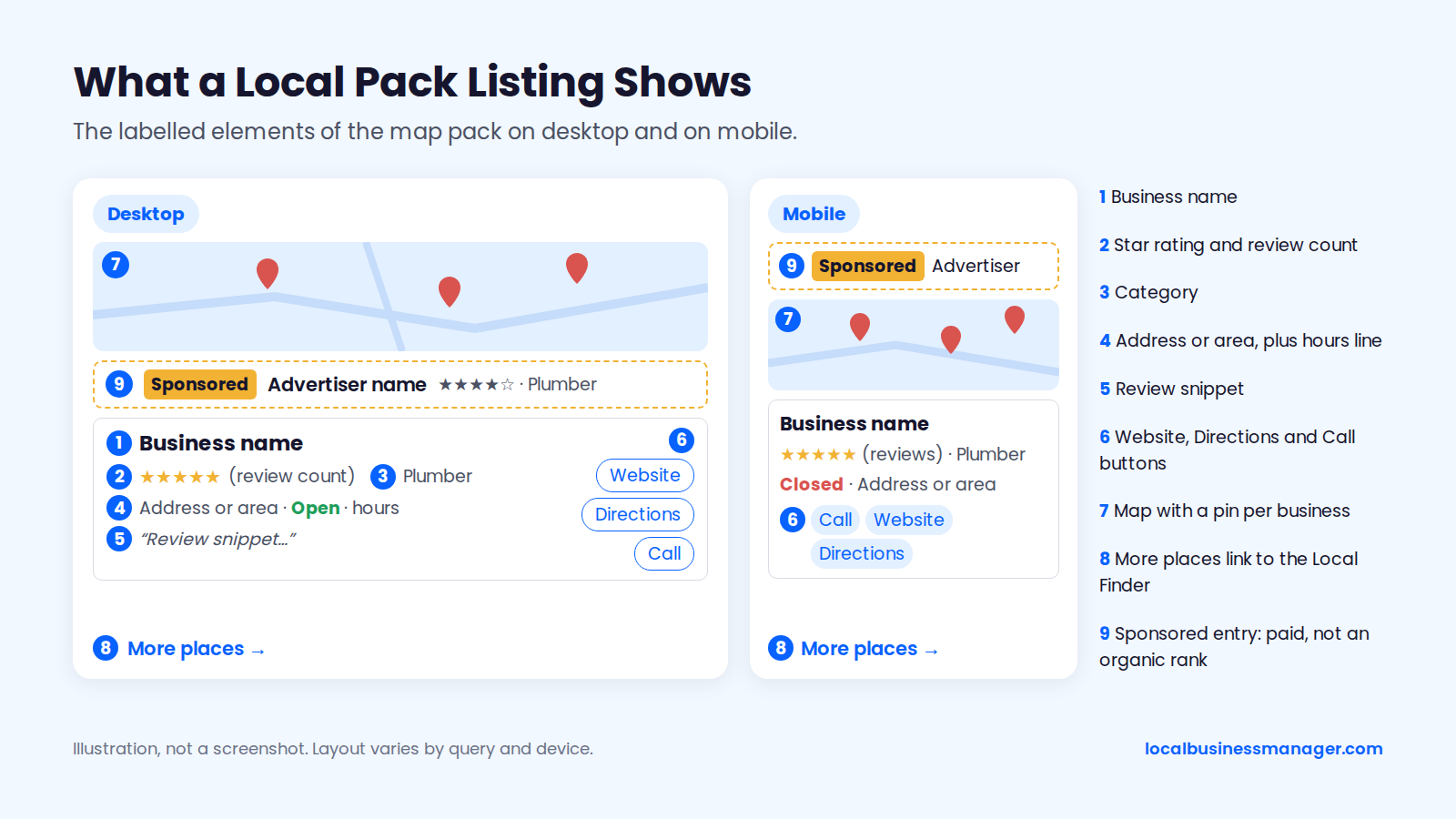
Illustration, not a screenshot. Element positions as of November 2026; the layout varies by query and device.
Desktop vs Mobile
We found no Google documentation of how the pack's layout differs by device, and the clearest measured difference between desktop and mobile is in the paid listings around the pack. Sterling Sky reported in late 2025 that Google cut Local Services Ads on desktop from 3 slots to 2, while mobile still often shows 3.
That means a desktop-only check can show fewer paid listings above the pack than a phone user sees for the same search. A single capture also shows only one moment, because the arrangement of listings varies by query and device.
When you show a client where they appear, capture desktop and mobile on the same day and date both images. If the client mostly gets calls from phones, lead with the mobile capture.
Sponsored Entries in the Pack
Sponsored entries are paid ads that can appear inside the local pack itself, next to the organic listings. Sterling Sky's State of Local SEO 2026 data, as summarized by the UK agency 365i in February 2026, found sponsored ads inside the local pack on about 22% of tracked keywords across 1,200 mobile reports, up from under 3%. A paid slot tells you nothing about organic rank, because organic pack positions can't be bought (see the paid placements section below).
When a client asks why a competitor with fewer reviews sits above them, check first whether that listing is marked as an ad. In client reports, count only listings without an ad label as organic positions, and list paid entries separately if the client cares who is advertising.
When Does Google Show a Local Pack?
Google shows a local pack when it reads local intent into a search. 3 kinds of searches usually trigger one:
- Explicit location: "roofer in Denver", where the place is typed into the search.
- "Near me": "dentist near me", where Google uses what it knows about the searcher's location.
- Implicit local intent: "emergency plumber", with no place named, where Google assumes the searcher wants someone nearby.
The local pack is not always the first result, and question-style searches often skip it. In WebFX's 2026 study of 100 home-services keywords, the pack appeared on 98 of the 100 keywords. Local Services Ads took position 1, above the pack, in all 142 searches where they appeared, but they showed up in only about 28% of repeated searches.
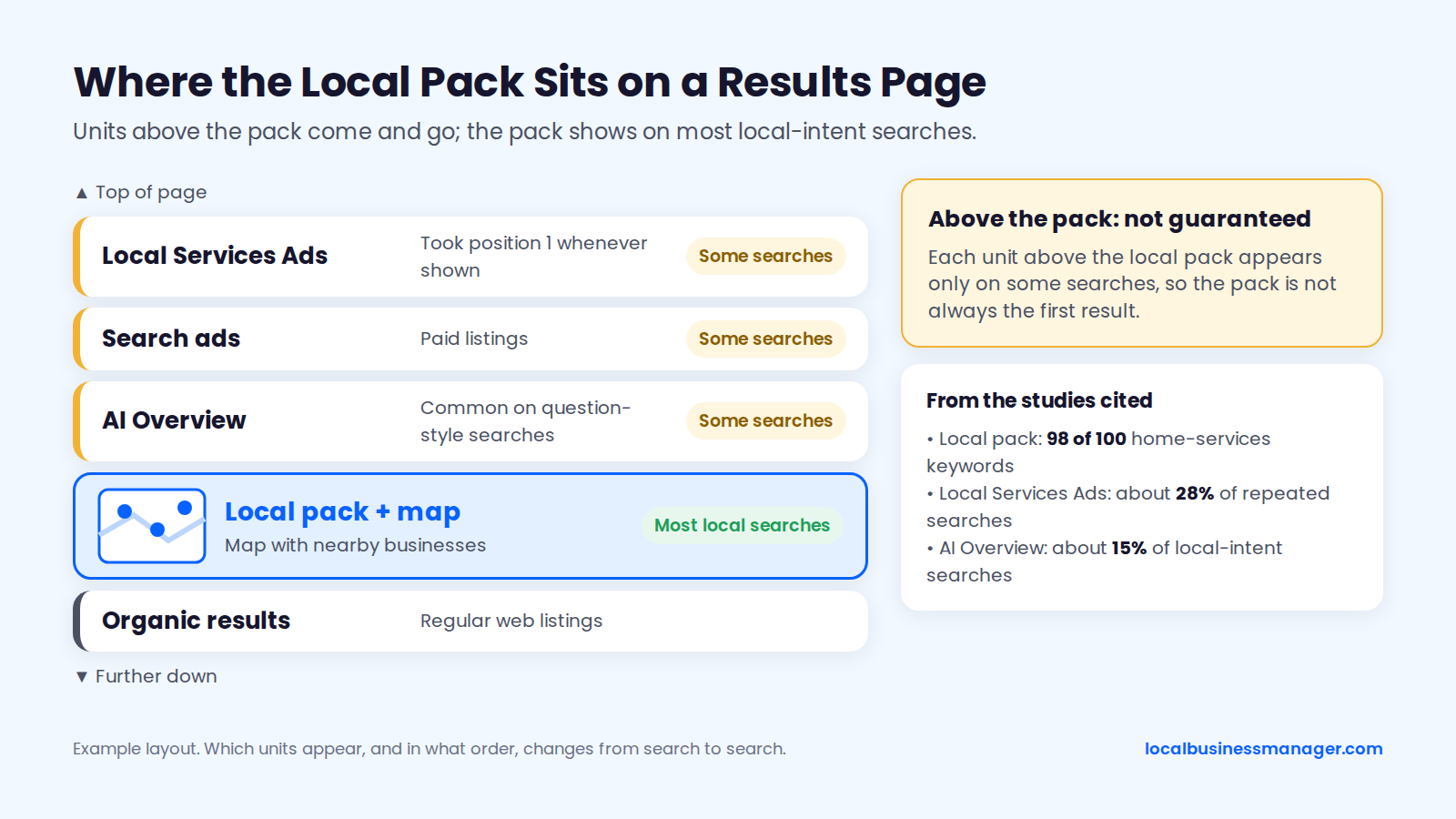
Example layout. Which units appear, and in what order, changes from search to search.
For money keywords, AI Overviews still show up far less often than the pack. A local SEO software company ran a 2025 study of 540 manual searches across 3 US cities and 6 industries. It found an AI Overview on about 15% of local-intent searches and a local pack on 93%, and the pattern flipped for question-style searches:
Query type | Example from the study | AI Overview shown (%) | Local pack shown (%) |
|---|---|---|---|
Local intent | "personal injury lawyers in Phoenix" | 15 | 93 |
Hybrid | "average cost of dental implants in Phoenix" | 97 | 17 |
Informational | "how long does an eye exam take near me" | 92 | 6 |
The 2026 Local Search Ranking Factors report describes local search as "insulated" from AI disruption.
Local Pack vs Local Finder vs Google Maps vs Organic Results
The local pack, the Local Finder and Google Maps all show Business Profiles, but they are separate lists, and a business can rank differently on each. Organic results rank web pages, and Local Services Ads are paid.
The table compares the 5 surfaces as of November 2026, ordered from the top of the results page down to the views that open separately:
Surface | Where it appears | How many results | What triggers it | Use in client reporting |
|---|---|---|---|---|
Local Services Ads | Above the pack and other ads, when shown | A few ads; the count varies by device | Some service searches in eligible categories | Paid; report leads and spend separately |
Local pack | Inside Google Search results | Usually 3 plus a map | Searches with local intent | Headline visibility for money keywords |
Organic results | Main Search results | A standard list of web pages | Any search | Website rankings, reported separately |
Local Finder | Opens from "More places" under the pack | A longer ranked list | A click on "More places" | Shows positions just outside the top 3 |
Google Maps | Maps app, maps.google.com, Maps tab | A longer list tied to the visible map area | A search inside Maps | Separate check; positions can differ from the pack |
We didn't find a published study that measures how often these surfaces disagree. Google has published nothing explaining why they rank differently, so the evidence so far comes from single examples:
- In one published test from a single Brooklyn coordinate, documented in September 2026 by a search-data provider, a plumber ranked #1 on Google Maps and #8 in the Local Finder. The same plumber was missing from the local pack, for the same query on the same afternoon. That's one example, not a study.
- The Local Finder's top 3 usually match the pack, but not always, according to a 2026 guide by the agency Lumina SEO.
Whichever surface an agency tracks, the report should name it and stick with it every month, so a month-to-month change can't come from switching surfaces.
How Does Google Decide Which Businesses Appear?
Google says local results are based mainly on 3 factors, relevance, distance and prominence, as listed on its local ranking help page. As of November 2026, the page's intro calls the third factor "popularity", while its subheading still says prominence. The same page says there's no way to request or pay for a better local ranking.
A business can't change its distance without actually moving. That's why most local SEO work goes into relevance and prominence:
Factor | What Google says | What you control | What you can't control |
|---|---|---|---|
Relevance | How well a profile matches the search | Primary and additional categories, services, profile details, website content | How Google interprets each query |
Distance | "How far each business is from the customer who's searching" | Only your real, verified address | Where each searcher is standing |
Prominence | How well known the business is | Review flow, replies, local links | Competitors' reviews and reputation |
Relevance
Relevance is how well a Business Profile matches the search, and the primary category is the strongest relevance lever practitioners report. In the 2026 Local Search Ranking Factors survey, published November 6, 2025 by a local SEO software company, 47 experts scored 187 factors. They ranked the primary category first for local pack and Maps rankings, with 227 points.
2 other findings support that:
- Category choice for PI firms: An undated Rankings.io study of injury attorneys in 426 US cities found that general categories ("Lawyer", "Law firm", "Legal services") tended to rank lower than "Personal injury attorney". 81% of the firms used "Personal injury attorney". That's a correlation, not a before-and-after test.
- Services: In a 2019 Sterling Sky test, adding Google's pre-defined services to a profile improved rankings within 24 to 72 hours.
My rule for the primary category: use what most of the ranking competitors use. If Google is rewarding a different category than the "logical" one, I go with the one Google rewards. A typical profile I work on ends up with 3 to 5 additional categories.
Distance
Distance is how far the business is from the person searching. Google's help page puts it plainly: "Distance refers to how far each business is from the customer who's searching." The page doesn't explain how a city typed into the search changes that calculation. In practice, "plumber in Dallas" and "plumber near me" can return different packs for the same person.
Practitioners rate distance almost as highly as category. The 2026 Local Search Ranking Factors survey put proximity of the address to the point of search second, at 225 points. Sterling Sky's 2024 research found that Google groups pack results tightly around the search point: usually 2 businesses close together and a third a little farther out. That held even in cities as large as Houston and Los Angeles, and even when the searcher wasn't physically in the searched area.
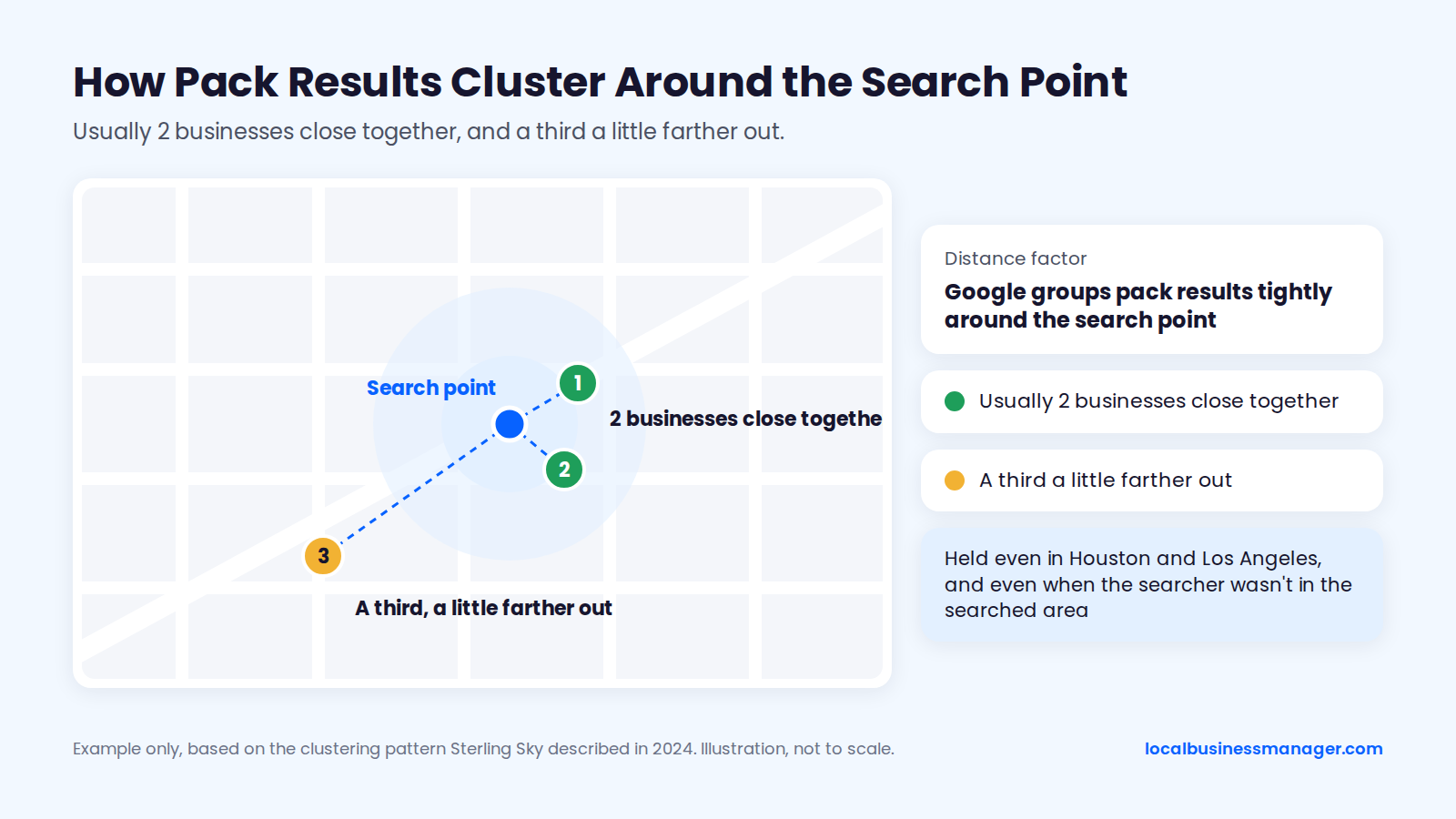
Example only, based on the clustering pattern Sterling Sky described in 2024.
No profile edit changes distance. Hiding the address doesn't either: Sterling Sky reports that pack ranking stays tied to the verified address when a service-area business hides it.
Prominence
Prominence is how well known Google considers a business to be. The 2026 Local Search Ranking Factors survey found that review signals gained weight compared with its 2023 edition.
I set the review target by the competition: match the average review count of the 3 businesses in the pack, then keep going. The links I've seen move Maps rankings came from local news coverage, sponsorships and industry directories.
Why Does the Local Pack Look Different for Every Searcher?
The local pack looks different for every searcher mainly because of where each person is searching from. Personal history plays a much smaller role. Google's own explainer on personalization says Search is "not highly personalized," but that location can change results, for example for "pizza near me." Incognito mode doesn't change this. Eleventh Peak Digital notes that incognito removes search history and logged-in account influence but doesn't change where Google thinks you are.
In a 2018 study summarized by Sterling Sky, Juris Digital found that law firms could dominate local organic results across a whole city, but the 3-pack didn't work that way. Picture one search, "car accident lawyer", run from 3 points in the same city: downtown, a suburb on the north side and the airport side of town. Each point can return a different pack, even though nobody touched a profile.
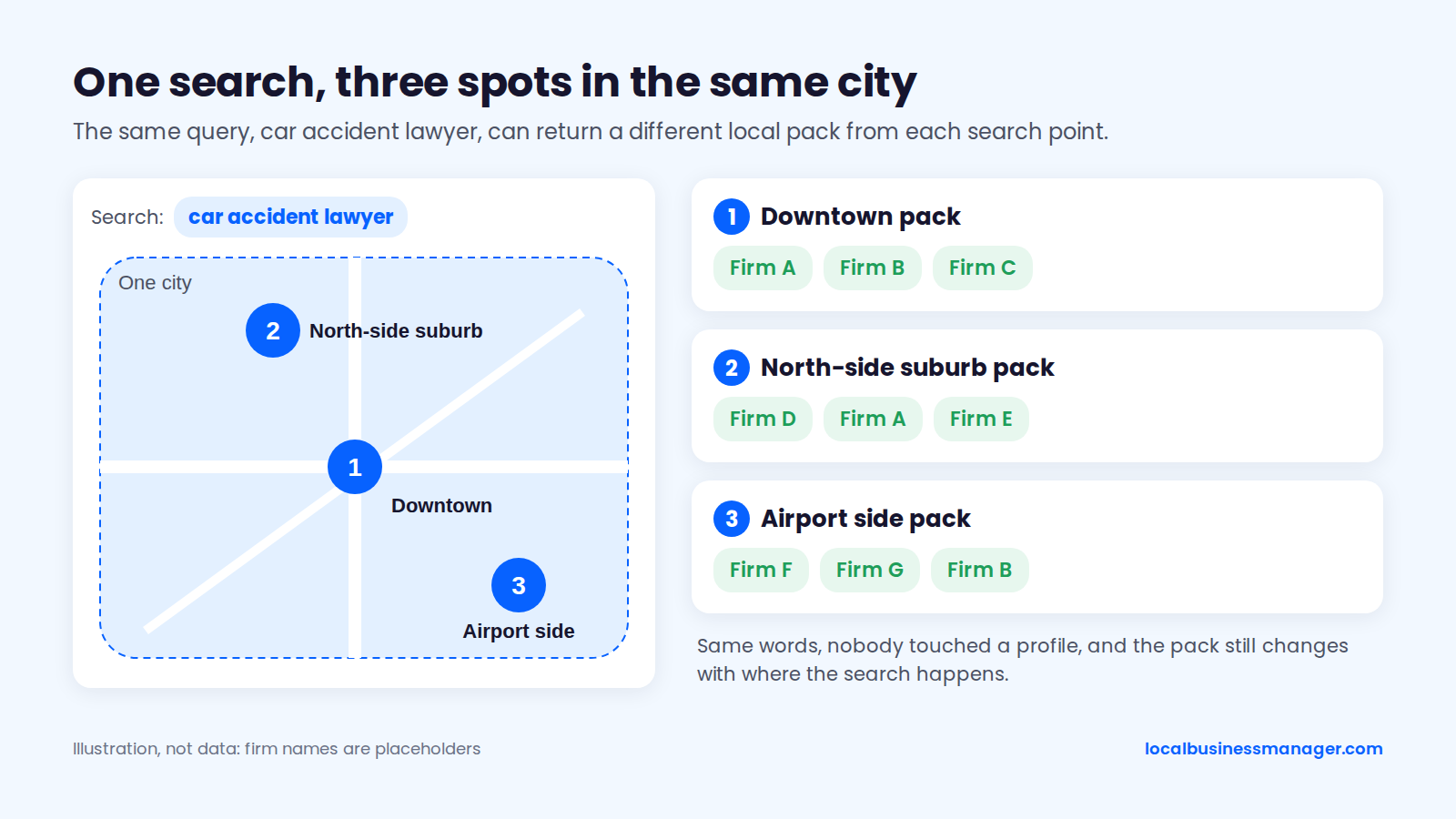
Illustration, not data: the same query searched from 3 points in one city.
I don't use single-point rank checks and I don't recommend them: one location says little about how a business ranks across its area. In my view, an average rank on its own is misleading right now too. Google is mixing results and the results page is very volatile, so the number is hard to read with confidence.
How to Explain It to a Client
Agencies get the "we dropped" call after a client searches from home or the office. These 4 sentences explain the problem without jargon. Adjust the wording to the client:
- "The map pack is built around where each person is searching from, so what you see at home is the pack for your street, not for your whole market."
- "Someone a few neighborhoods away typing the same words can see a different set of businesses, and incognito doesn't change that, because Google still knows roughly where you are."
- "That's why we check your rankings from many points across your service area instead of from one address."
- "The numbers that tell us whether this is working are your calls and your rankings across the area, and here's how they moved this month."
Bring 2 things to that call: the many-point ranking view and the call trend from the same period. Leave out single screenshots from one location, including your own office.
Can You Pay to Appear in the Local Pack?
No. Organic local pack positions can't be bought. Google's local ranking help page says there's no way to request or pay for a better local ranking. Businesses can pay for 2 placements around the pack, sponsored entries and Local Services Ads, and both are separate from organic rank.
Spending more doesn't buy a higher Local Services Ads position either, Rankings.io reported in January 2026:
Placement | Where it shows | Can you pay for it? | How it's billed | Does a bigger budget raise its position? |
|---|---|---|---|---|
Organic local pack | Inside Search results | No | Not billed | No |
Local Services Ads | Above the pack and other ads, when shown | Yes | Per valid lead (Google) | No (Rankings.io, January 2026) |
Sponsored pack entry | Inside the pack | Yes | Not published | Not published |
Google's Local Services help page on how leads work says advertisers are charged for each valid lead, such as a call, message or booking, not for clicks. According to the same help page, invalid or low-quality leads aren't charged, and charged leads may later be credited. Google Ads Help says Local Services Ads are moving to Performance Max campaigns with pay-per-lead goals, and the pay-per-lead model stays the same.
Law firms have 3 extra details to know, all reported by agencies and legal-industry companies rather than confirmed here against Google's own pages:
- Screening: VIP Marketing and Postali report that law firms can't use Google Guaranteed and qualify instead through a screening that checks each attorney's bar license and the firm's malpractice insurance. Clio lists personal injury among the covered practice areas.
- Badge name: Postali reported in October 2025 that "Google Verified" replaced "Google Screened" for law firms, while other agencies still describe Screened. Check Google's Local Services help center for the current label.
- Lead cost: Personal-injury lead costs come from agencies, not Google. Rankings.io saw $150 to $225 per lead in one market (January 2026).
How to Get Into the Local Pack: A Checklist
Getting into the local pack takes work in 4 areas: the profile, reviews, the website and the business name. Every step below stays inside Google's guidelines.
When I take on a new local client, I check 4 things in this order:
- Rankings across the area, with a geo-grid scan.
- The business name, compared with the names of the ranking competitors.
- The primary category.
- The website.
That audit finds the biggest gaps against the businesses already in the pack. The fixes below follow a different order, set by what depends on what: reviews, links and a rename only count once the profile is verified and set up.
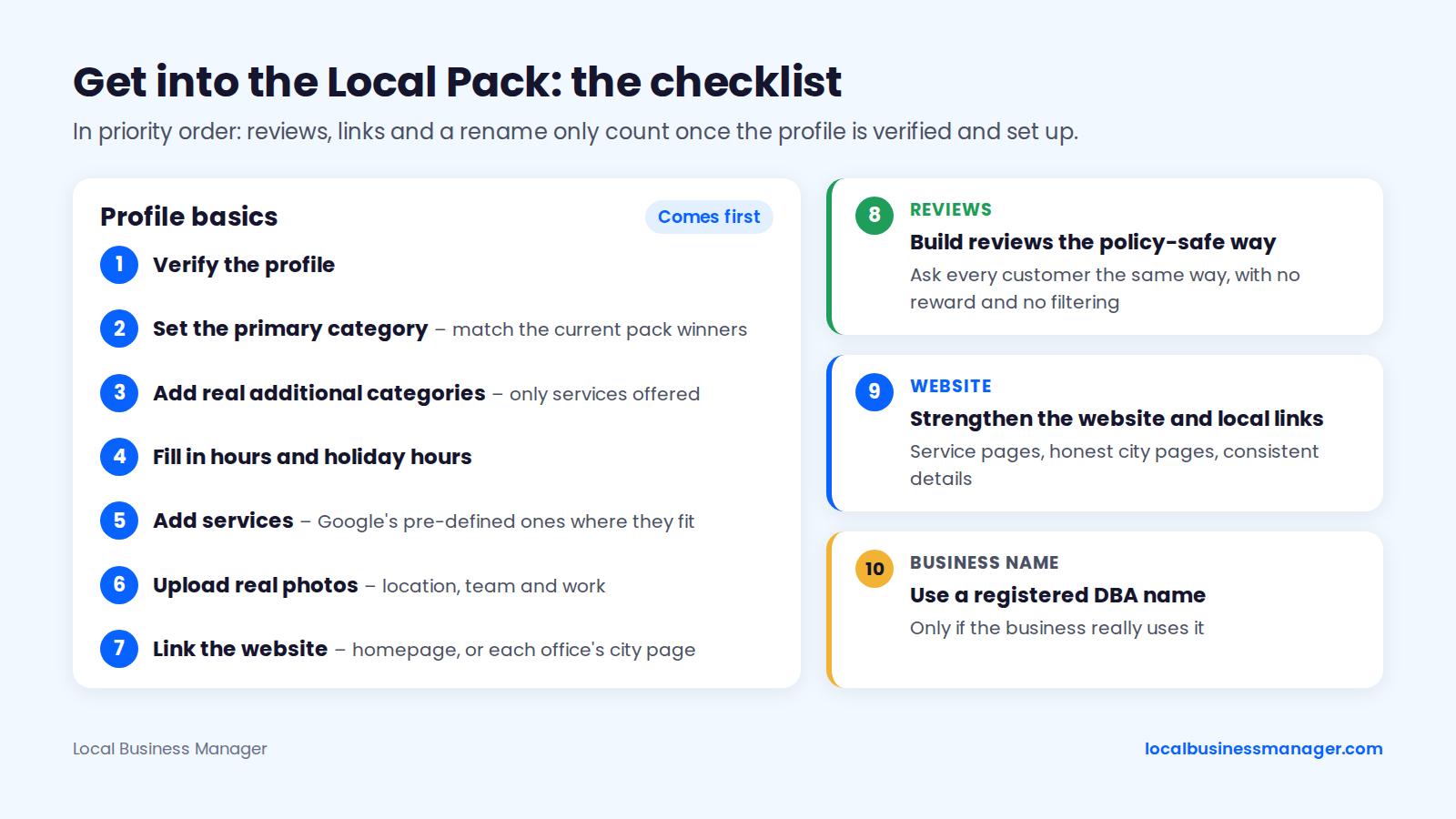
The get-into-the-pack checklist, in priority order.
Profile Basics
The profile basics come first, because they set relevance and the profile has to be live before anything else counts:
- Verify the profile.
- Set the primary category to what the current pack winners use for the client's main search. Open each winning competitor's profile to see the category it uses.
- Add additional categories only for services the business really offers.
- Fill in regular and holiday hours. Sterling Sky observed that since a November 2023 update, listings can drop sharply when the business is closed at the time of the search.
- Add services, using Google's pre-defined services where they fit.
- Upload real photos of the location, the team and the work.
- Link the website. My practice: a single profile links to the homepage, and with several offices, each profile links to its own city page.
Space out sensitive changes. After a name, address or category edit, I wait a day or two before the next sensitive edit. Google's community guide on suspensions lists drastic edits made too quickly among the common triggers.
Reviews (the Policy-Safe Way)
The safe way to build reviews is to ask every customer the same way, with no reward and no filtering. Google's Maps user-contributed content policy prohibits incentivized reviews and selective solicitation. Our guide to getting Google reviews without breaking policy covers the full request process. Every review request should meet all of these:
- Ask every customer at the same point in every job, and hand over the direct review link or a QR code at that step.
- Never offer discounts, gifts or prize entries for a review.
- Show every customer the Google review link, whatever feedback they give first. Never route only happy customers to Google.
- Send review texts only to customers who agreed to receive them.
- Reply to reviews, positive and negative, within a set window (law firms: see the ABA note below).
- Don't stuff keywords into replies.
Personal-injury firms need one adjustment. Ask every client when their matter closes. For clients who recovered, that moment comes after they've been paid. Asking only at payout would mean asking only winning clients, which is selective solicitation.
Law firms also need care with replies. ABA Formal Opinion 496 (January 13, 2021) says lawyers may not reveal confidential client information when responding to online reviews. It also says they should seriously consider not responding at all, or invite the reviewer to contact them privately. State bar rules control, so check yours.
Website and Local Links
The website supports the pack through service pages, honest city pages, consistent details and local links. The website work that matters:
- A page for each main service, written for the people who buy it.
- City pages only for towns the business actually serves. That's the main requirement. After that, case studies of jobs in that town, job photos from there and reviews from customers there make the page stronger, and those reviews are a huge plus.
- The same business name and address on the site as on the profile.
- Accurate core listings. A Sterling Sky case study found that citations can sometimes boost organic rankings but often have little to no impact on local pack rankings. An expert quoted in a citation survey said returns diminish once the 20 to 30 main listings are right.
- Local links from news coverage, sponsorships and industry directories.
Business Name and the DBA Route
Google requires the profile name to be the business's real-world name, under its guidelines for representing your business on Google. Adding keywords to a name the business doesn't use breaks that rule. The 2026 Local Search Ranking Factors survey ranked keywords in the business name third for pack rankings, at 223 points. The same survey also listed keyword names among the top suspension risk factors.
I recommend the compliant version: make the keyword name the business's actual name. I've taken many clients through the DBA process. The compliant order is:
- Register the name as a DBA (assumed business name).
- Use that exact name on the signage, website, stationery, phone greeting and other listings.
- Change the Business Profile name last, once everything else carries it.
- Keep the DBA filing and signage photos ready in case Google asks.
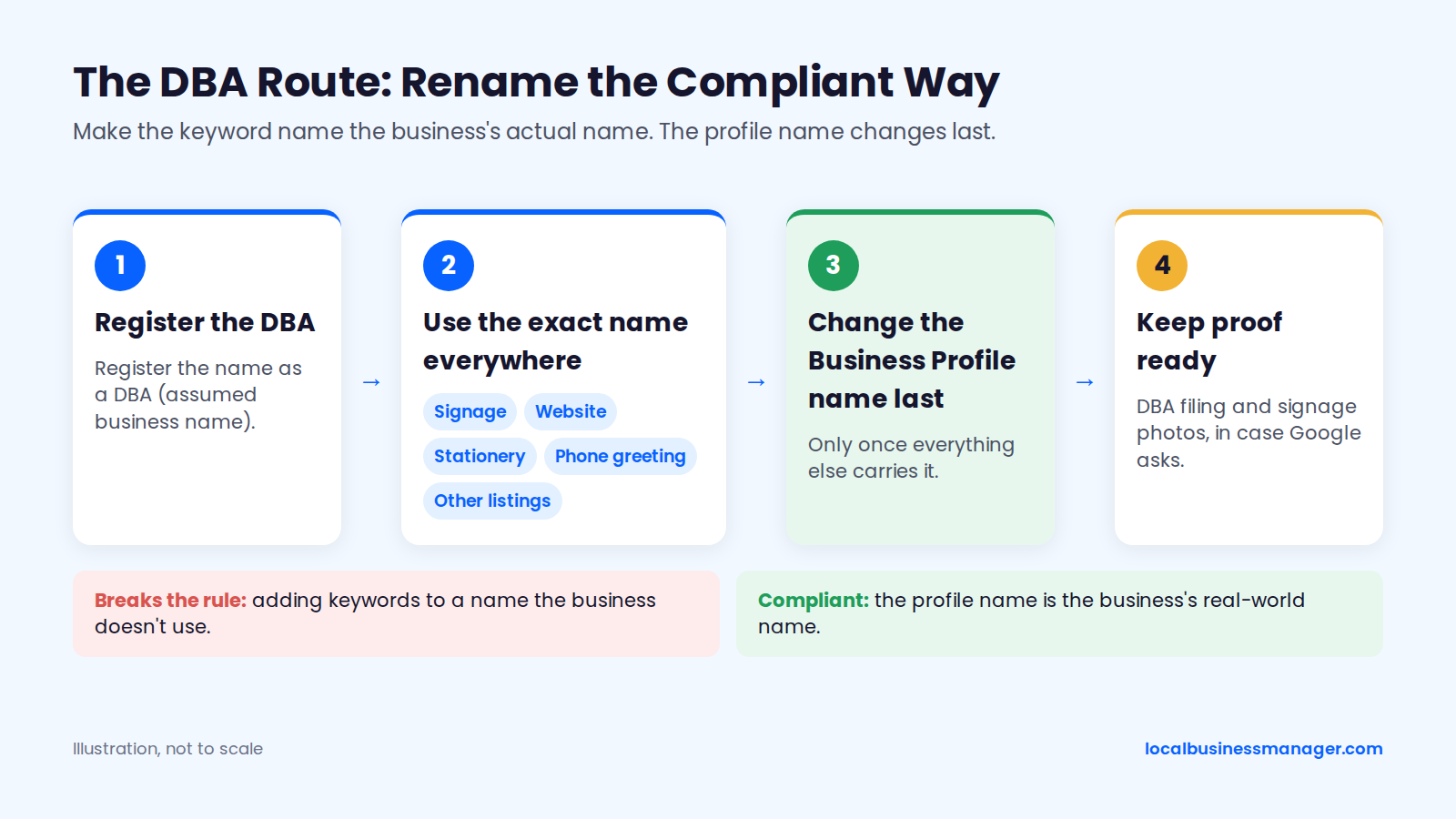
The DBA route, in order. The profile name changes last.
A DBA document alone doesn't make a name compliant. Google judges the name the business really uses and can still challenge or suspend it. In my experience, name and address edits cause the most suspensions. Our guide to business name rules and the DBA route goes step by step.
Extra Step for Law Firms
A law firm's trade name has to clear its state bar's rules before the DBA is filed. This is marketing guidance, not legal advice.
ABA Model Rule 7.1 bars false or misleading communications about a lawyer's services, and its Comment 5 applies that to firm and trade names. State rules go further in several places:
- New York bans trade names under Rule 7.5(b).
- Texas requires state-bar approval of a trade name.
- Kentucky, New Jersey and Rhode Island restrict trade names.
Check your state bar's current rule before filing a DBA or changing any profile name.
What Doesn't Help (or Isn't Proven)?
Several common local pack tactics have no proven ranking effect, and one feature older guides still recommend, Business Profile chat, no longer exists. Google doesn't confirm or rule out any single ranking tactic, so most rows rest on practitioner tests or expert opinion. The certainty labels are our own reading of the evidence, checked in November 2026, and "Unproven" means we found no test either way. The rows run from strongest evidence to weakest:
Tactic | What the evidence says | Certainty level |
|---|---|---|
Review-star schema on your own site | On September 16, 2019, Google stopped showing review rich results for LocalBusiness and Organization when the business controls the reviews itself (Google Search Central Blog) | Google confirms |
Business Profile chat (messaging) | Google removed chat and call history from Business Profiles on July 31, 2024 (Google Business Profile Help) | Google confirms |
Google Posts as a ranking lever | No measurable pack impact on 3 profiles (Sterling Sky, 2021); the survey ranks post factors 148th to 168th of 187 | Practitioners observe |
A bigger service-area setting | Pack ranking stays tied to the verified address, even when a service-area business hides it (Sterling Sky) | Practitioners observe |
Citation volume past the core listings | Often little to no impact on local pack rankings (Sterling Sky case study) | Practitioners observe |
Map embed on the website | Survey reportedly ranks it 125th of 187; a 2021 myths list called it not a ranking factor on its own | Practitioners observe |
Keywords in the business description | Survey ranks it about 171st of 187; no controlled public test found | Unproven |
The posts and description rows need a caveat. A local SEO software company's 2026 correlation data showed small positive gaps for profiles with posts and with description keywords. "No proven ranking lever" is accurate, but "no impact" would be too strong. Schema also isn't a documented pack factor.
I still post 3 times a week. In my view posting has very little influence on rankings, but regular posts signal to Google that the business is active.
Why Isn't My Business Showing in the Local Pack?
A business usually misses the local pack for one of 7 reasons, ranging from eligibility problems to plain competition. Check them in roughly this order, because the first 4 can keep a profile out no matter how strong it is:
- The profile isn't verified, or it's suspended.
- Duplicate listings. Google allows only one Business Profile per business location.
- Filtering. Google's local filter can hide listings that look similar or duplicate, such as several businesses sharing the same address. This is Sterling Sky's finding, not Google's, and Sterling Sky says the filter became more noticeable after the 2016 Possum update.
- The address isn't eligible: a virtual office, PO box or unstaffed coworking desk.
- The searcher is too far away for the pack Google builds around their location.
- The primary category doesn't match what the pack winners use.
- Prominence is weak: fewer reviews and links than the businesses in the pack.
When personal-injury firms miss the 3-pack, the most common causes I see are a review flow that's too low and a Business Profile name that doesn't carry the service. We fix the name only through a registered DBA the firm actually uses everywhere. If the profile doesn't show on Maps at all, start with why a business isn't showing on Google Maps.
Address Rules for Service-Area Businesses
Google's representation guidelines say service-area businesses should hide their address. The overall service area should stay within about 2 hours' driving time of where the business is based. A service-area business with a hidden address can still rank: Sterling Sky found that rankings are tied mainly to the address used to verify the business, not to the service areas listed. Our service-area business setup guide covers the settings.
3 address setups put a service-area profile at risk:
- Virtual offices. Sterling Sky's eligibility review, updated September 2026, says a virtual office qualifies only if the business actually operates there. A service-area business can't use one unless it's staffed during business hours.
- Coworking desks. A local SEO software company's guidance says a coworking address works only with clear signage, staff on site and customers received there during business hours.
- Settings that contradict reality. In a November 2025 Google community thread, a business switched to a service-area setup while a Maps photo still showed a physical location. The profile was suspended 2 weeks later.
The sources pull in different directions on what hiding the address costs. A Sterling Sky test found that hiding it lowered rankings and calls, while the 2026 Local Search Ranking Factors survey lists showing the address as a service-area business as a negative factor. Neither finding changes Google's requirement: service-area businesses hide the address.
Suspended or Duplicate Profiles
A suspended profile drops out of the pack entirely. Google's community guide on suspensions lists the common triggers:
- Address and service-area settings that don't match.
- Virtual office or PO box addresses.
- An address Google can't verify.
- Duplicate listings.
- Drastic edits made too quickly.
In my experience, reinstatement usually needs documents: the DBA filing, a lease agreement and photos of the office with signage, or a video recording the storefront and office. After a denied appeal, what worked for me was a second review with new evidence. Rankings recover after reinstatement if you act fast, and I've never lost reviews in a reinstatement. The full process is in our guide to suspensions and reinstatement.
For duplicates, the route that has worked for me is a merge request through Google support.
How to Measure Local Pack Results
Measuring local pack results takes 2 views: profile interactions from Google's own tools, and rankings checked from many points across the area. The first shows what searchers did on the profile. The second shows where the business appears across its market.
What Google's Tools Show
Google's Business Profile reports show how people interacted with the profile, but not where it ranks. Google Search Console doesn't report local pack positions either, so neither tool tells you where the profile sits in the pack. Older guides still describe an "Insights" dashboard, so check Google's Performance help page for the current metric names before you build a report around them.
Set up 2 things so profile activity is measured cleanly:
- Tag the profile's website link with UTM parameters, for example
?utm_source=google&utm_medium=organic&utm_campaign=gbp-listing. The campaign value is what lets you separate profile visits from the rest of your Google organic traffic in Analytics. - Track calls properly. I put the call-tracking number in the profile's primary phone number field, with no secondary number needed.
Keep the same metric set every month so changes reflect real movement. Calls and rankings lead my monthly client reports.
How to Check Rankings Honestly
An honest ranking check samples many points across the service area, not one address. Agencies usually run it with a map pack ranking tracker that checks from a grid of points, often called a geo-grid tool. No primary source sets a minimum number of check points, so any standard is a judgment call.
My method is to run one scan first just to learn how the business ranks, then adjust. A typical first scan is a 13 Ã 13 grid with 0.5 miles between points. If the grid comes back mostly strong, I widen the spacing to see how far the ranking reaches. If it comes back mostly weak, I tighten it.
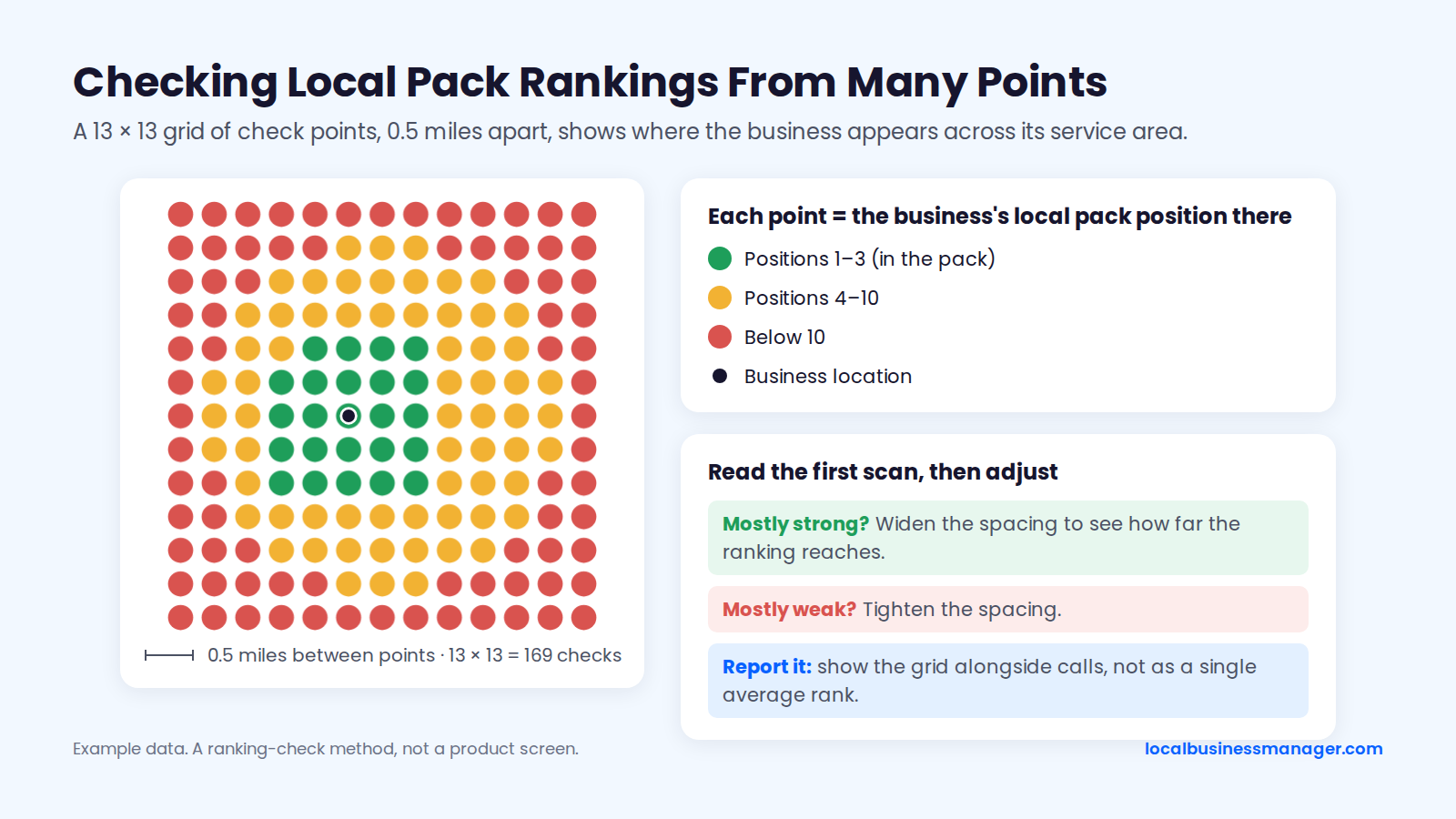
Example data. A many-point ranking check, shown as a method, not a product screen.
How often you scan depends on what you're testing. In my view, agencies should scan at least once a month, and daily scans make sense only right after an edit, to see whether it produced a result. Report the grid alongside calls rather than as a single average rank.
How Has the Local Pack Changed?
The local pack shrank from 7 listings to 3 in early August 2015. Since then the main changes have been more weight on proximity, an open-hours ranking signal, the end of Business Profile chat, and shifts in the paid and AI units around the pack. The table lists them oldest first:
Date | What changed | Reported by |
|---|---|---|
Early August 2015 | The pack went from 7 listings to 3, on mobile and desktop, with no formal Google announcement | Trade press at the time, including Search Influence |
November 30 to December 8, 2021 | A confirmed local search update put more weight on proximity; Sterling Sky named it the "Vicinity" update | Google; Sterling Sky |
November 2023 | Whether a business is open at the time of the search started to affect pack rankings | Sterling Sky |
July 31, 2024 | Chat and call history were removed from Business Profiles | Google Business Profile Help |
Late 2025 | Desktop Local Services Ads went from 3 slots to 2, with advertisers rotated more evenly | Sterling Sky |
AI Mode lists local businesses differently from the pack. The agency Humanlevel reported in 2025 that AI Mode showed local lists of up to 10 businesses, which included the usual top-3 pack businesses. Clicking a business opened its Business Profile.
When an AI Overview appears above the Business Profile section, I usually see it pull in the businesses that already rank at the top. Here's what I do about AI answers:
- Keep reviews coming in steadily.
- Keep the website information up to date.
- Keep citations accurate.
- Earn reviews on the other platforms Google pulls information from.
For law firms, I've also seen paid legal directories bring cases and help firms get mentioned in AI Overviews. That's my observation, not a measured result.
Local Pack FAQs
3 questions still come up after everything above: what "local search" covers as a whole, why a competitor with fewer reviews can outrank a client, and how long getting into the pack takes.
What Is Google Local Search?
Google local search means searches where Google reads local intent and returns nearby businesses, mainly through the local pack, the Local Finder and Google Maps. Those results come from Business Profiles and are ranked mainly on relevance, distance and prominence. The organic results below them rank websites.
Why Does a Competitor With Fewer Reviews Rank Above Me?
Check 3 things in order: whether the listing is marked as an ad, whether the competitor is closer to where the search happened, and whether its primary category fits the search better. Review count is only one signal. Google ranks on relevance, distance and prominence together, so a closer competitor with a better-matched category can outrank a business with more reviews.
How Long Does It Take to Get Into the Local Pack?
Google publishes no timeline. In my experience, a new profile in a competitive city can take a month or two to show in the pack for category searches. That's not a guarantee. A single high-impact fix can show ranking gains within about a month, for example moving the profile to a registered DBA name that includes the keyword and that the business uses everywhere. Once the basics are done, further gains come gradually, for example from a strong review push. Kantha Digital, a digital marketing agency, says some businesses see local pack results within a few weeks and others take months.
Where to Start With a Client
The fastest way to find a client's gap is to look up the businesses that win the pack from several points across the client's area. Note their primary categories and review counts, then put the client's profile next to them. When you're ready to run that work across all your clients in one place, join Local Business Manager early access.