Local SEO Pricing and Packages: What It Costs, What You Get, and How to Price It

If a prospect has ever told you "the other agency quoted half that," you know a local SEO price means nothing until you see what it buys. An SEO software company's survey of 439 providers put the average local SEO retainer at about $1,557 a month, and agencies selling to personal-injury firms in big metros quote several times that.
Competition, location count, the profile's starting condition and reporting depth decide where a quote lands. Below you'll find a deliverables-by-tier table, a scorecard for comparing quotes, and a free worksheet for agencies building a price from their own hours and tools.
How Much Does Local SEO Cost?
Published surveys put a typical local SEO retainer at roughly $500 to $1,600 a month. Agency price pages put a one-time setup or audit at $300 to $3,000 and consulting at $35 to $250 an hour. Agencies quote personal-injury firms in big metros far more.
The most traceable retainer figures come from published provider surveys. All of them were run by companies that sell SEO software:
- The 439-provider pricing survey (an SEO software company; first published December 2023, figures as reported in August 2024): local SEO averaged about $1,557 a month, roughly $1,819 at agencies and $1,150 at freelancers. Its most common band for any SEO retainer, not just local, was $501 to $1,000 a month, chosen by 20.4% of providers.
- The 260-agency pricing survey (an SEO software company, 2025): 64% of agencies charge retainers under $1,000 a month and 30% charge under $500. These figures cover SEO retainers in general, not local SEO alone.
- The 534-response local search industry survey (a local SEO software company, 2023, self-selected sample): US agencies averaged $799 a month per client in year 1, $1,349 in year 2 and $1,569 in year 3.
These figures reached us through secondary reports of the original surveys. Treat them as benchmarks from interested parties, not independent research. The Google Business Profile itself (formerly Google My Business) costs nothing: according to Google's Business Profile page (business.google.com), creating a profile and listing a business on Google is free. A quote prices the work.
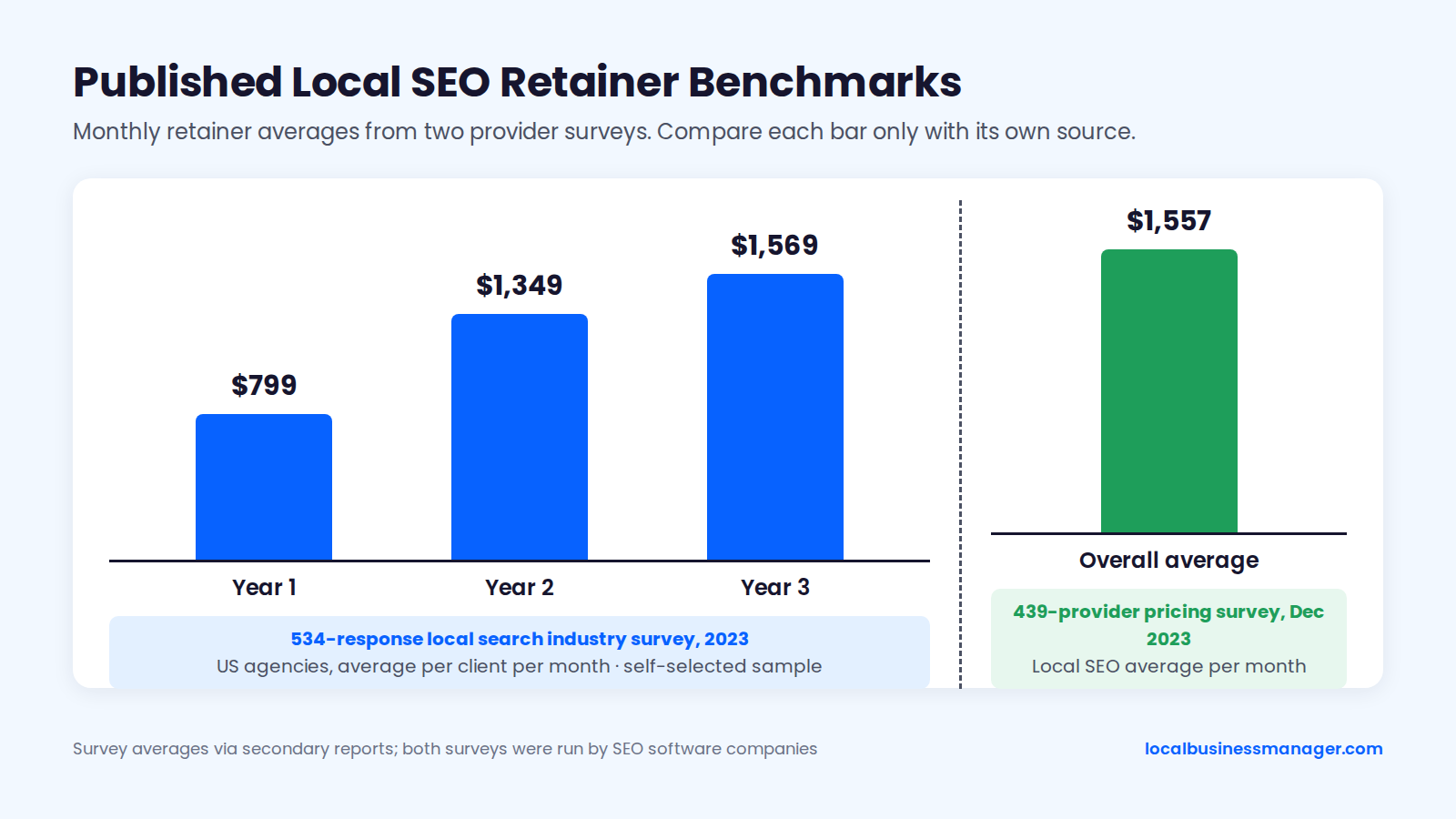
The year-by-year bars come from the 534-response survey, and the $1,557 average comes from the 439-provider survey. They use different samples, so compare each bar only with its own source.
As of November 2026, published figures run from $35 an hour for consulting to $25,000+ a month for personal-injury SEO in a major metro. Rows are grouped by billing unit: one-time fees first, then hourly rates, then monthly retainers. The 2 survey rows are averages across providers; the agency rows come from each agency's own page, and none of those publishes a method.
Pricing model | Range (USD) | Unit | Source and date | Best for |
|---|---|---|---|---|
One-time GBP setup or overhaul | $300 to $800 | Per location, once | Arc4 agency blog, 2026 | A profile that needs fixing once |
Setup or cleanup fee | $300 to $1,500 | Once | Untap Web agency blog, 2026 | Starting a retainer on a messy profile |
One-time audit | $750 to $3,000 | Once | Arc4 agency blog, 2026 | Finding what's broken before committing |
Hourly consulting, freelancer or company | $35 to $250 | Per hour | SEOProfy pricing guide, 2026 | A second opinion on one problem |
Hourly consulting, by experience | $75 to $200+ | Per hour | WebFX pricing guide, 2026 | An experienced consultant |
Hourly, freelancers | $50 to $150 | Per hour | PageTraffic, undated page | Small, defined tasks |
Monthly retainer, year 1 | $799 | Per client per month, survey average | 534-response industry survey, 2023 | Benchmark for a new client |
Monthly retainer, local SEO | $1,557 | Per month, survey average | 439-provider survey, December 2023 | Ongoing work in a normal market |
Monthly retainer, PI firm in a major metro | $10,000 to $25,000+ | Per month | Searchbloom legal SEO agency, 2026 | Personal injury in a big city |
Monthly retainer, PI law firm (my clients) | About $5,000 low end, about $12,000 average | Per month | My own PI clients, not a published figure | Personal injury, a high-cost niche; not a general benchmark |
I've worked with close to 100 PI firms in Houston, Denver, Los Angeles and New York, and my personal-injury clients paid from about $5,000 a month at the low end, and around $12,000 a month on average, for local SEO. Those are personal-injury numbers from a high-cost niche, so don't use them to price a plumber.
Local SEO Pricing Models Compared
Local SEO is sold in 7 ways: retainer, per location, setup plus retainer, one-time project, hourly, performance-based and white-label. Each model puts the risk of wasted spend on a different side of the deal, which is what the buyer-risk column below tracks.
The monthly retainer is the most common model for SEO in general. The same SEO software company's pricing survey, in its 2026 version, reports that 78.2% of 350 surveyed SEOs charge one. That sample differs from the 439 providers behind the local average, and it covers all SEO work. The other 6 models either sit on top of a retainer or replace it for a short project.
Model | How it's billed | When it fits | Buyer risk |
|---|---|---|---|
Monthly retainer | Flat fee each month | Ongoing work in any market | Paying for activity if deliverables are vague |
Per-location pricing | Fee per location per month | Chains, franchises, multi-office firms | Paying full price for shared work at every location |
Setup fee plus retainer | One-time fee, then monthly | Profiles that need cleanup first | Unclear what the setup actually bought |
One-time project | Fixed fee per project | Audits, cleanups, one fix | Nobody maintains the fixes afterward |
Hourly consulting | Rate times hours worked | Second opinions, in-house teams | Open-ended bills |
Performance-based | Paid when a ranking or lead target is hit | Uncommon; Google warns against guaranteed rankings | Easy keywords or risky tactics |
White-label | Agency buys wholesale and resells | Agencies filling a skill gap | An unknown vendor touching the profile |
Monthly Retainer
A monthly retainer pays for a fixed list of work every month, whatever the month brings. It's the default because local SEO doesn't finish: Google or a third party can change a profile's name, attributes or services at any time, and someone has to catch the edit.
A retainer's weak spot is vagueness. "Local SEO management, $1,000/month" tells the buyer nothing. A good retainer names 3 things, so each cost ties to a deliverable:
- The deliverables
- Roughly how much of each happens per month
- What the monthly report shows
For me, a retainer has to deliver one thing above all: rankings for the main terms.
Per-Location Pricing
Per-location pricing charges a fee for each Business Profile the agency manages. It's the natural model for franchises, multi-office law firms and home-service companies with several branches.
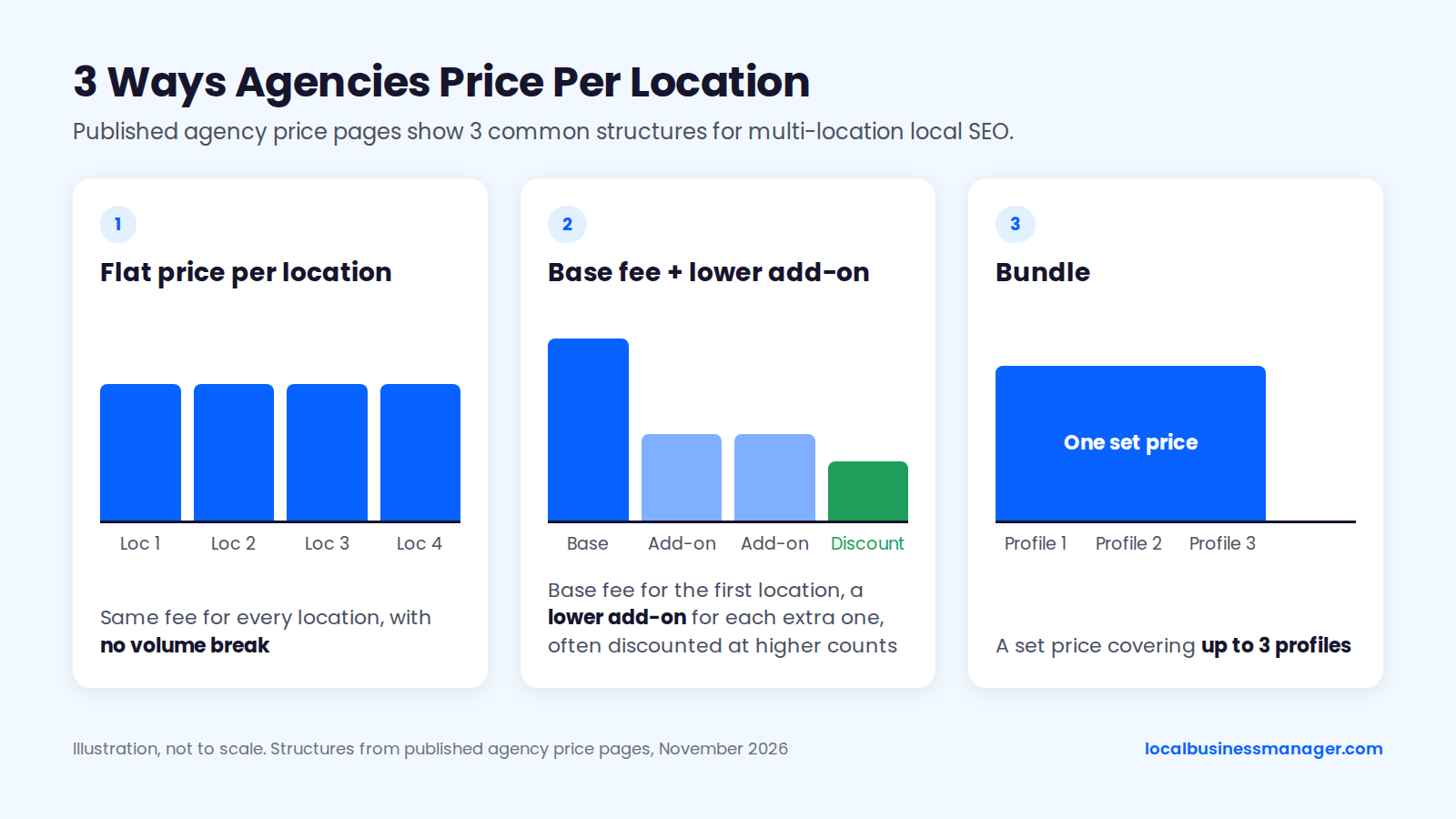
Published agency price pages, reviewed in November 2026, show 3 common structures:
- A flat price per location, with no volume break
- A base fee for the first location, plus a lower add-on for each extra one, often discounted at higher counts
- Bundles, such as a set price for up to 3 profiles
Published add-ons differ widely on pages checked in November 2026. ZapMinds gives $100 to $400 per additional location per month, and UpBusinessCo gives $150 to $400. MultiWebTeam puts the full multi-location price at $300 to $800 per location, and Franchise Success Team puts franchise spend at $75 to $300 per unit.
Volume discounts on these pages start anywhere from 3 to 20 locations. Every figure comes from a provider selling the service, and we found no independent survey of multi-location pricing.
Setup Fee Plus Retainer
A setup fee pays for the front-loaded work in month 1: the audit, category and service fixes, duplicate cleanup and a citation baseline. Published setup fees from agency pages are in the first table, and some managed services charge no setup fee at all.
A setup fee earns its place when the profile needs real repair. If the profile is already clean, ask what the fee pays for beyond a login and a kickoff call. Either way, ask for the setup work itemized with the hours it's expected to take; the full list of what it should cover is in the contracts section below.
One-Time Projects (Audit, Profile Cleanup, Citation Cleanup)
One-time projects fix a defined problem for a fixed fee. Agency prices for audits and one-time profile overhauls are in the first table. Suspensions have their own pricing: Sterling Sky publishes the only success-based reinstatement fee we found, $0 upfront and $800 only if the profile is reinstated.
The risk is what happens after the project. Fixed categories, cleaned citations and a repaired name don't stay fixed on their own. My weekly routine includes checking every profile for edits to the name, attributes, services and other fields, because Google and third parties change them. So before buying a one-time project, find out who will be checking the profile once it ends.
Hourly Consulting
Hourly consulting bills time spent, usually for advice rather than execution. It suits in-house teams that do the work themselves and want an expert to check categories, review a suspension appeal or sanity-check a site structure.
The first table lists 3 published hourly ranges, from $35 to $250 an hour. None states a method, and none explains why freelancer and agency rates differ. A likely reason, though none of the sources says so, is overhead: an agency rate also pays for account management, staff and backup that a solo freelancer doesn't carry. Ask for a written estimate of hours per task and a cap that needs your approval before it's exceeded.
Performance-Based Pricing
Performance-based pricing pays only when rankings or leads hit an agreed target, and Google's guidance makes the ranking version hard to sell honestly. Google's own pages and 2 agencies weigh against it:
- Google Search Central's page on whether you need an SEO states that no one can guarantee a #1 ranking on Google, and warns businesses to beware of SEOs that claim to guarantee rankings.
- Google's Business Profile help page on working with third parties lists "guarantees placement on Google" as a warning sign.
- WebFX and SEOProfy, 2 agencies that sell other pricing models, say pay-for-performance pushes providers toward easy keywords, short-term tactics or spammy links. They have a stake in that view, and no independent study compares outcomes.
Law firms have a second issue: pay-per-lead is a bar ethics question. The ABA's Comment on Model Rule 7.2 allows lawyers to pay marketing vendors and lead generators, but not to pay for a recommendation. State bars differ on per-lead fees. This is marketing guidance, not legal advice, so check your state bar's ethics opinions before signing.
White-Label (Wholesale) Local SEO
White-label local SEO means an agency buys the work wholesale from a vendor and resells it under its own brand. The resale price is the vendor's fee plus a markup that covers the agency's account management, strategy, reporting and margin.
Not telling clients the work is outsourced is common white-label practice. It only works if 3 things hold:
- The agency stays accountable for every deliverable.
- The client stays primary owner of the profile.
- The vendor works through the agency's own access, so no unknown manager ever appears on the client's profile.
The task I've outsourced is link building. I never outsource Business Profile naming or category selection.
What Should a Local SEO Package Include at Each Price?
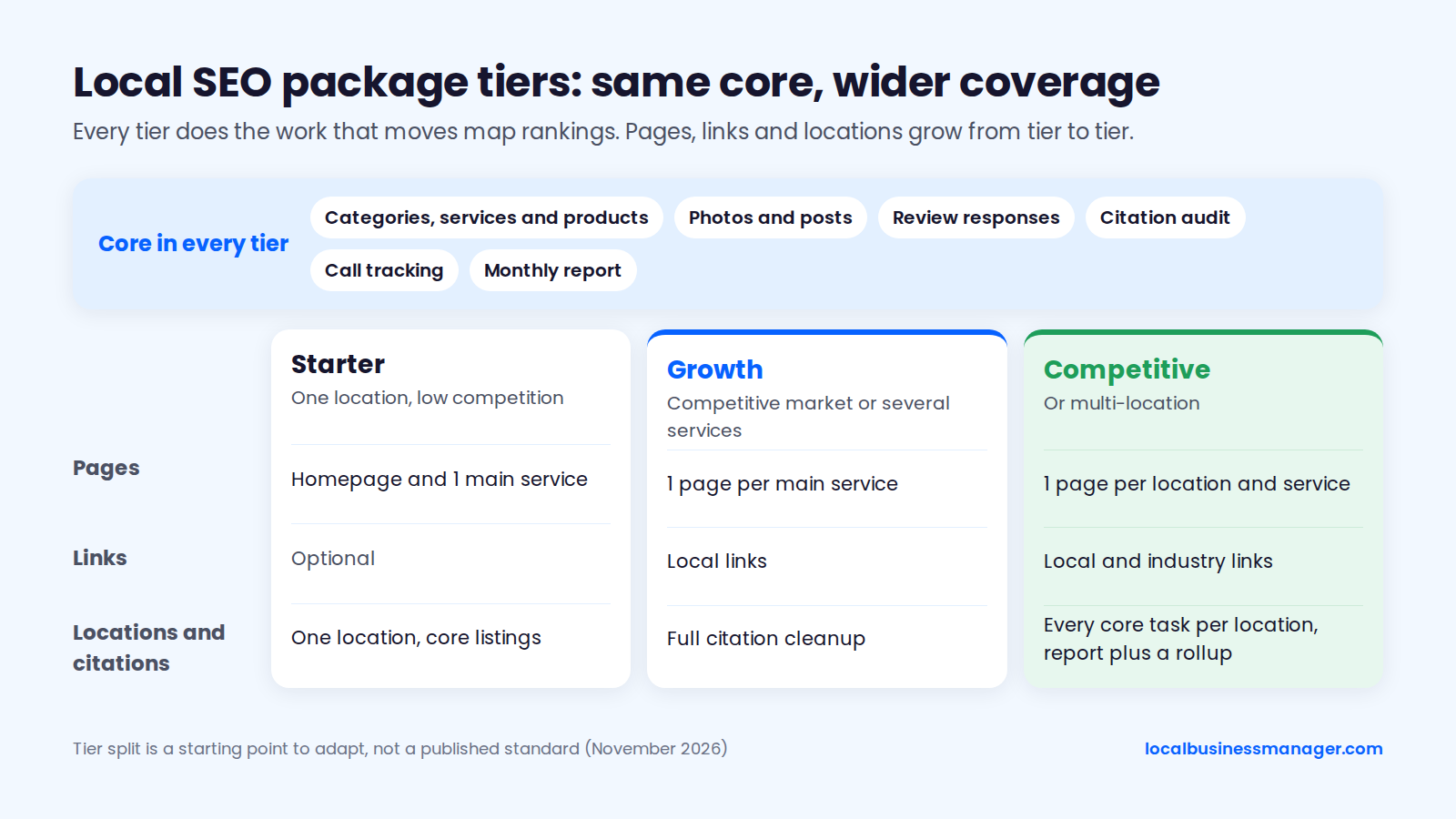
A local SEO package should include the work that moves map rankings at every price: categories, services, reviews, pages that match the profile, and reporting. Between tiers, what grows is how many pages, links and locations the work covers.
The survey figures in the first section are averages across providers, not tier prices, so price each tier from its hours with the worksheet further down. The one published hours example comes from eSEOspace, an agency: its $750 package "might provide 5 hours of work" and its $2,500 package "could provide 20 hours of service."
No published survey defines what each tier contains, so treat the split below as a starting point to adapt (November 2026). The last column names the padded version of each line item.
Deliverable | Starter | Growth | Competitive or multi-location | Padded version to watch for |
|---|---|---|---|---|
Categories, services and products on the profile | Yes | Yes | Yes, per location | Rarely padded |
Photos and posts | Yes | Yes | Yes, per location | Posts sold as a ranking lever |
Review responses | Yes | Yes | Yes, per location | Rarely padded |
Citation audit and cleanup | Core listings | Full cleanup | Full cleanup per location | Citation counts that keep growing |
Location and service pages | Homepage and 1 main service | 1 page per main service | 1 page per location and service | Word-count quotas |
Link earning | Optional | Local links | Local and industry links | Bookmarking, classifieds, blog comments, guest-post quotas |
Call tracking | Yes | Yes | Yes, per location | Rarely padded |
Monthly report | Calls and rankings | Calls, rankings, pages, reviews | Per location plus a rollup | Activity counts with no calls or rankings |
Starter: One Location, Low Competition
A starter package covers one location in a market with few strong competitors. It still covers 6 core tasks, all set out step by step in our Google Business Profile optimization guide:
- Primary category plus additional categories that match the services
- Services and products filled in on the profile
- A reply to every review
- Core citations checked and corrected
- A homepage and one main service page that match the profile
- A call-tracking number and a monthly report on calls and rankings
A typical profile I work on ends up with 3 to 5 additional categories. I put the call-tracking number in the profile's primary phone field, with no additional number. Both are my own practice.
Growth: Competitive Market or Several Services
A growth package adds a page for every main service and active link earning, because the competition is too strong for profile work alone. The extra work goes into 3 areas:
- Service pages: local keyword relevance of content ranks among the top local organic factors in the 2026 Local Search Ranking Factors survey.
- Reviews: the same survey moved review recency to #11, up from #93 in 2023.
- Links: industry-relevant inbound links also rank among its top local organic factors.
My review goal is to match the average review count of the top 3 map-pack results, then keep going. The links I've seen move Maps rankings came from local news, sponsorships and industry directories.
Competitive or Multi-Location
The competitive tier is for personal-injury firms in big metros, multi-office businesses and anyone fighting dozens of strong profiles. Agencies that sell legal SEO quote personal injury from about $1,000 a month in low-competition markets (Fortress Growth, 2026) up to the major-metro range in the first table (Searchbloom, 2026). Sapphire SEO Solutions also publishes PI pricing, and none of the 3 shows its data.
The work at this level includes:
- A review flow that keeps pace with the top 3 competitors
- A business-name decision, which may mean the DBA-first rename covered under red flags below
- A page for each location and each main service
- City pages only for towns the business actually serves
- Weekly checks of every profile for unwanted edits
- Link earning from local and industry sources
When I look at why PI firms miss the 3-pack, it's most often 2 things: the business name isn't optimized (the fix is the DBA-first rename covered under red flags below) and review flow is too low.
What Counts as Padding in a Local SEO Package?
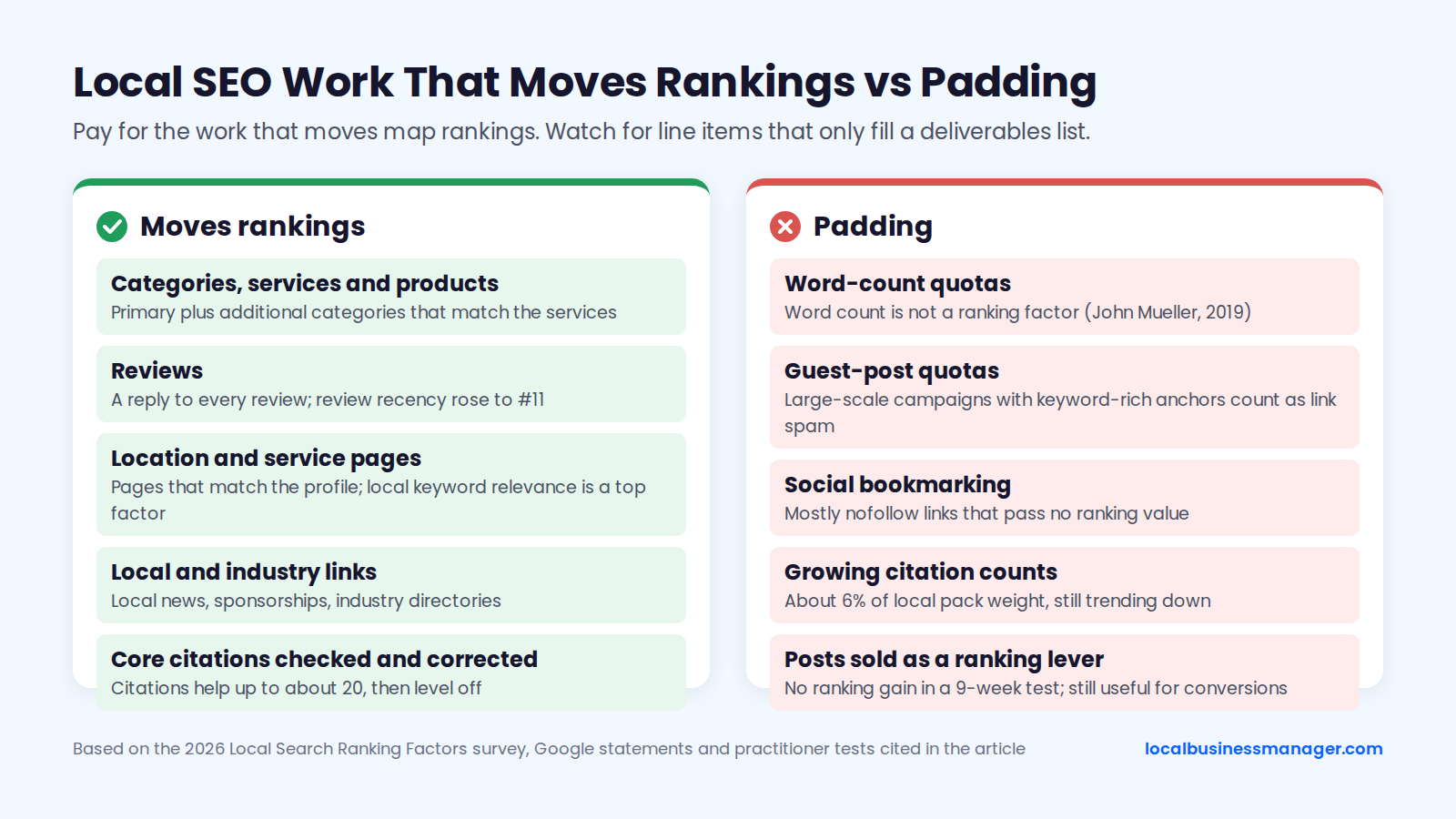
Padding is work that fills a deliverables list without moving rankings or calls. Google's own statements and practitioner tests back most of the split:
- Word-count quotas: Google's John Mueller said in 2019 that word count is not a ranking factor.
- Guest-post quotas: Google's spam policies treat large-scale guest-post campaigns with keyword-rich anchor text as link spam. A genuine article for a publication with real readers is fine.
- Social bookmarking: most bookmarking links are nofollow and pass no ranking value, according to a 2026 link-building guide.
- Growing citation counts: the 2026 Local Search Ranking Factors survey gives citation signals about 6% of local pack weight, still trending down. A local SEO software company's tracking data from September 2026 found citations help up to about 20, then level off.
- Posts as a ranking lever: in an undated Sterling Sky test, weekly Google posts over 9 weeks, tracked across 441 keywords, did not improve local rankings. Sterling Sky still recommends posts for conversions.
I post 3 times a week anyway. The ranking evidence is weak, but I see regular posting as a signal to Google that the business is active.
What Makes Local SEO More or Less Expensive?
Local SEO costs more when the market is crowded, the business has more locations or services, the profile starts broken, or the client wants deeper reporting. Each factor adds hours, and hours are what a quote prices.
Competition in the Vertical and City
Google ranks local results on 3 factors: relevance, distance and prominence, according to its help page on local ranking. Distance is outside the business's control, so competition decides how much relevance and prominence work a business needs to win the area it can.
The 2026 Local Search Ranking Factors survey ranks the primary category, proximity and keywords in the business name as the heaviest local pack factors. That's why my first look at any market compares the client against the businesses already ranking.
The first 4 things I check on a new client, in order:
- Rankings across the whole area, from a grid of points
- The business name compared with the names of the ranking competitors
- The primary category
- The website
Example: A PI Firm in a Big Metro vs a Cleaner in a Small Town
The same 3 ranking factors produce very different workloads. Picture a personal-injury firm in a large metro and a house cleaner in a small town. Both want the 3-pack.
The PI firm faces dozens of firms with heavy review counts, several practice areas that each need a page, and competitors whose names may already carry keywords. Its scope covers:
- A business-name decision and a review flow that keeps pace
- Practice-area pages
- Link earning from local and legal sources
- Weekly edit checks
- Rank checks across a big map
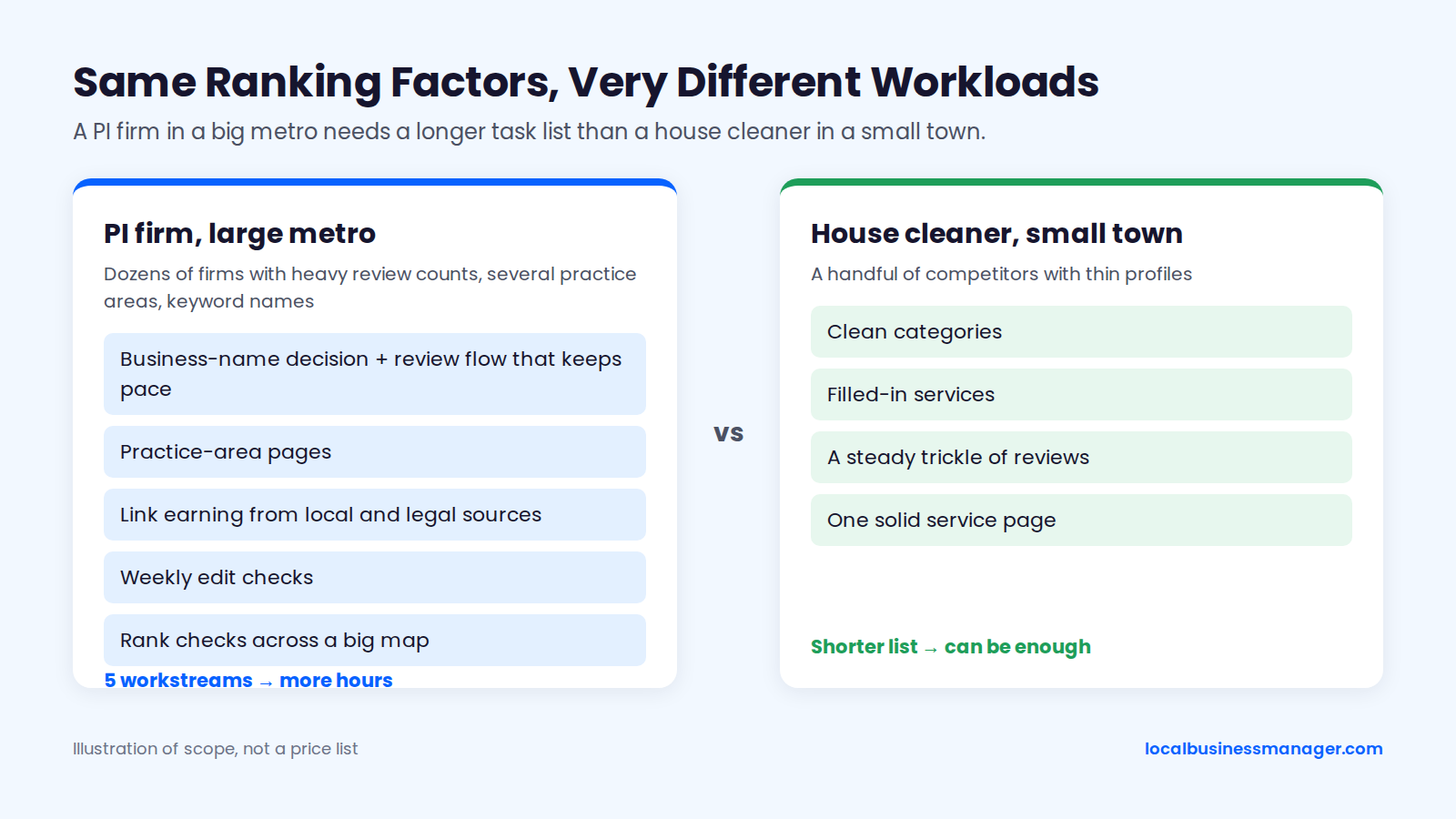
The cleaner may face a handful of competitors with thin profiles. Clean categories, filled-in services, a steady trickle of reviews and one solid service page can be enough.
Number of Locations and Size of the Service Area
Every location adds its own profile, page, reviews, citations and call-tracking number, so most of the work multiplies with location count. A large service area adds checking work: rankings change across a map, and a check from one spot says little about the rest.
My usual first rank scan is a 13 Ã 13 grid with 0.5 miles between points, to learn how the business ranks before adjusting. If it comes back mostly strong, I widen the spacing to see how far the ranking reaches. If it's mostly weak, I tighten it.
City pages follow one rule: the business must actually serve that town. After that, 3 things make the page stronger:
- Case studies of jobs done in that town
- Job photos from there
- Reviews from customers there
Starting Condition of the Profile
A suspended, duplicated or badly named profile adds cleanup work before any ranking work can start. Google's help pages set out the process for 2 common problems:
- Suspension: the business gets one appeal through Google's appeal tool, and if that's denied, Google may allow one more review.
- Duplicates: a duplicate on Maps needs a merge request through "suggest an edit". Sterling Sky notes Google won't merge listings at different addresses.
Reinstatement timing varies. A small-business software company's help center gives 1 to 5 weeks. During a 2025 suspension bug, a local SEO software company reported responses taking 25 to 30 business days. Law firms add a wrinkle: attorneys can have their own profiles, so an allowed attorney profile can look like a duplicate.
In my experience, name edits and address edits cause the most suspensions. Reinstatement usually needs documents: a DBA, a lease, photos of the office with signage, or a video of the storefront and office. After a denied appeal, what worked was a second review with new evidence.
Problems I've inherited from previous agencies include duplicate listings, bad naming, no review campaign, and no services or products set up. Our guide to Google Business Profile suspensions and reinstatement covers the appeal in detail.
Number of Services Needing Their Own Pages
Each main service needs its own page that matches what the profile says the business does. A roofer that also does gutters and siding needs 3 pages, and a PI firm covering car, truck and motorcycle accidents needs a page for each practice area.
Every page has to be written, linked from the right place and kept accurate. Multiply services by locations to get the page count the quote has to cover.
Reporting Depth
Reporting costs more hours as it adds locations, metrics and custom formats. A one-page monthly summary for one location is quick. A white-label report per location, plus a rollup for a regional manager, plus call-tracking data matched to booked jobs, is a real monthly task.
If a client wants signed cases or booked jobs matched to calls, price the extra setup and the monthly reconciliation separately. What belongs in the report itself is in our guide to monthly local SEO client reports.
How Should Agencies Price Local SEO?
Agencies should charge what it costs to deliver the work: hours times loaded hourly cost, plus tools per location, plus margin. For a market check on how much to charge for local SEO, compare the result with the freelancer and agency averages in the comparison table further down.
Step 1: Estimate Monthly Hours per Location
Monthly hours per location are the biggest unknown in local SEO pricing, and we found no independent study that measures them. Every published estimate comes from a vendor:
- A software company that sells agency tools cites an estimate of about 100 minutes per profile per month for fully manual Business Profile work. The same company says no independent survey has measured time per task.
- Colorado Web Impressions puts minimum management at roughly 4 to 6 hours a month: weekly posts, photos, Q&A, review replies within 48 hours, attribute updates and a monthly insights review.
We found no published estimate of setup hours. Track your own time on 3 or 4 clients for a month before you trust any number, including these.
My own recurring work per profile runs on 2 clocks: weekly checks for edits to the name, attributes and services, and monthly rank checks plus a post-schedule review. The posts themselves sit on top of that.
Step 2: Add Tool Cost per Location
Tool cost per location is your monthly software bill divided across the locations it serves. Local SEO delivery typically draws on tools such as:
- Rank tracking across the service area
- Review monitoring and replies
- Citation and listings management
- Call-tracking numbers, one per location
- Reporting
Some tools charge per seat, some per location, some per scan or credit. Convert each to a monthly cost per location, using a busy month. A per-location tool cost you can't predict is a warning sign, for the reason covered under per-scan pricing below.
Step 3: Add Margin and Set a Minimum
Margin turns delivery cost into a price, and a minimum stops you taking work that can't be done well. This worksheet works as a free local SEO pricing calculator you can run on paper or in a spreadsheet, once per package:
- Ongoing hours per location per month: [your number]
- Loaded hourly cost (wage plus taxes, benefits and overhead): [your number]
- Labor cost = line 1 Ã line 2
- Tool cost per location per month: [your number]
- Delivery cost = line 3 + line 4
- Target margin as a percentage of price: [your number]
- Monthly price = line 5 ÷ (1 â line 6)
- If line 7 is below your minimum, quote the minimum or don't take the client
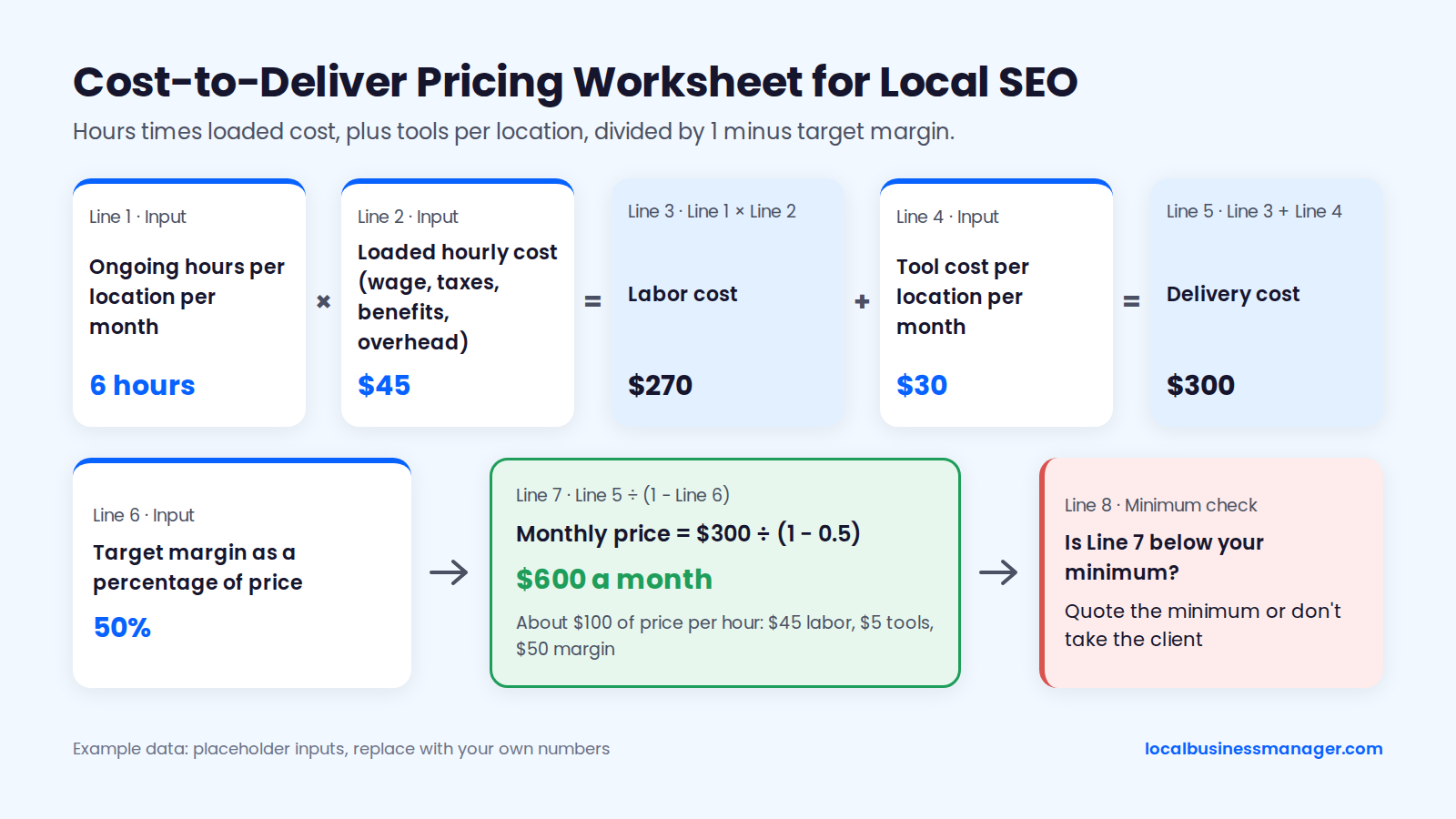
Placeholder example, to replace with your own numbers: 6 hours à $45 = $270 labor. Add $30 in tools for $300 delivery cost. A 50% target margin gives $300 ÷ 0.5 = $600 a month. Run it the other way: at these placeholder costs each hour carries about $100 of price ($45 labor, $5 tools, $50 margin), so a $600 quote buys about 6 hours.
Check capacity too. The 2020 local search industry survey, from a local SEO software company, found agency employees handled 17 clients on average and freelancers 8. The data is old, but it's a sanity check on how many accounts one person can carry.
Step 4: Decide the Setup Fee and Term
A setup fee should charge for the hours month 1 needs beyond a normal month, meaning the work listed under "What a Setup Fee Should Cover" in the contracts section. Run those hours through the same worksheet and charge them once. A clean profile needs a small fee or none; a suspended one with duplicates needs a large one.
Term is a business choice; Google, the FTC and bar rules don't set one. Google's general SEO timeline of 4 months to a year, covered under measuring results below, is the usual argument for a minimum term. What agencies actually publish about terms is in the contracts section.
Watch for Tools Priced per Scan or Credit
Tools priced per scan or credit make delivery cost move with how often you check rankings. A 13 Ã 13 grid is 169 points for one keyword. Five keywords make 845 checks per scan, for one location.
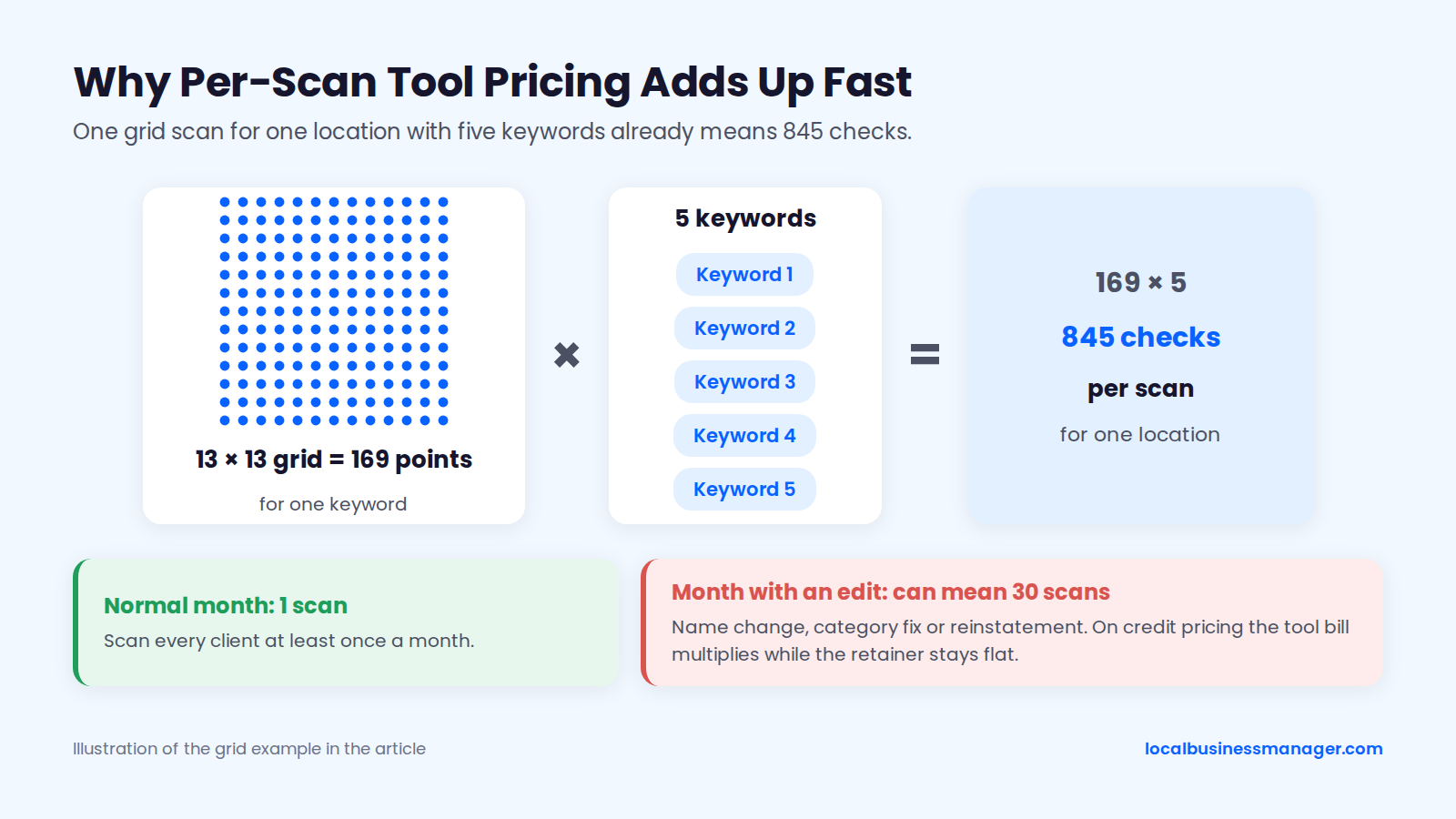
I recommend agencies scan every client at least once a month, and run daily scans only after an edit, to see whether it produced a result. A month with a name change, a category fix or a reinstatement can mean 30 scans instead of 1. On credit pricing, that month's tool bill multiplies while the retainer stays flat, which is why a package priced on an average month can lose money in a busy one.
Scope-of-Work Checklist to Paste Into a Proposal
A proposal built from the worksheet should spell out the work, the hours and the exit in writing. Paste and fill in:
- Monthly deliverables with quantities: review replies, posts, pages, link targets, edit checks
- Estimated hours per location per month
- Report contents, including calls and rankings across the service area
- Ownership: the client stays primary owner; the agency is added as a manager through its organization account
- Setup work, itemized, with its one-time fee
- Term, notice period and how either side exits
- Out-of-scope items, and who implements what (agency or client)
- Compliance: no review incentives or filtering, texts only to customers who opted in, any name change only through a registered DBA used everywhere first
- Handover on cancellation, using the checklist in the contracts section
How Should Multi-Location Businesses Be Priced?
Multi-location businesses should be priced per location for work that repeats at every location, and once for work that's shared. That split is why per-location prices often fall as the location count rises: shared costs spread across more profiles.
Of 9 common tasks, 6 repeat at every location and 3 are done once for the brand. No survey publishes this split; it follows from which tasks repeat at each profile. Rows are sorted per-location first (November 2026).
Task | Billed | Why |
|---|---|---|
Profile upkeep (hours, services, photos, posts) | Per location | Each profile is edited separately |
Weekly checks for unwanted edits | Per location | Any profile can be changed by Google or a user |
Review replies | Per location | Volume follows each location's customers |
Location page | Per location | Each office needs its own page with local details |
Citation cleanup | Per location | Each address has its own listings |
Call-tracking number | Per location | Each profile needs its own number |
Strategy and keyword plan | Shared | Done once for the brand |
Post and reply templates | Shared | Written once, adapted per location |
Reporting setup | Shared | Built once, then filled per location |
Per-location prices fall with volume because only the shared rows stop growing. The per-location rows never get cheaper. A franchise with 40 locations still has 40 profiles to check every week and 40 review inboxes to answer.
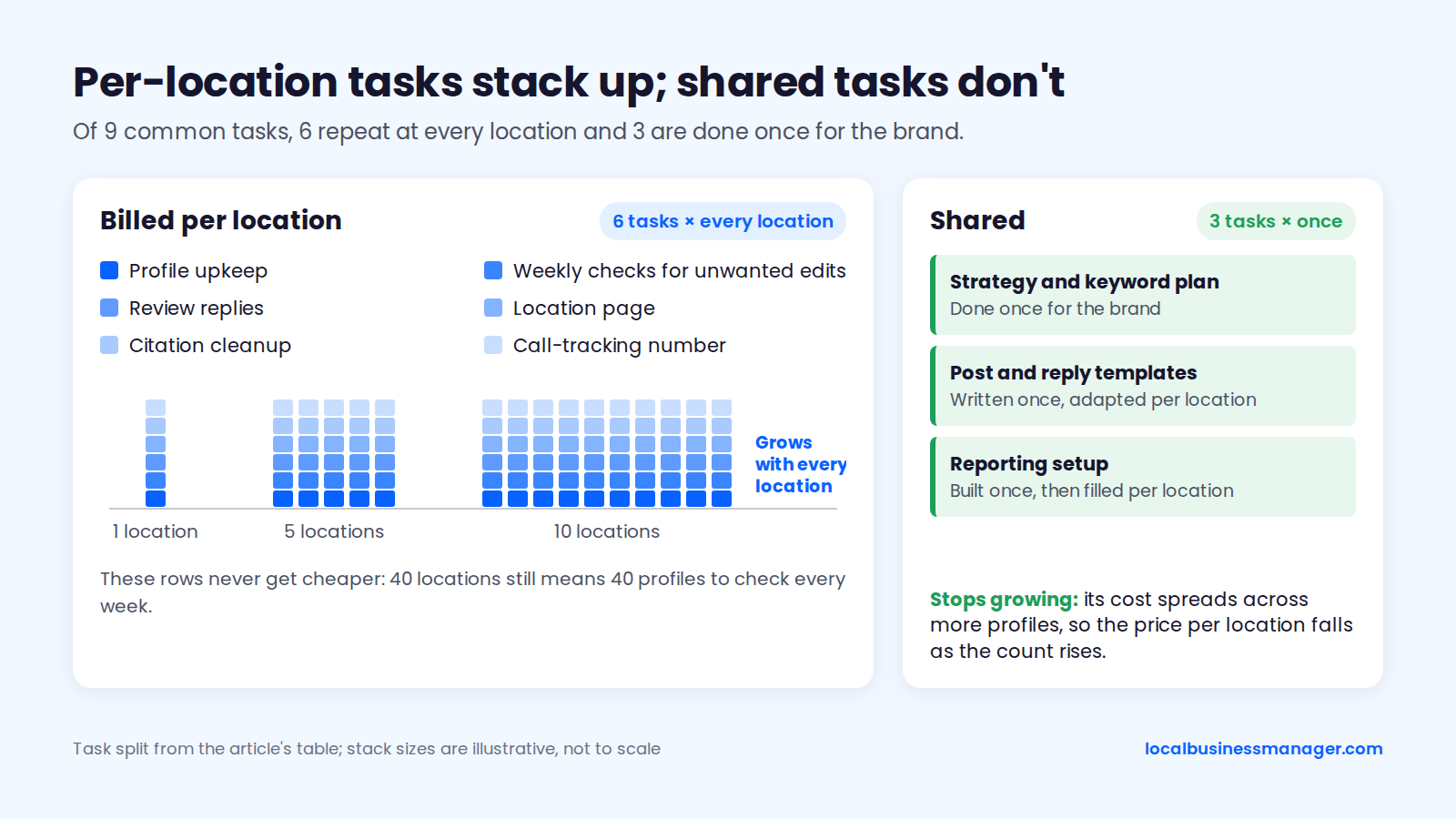
The worksheet shows the effect. With placeholder inputs (4 shared hours a month, 4 hours per location, $45 loaded hourly cost, $30 in tools per location, 50% margin), the price per location falls from $780 at 1 location to $456 at 10, while each location still gets the same 4 hours.
Locations | Total hours per month | Delivery cost (USD) | Monthly price (USD) | Price per location (USD) |
|---|---|---|---|---|
1 | 8 | $390 | $780 | $780 |
5 | 24 | $1,230 | $2,460 | $492 |
10 | 44 | $2,280 | $4,560 | $456 |
On page structure, each office's profile links to its own city page, which carries the local details for that office. A single-location profile links to the homepage. That's my practice for multi-office clients, and our guide to multi-location Google Business Profile management covers the rest of the setup.
Agency, Freelancer, In-House or DIY: Which Costs Less?
DIY costs the least in cash, and freelancers averaged less than agencies in the one survey that splits them. But the cheapest option is the one with enough hours for the market.
Freelancers averaged $1,150 a month for local SEO against $1,819 for agencies in the 439-provider survey (December 2023). The capacity figures come from the 2020 local search industry survey. No sourced benchmark exists for in-house cost or DIY owner hours.
Option | Cost basis | Typical cost (USD or hours) | Capacity | Main risk | Best fit |
|---|---|---|---|---|---|
Agency | Retainer per client or location | About $1,819 a month average | 17 clients per employee (2020) | Time split across many clients | Competitive or multi-location |
Freelancer | Retainer or hourly | About $1,150 a month average | 8 clients each (2020) | One person, no backup | One location, moderate competition |
In-house | Salary plus tools | Not published | One business | Single skill set, tool costs | Large multi-location brands |
DIY | Owner time plus optional tools | Not published | One business | Gaps in links, tracking and policy | One location, low competition |
DIY owners can do the core profile work themselves inside the Business Profile: categories, services, photos, posts and review replies. The paid parts are rank tracking across the area, call tracking, review monitoring and listings management.
Cube Creative's local SEO cost article, written in 2021, says automated listing platforms typically cost a flat $90 to $500 a year, and warns that once payments end, the platform stops performing the service. Links and pages cost time or a contractor either way.
Contracts, Setup Fees and Who Owns the Profile
The contract decides whether the business keeps its Business Profile when it leaves the agency, and ownership is the most expensive thing to get wrong. Term length and setup fees matter too, and both should be in writing before work starts.
Month-to-Month vs Fixed Terms
My PI clients were on month-to-month terms. Digital Domination's contract guide calls a 3 to 6 month first term that rolls to month-to-month fair, and calls a 12-month auto-renewing term with no milestone unfair. Stridec recommends 6 months as the realistic minimum, then month-to-month rollover instead of another 12-month auto-renewal.
Most agencies don't publish their terms, and the ones that do lean month-to-month. The Fractional SEO crawled 990 US agency websites in 2026 and found only 22.3% state contract terms: 16.6% say month-to-month and 5.8% state a minimum.
That crawl is one practitioner's data with no published method, and it counts what agencies publish, not what they sign. Among the 52 sites that give a number:
- 6 months appeared on 25 sites
- 3 months appeared on 15
- 12 months appeared on 12
Google's third-party policies also apply. Third parties serving small and medium businesses must share Google's "Working with a third party" notice, and clients should know about any management fees.
What a Setup Fee Should Cover
A setup fee should cover specific month-1 work the client can see, listed in the proposal:
- An audit of the profile, website and competitors
- Category, service and product fixes
- Duplicate removal or merge requests, and any suspension work
- A citation baseline and fixes to core listings
- Call-tracking setup, with the number placed on the profile
- A ranking baseline across the service area
- Report setup
A setup fee listed with none of these needs an explanation of what it pays for. On an already clean profile, the fee should shrink.
Profile Ownership and Handover on Cancellation
The business should stay primary owner of its Business Profile, with the agency added as a manager. Google's help page on owners and managers sets the roles. A profile can have several owners but only one primary owner. Owners can add and remove users and delete the profile; managers can't do either. Only the primary owner can transfer primary ownership, and only to an existing owner or manager.
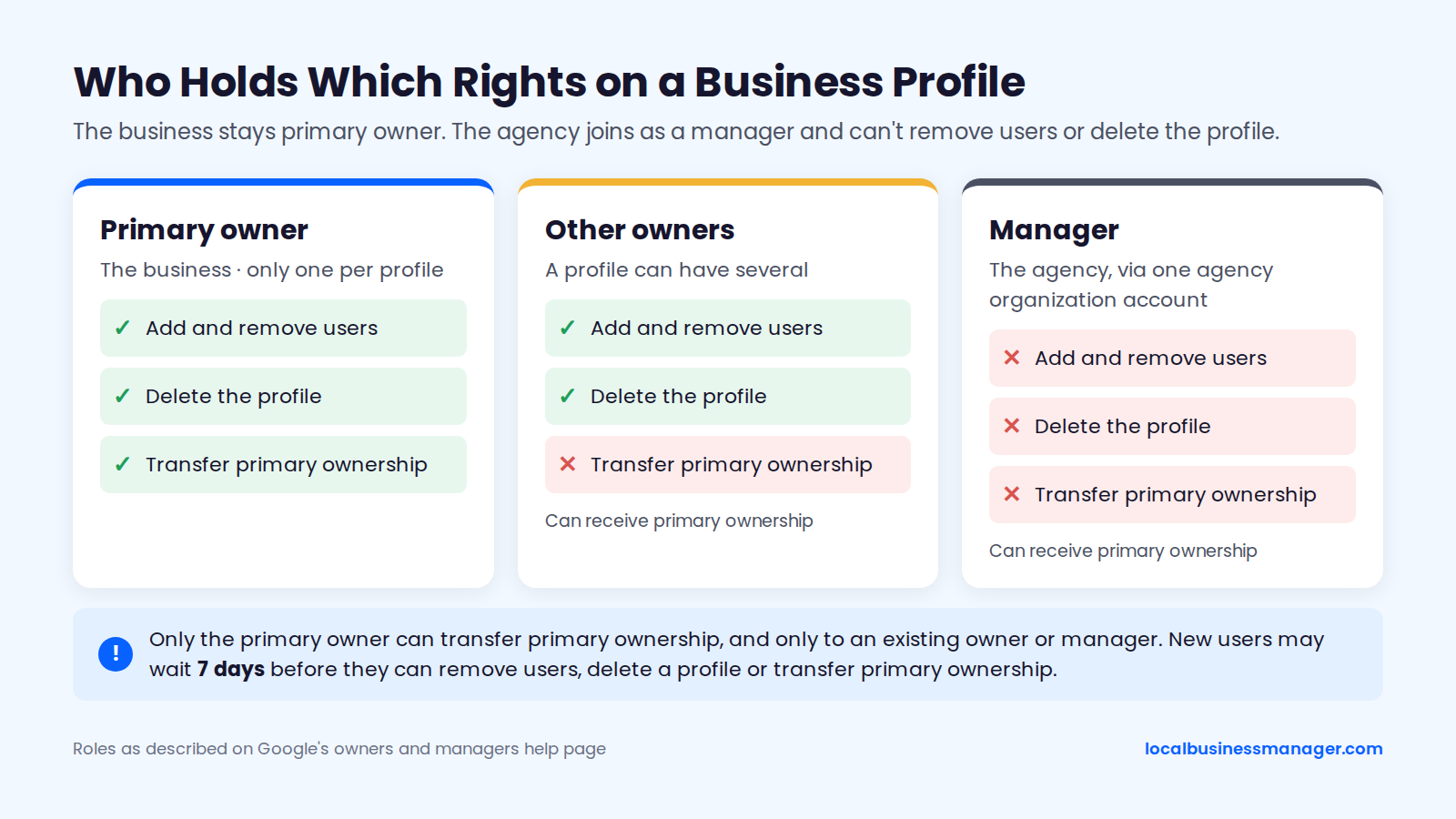
A Google Product Expert guide in the Business Profile community notes that new users may wait 7 days before they can remove users, delete a profile or transfer primary ownership. Plan agency changes around that delay. Sterling Sky warns that if an agency holding owner access gets its account suspended, the client profiles it manages can be suspended too.
My practice: the client is primary owner, and the agency accepts invites through one agency organization account, never personal or shared logins. Getting a profile back from a former agency or ex-employee has taken anywhere from immediately to a week or two, depending on the person.
Handover checklist for a cancellation:
- Business Profile: client confirmed as primary owner, agency access removed
- Website: domain, hosting and site admin logins in the client's name
- Call-tracking numbers: transferred, or replaced with the real number on the profile
- Citation and directory logins
- Review tool and listings tool accounts
- Analytics and Search Console access
- Ad accounts, including Local Services Ads if used
- Past reports and the raw ranking and call data behind them
Red Flags in Local SEO Packages
A local SEO package is a red flag when it puts the Business Profile at risk or promises what no one can deliver, such as a guaranteed #1 ranking. 4 of the 8 flags below can cost a business its profile: the agency as primary owner, a keyword name with no DBA, a fake or virtual address, and review gating or fake reviews. Texting without opt-in is a consent risk under the FCC's TCPA rules, and guaranteed rankings are a buyer risk.
Rows are sorted by risk to the profile, highest first, and each flag has a compliant alternative in the last column.
Red flag | Why it's a problem | Ask for instead |
|---|---|---|
Agency listed as primary owner | The client can lose the profile | Client as primary owner, agency as manager |
Keyword added to the profile name with no DBA | Breaks Google's real-name rule | The DBA-first rename, or the real name |
Virtual office, PO box or coworking address | Breaks Google's address rules | A real staffed address, or a service-area profile |
Review gating, incentives or fake reviews | Breaks Google's review policy | Ask every customer the same way |
Texting customers who haven't opted in | Marketing texts need consent under the FCC's TCPA rules | Texts only to customers who opted in |
Guaranteed rankings | Google says no one can guarantee #1 | Targets for calls and rankings, no guarantee |
Padding quotas | No ranking value | Deliverables tied to reviews, pages and links |
A promise to "show up in ChatGPT" | No one controls AI answers | Clear answers on what's measured |
Keyword Business Names: The DBA-First Exception
A keyword in the business name is allowed only when it's the business's real name. That means it's registered and used everywhere before the Business Profile changes. I recommend keyword names, and I've taken many clients through this process. I do it only in this order:
- Register the DBA (assumed name).
- Use that exact name on signage, the website, stationery, the phone greeting and other listings.
- Change the Business Profile name last.
- Wait a day or two after the name edit before any other sensitive edit.
A DBA document alone doesn't make a name compliant: Google judges the name the business really uses and can still challenge or suspend the profile, and the DBA is what proves the name during reinstatement or re-verification. The risk runs both ways, since the 2026 Local Search Ranking Factors survey lists keyword names among the top suspension risk factors and also finds they correlate with higher local-pack rank. The full process is in our guide to keyword business names and DBAs.
Law firms have one more check. The trade name must also pass the state bar's rules, and some states restrict or ban trade names. This is marketing guidance, not legal advice, so check your state bar before filing.
Reviews and Review Requests
A review plan is compliant only if it asks every customer the same way, with no incentive and no filtering. Google's review policy prohibits incentives and selective solicitation, and says fake engagement and incentivized or biased reviews aren't allowed and will be removed.
Separately, the FTC's final rule on fake reviews, announced in August 2024 (16 CFR Part 465), bans buying, selling or spreading fake reviews and testimonials. The same rule bans offering payment or other incentives on condition that a review expresses a particular sentiment, positive or negative. Any quote that mentions one of these 3 things is a red flag:
- Discounts or rewards for reviews
- Asking only happy customers
- Review routing that hides the Google link from some customers
The FCC's rules under the Telephone Consumer Protection Act (TCPA) require consent for marketing texts, so review requests by text go only to customers who agreed to receive them. For PI firms, ask every client the same way when their matter closes. For clients who recovered, that moment comes after payout; asking only at payout would mean asking only winning clients.
How to Tell if Your Local SEO Spend Is Working
Local SEO is working when calls and rankings across the service area rise and stay up, measured against a baseline taken before the work started. The numbers below show the direction; the timing section says when to judge it.
Which Numbers Prove Local SEO Is Working?
4 sets of numbers show whether local SEO is working:
- Business Profile Performance report: searches, views, calls, website clicks, direction requests and bookings. Sterling Sky points out that "Calls" counts taps on the call button, not completed calls.
- Call tracking: a call-tracking number on the profile fills the gap between call taps and real calls.
- Signed cases or booked jobs: for law firms, Rankings.io, a law-firm SEO agency, argues firms should judge SEO by signed cases from organic search and cost per case (SEO spend divided by signed cases). Rankings.io recommends dynamic call tracking because most law-firm leads come by phone and GA4 can't see them.
- Rankings across the service area: checked from many points across the area; a check from the client's office shows one spot.
My monthly reports lead with calls and rankings, then everything else.
When Should You Judge the Results?
No published rule says when to judge local SEO; judge it against the pre-work baseline over several months, not one. Google's Maile Ohye said in a Google video that an SEO usually needs 4 months to a year to implement improvements and see a benefit, which covers SEO in general. The only local-specific figure is small and undated: a local SEO software company asked 18 local search professionals, and 78% said a new business in a competitive sector can reach significant rankings in 3 to 9 months.
In my experience, timing depends on what was already done, and a single high-impact fix can show ranking gains within about a month. My example is getting the keyword into the business name through the DBA process. Once the basics are done, further gains, such as from a strong review push, come gradually.
Do Local SEO Packages Include AI Search Visibility?
No standard exists yet for AI search visibility in a local SEO package, and no one controls what AI answers say. Clients ask "are we showing up in ChatGPT?" and some packages now promise exactly that. A buyer should treat the promise as a red flag and the measurement as a fair request.
Before paying for AI visibility work, ask:
- What exactly is measured: mentions, recommendations or cited sources?
- Which AI tools are checked, and are they checked the way customers use them?
- How often, and for which prompts and locations?
- What was the baseline before the work started?
- Which specific actions are expected to change the result?
- How will it appear in the monthly report, next to calls and rankings?
In my law-firm work, I've observed that some paid legal directories bring cases, and they also help firms get mentioned in AI Overviews.
How to Compare Local SEO Quotes
Compare local SEO quotes by the work listed, the hours behind it and the contract terms. Two quotes at the same monthly total can buy very different amounts of work. Buyers get a 12-point scorecard; agencies get an honest answer to "another agency quoted less."
Quote Comparison Scorecard
Score each quote 1 point per yes. A no on items 3 to 8 is a reason to walk away at any price: items 3, 5, 6 and 7 put the profile at risk, item 8 is a consent risk, and item 4 is a promise nobody can keep.
- Does the quote list monthly deliverables, not just a price?
- Does it say how much of each deliverable happens per month, or estimate hours?
- Does the business stay primary owner of the Business Profile?
- Does it avoid guaranteed rankings?
- Does any business-name change go through a registered DBA used everywhere first?
- Does it use only a real address, or hide the address for a service-area business?
- Does the review plan ask every customer the same way, with no incentives and no filtering?
- Do texts go only to customers who opted in?
- Is it free of padding quotas (bookmarking, classifieds, blog comments, word counts, growing citation counts)?
- Does the report show calls and rankings across the service area?
- Are the setup fee and contract term written down, with a clear exit?
- Does it say what the business gets back on cancellation (profile, website, numbers, logins, reports)?
Script: Presenting Your Price to a Client
Adjust the bracketed parts:
- Agree to compare. "That's worth checking. Can you share their scope? I'd rather we compare the work than the totals."
- Show the hours. "Our price covers about [X hours] a month across [deliverables]. If their quote covers the same work for less, that's a fair deal and you should take it."
- Name the difference. "Where we cost more, it's [review flow, service pages, links, the profile cleanup]. Those are the things the top 3 in your area have more of."
- Cover ownership. "Whoever you choose, you stay primary owner of your profile and the agency is a manager. Ask them to confirm that in writing."
- Refuse to guarantee. "I can't guarantee a ranking, and nobody honestly can. What I commit to is the work listed, a monthly report on calls and rankings, and [your terms]."
- Offer a smaller scope. "If budget is the issue, I'd rather do less work properly than the same work cheaper. Here's what a smaller package covers."
More Questions About White-Label and Profile Access
White-label local SEO has no standard wholesale price, and an agency rarely needs more than manager access to a client's Business Profile. Both questions come up whenever an agency resells work or a business hands over access.
What Does White-Label Local SEO Cost?
No standard white-label price exists; one white-label vendor publishes pricing from $299 per location per month, with volume pricing above 5 locations. The resale price is the wholesale fee treated as a tool cost in the worksheet, plus your own hours for account management, strategy and reporting, plus your margin. No source publishes a standard markup percentage, so build it from your costs.
Can an Agency Hold Owner Access Instead of Manager Access?
An agency can be an owner, but it should never be the only owner, and most agency work only needs manager access. A Google Product Expert guide in the Business Profile community says most agency work can be done as a manager. Steady Demand notes an agency may need owner access when it's responsible for watching ownership or hijacking requests or managing users. Either way, the business keeps primary ownership, and Sterling Sky recommends a domain-based email for the primary owner.
Before You Send or Sign the Next Quote
Get the hours on paper: what each month of the retainer buys in real work at each location. If those hours don't fit the market, the price is wrong in one direction or the other. If you're pricing per location and want tool costs that don't swing with scan volume, Local Business Manager is in early access with flat per-location pricing and no credits: join the early-access list.