Local SEO for Contractors: How to Win the Map Pack Without a Storefront

Local SEO for contractors comes down to 4 things: a Google Business Profile set up correctly as a service-area business, the right primary category, a steady flow of reviews, and website pages that prove you work in the towns you target. Most contractors run their business from a truck, and most local SEO advice is written for storefronts.
This playbook gives agencies and contractors the order to work in. It includes review scripts, a city-page test, a suspension checklist and a monthly report list. I've spent years ranking personal-injury law firms. Where contractor work goes beyond my own experience, I've written from sourced research and said so.
What Makes Local SEO Different for Contractors?
Most contractors are service-area businesses. They go to the customer, so the profile usually hides its address. In Sterling Sky's tracking, a hidden-address profile still ranked around its verification address. Paid Local Services Ads can also sit above the map pack on contractor searches.
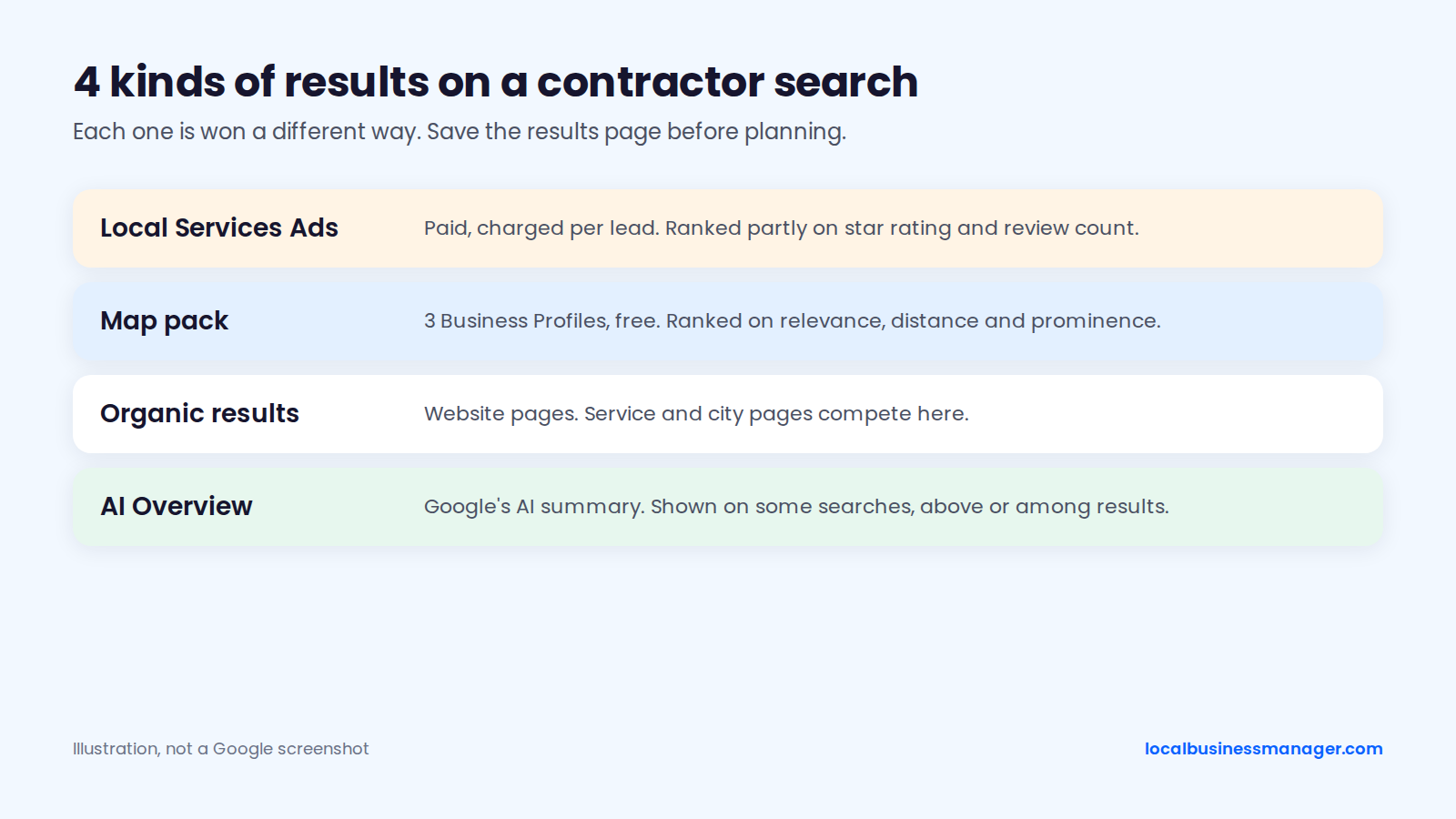
Before planning anything, search the client's top 3 service-plus-town phrases and save each results page. A contractor search can show 4 kinds of results, and each is won a different way:
Result type | Paid or free | How it's won |
|---|---|---|
Local Services Ads | Paid, charged per lead | Star rating, review count and other ad factors. Boomcycle reports they push the map pack down the page. |
Map pack | Free | Relevance, distance and prominence. Google says nobody can pay for a better local ranking. |
Organic results | Free | Website pages. A 2023 Local Search Forum discussion found service-plus-city pages help here but do little for the map pack. |
AI Overview | Free | Google's AI summary, covered in its own section below. |
Google ranks local results mainly on 3 factors, relevance, distance and prominence, according to its help page on how local ranking works. Distance is how far the business is from the location in the search, or from the searcher if the search names no place.
The service areas a contractor lists don't change where it ranks, according to Sterling Sky's 2023 tracking. One 2024 industry estimate puts most businesses ranking within roughly 1 to 5 miles of the verification address, depending on competition and optimization. That figure is an estimate rather than a measurement.
How Do Contractors Choose Local Keywords?
Contractor keywords follow 5 patterns, and each one belongs to a different page. Map every keyword the client wants to a page before writing anything, so 2 pages never compete for the same search.
Query type | Example | Page that should rank |
|---|---|---|
Service + town | "electrical panel upgrade Plano", "kitchen remodel Frisco" | The service page, plus a city page once one passes the test below |
Near me | "electrician near me", "remodeling contractor near me" | The Business Profile and the homepage |
Emergency | "emergency plumber", "roof leak repair today" | The service page, with a tap-to-call number at the top |
Cost and research | "roof replacement cost", "do I need a permit for a deck" | A cost guide or the service page's FAQs |
Trust | "best roofer Plano", "[business name] reviews" | The About page, project pages and the Business Profile |
Google Keyword Planner shows search volume only as ranges unless an ads account is spending, so use it to compare terms, not to forecast. The saved results pages are the real test: if the map pack shows for a term, the profile does most of the work; if it doesn't, a page has to.
How Should a Contractor Set Up a Google Business Profile?
Set up a contractor's Google Business Profile (formerly Google My Business) in 3 steps: the address and service areas, verification, then the name. Each step has a Google rule behind it, and practitioners tie mistakes at each step to suspensions.
Step 1: Set the Address and Service Areas
Google's guidelines for representing your business say a service-area business that doesn't serve customers at its address should hide it. The same guidelines rule out a virtual office unless it's staffed during business hours. Search Engine Land (2023) lists further address violations: P.O. boxes, UPS boxes, coworking addresses, and a home address shown without signage or customer visits.
In a 2023 Sterling Sky test, a profile's rankings and calls dropped after its address was hidden, then recovered when it was shown again. Another practitioner disputes this and says he's unconvinced that showing or hiding the address is a ranking factor.
The suspension side is clearer. The 2026 Local Search Ranking Factors survey of 47 local SEO practitioners lists a shown address on a service-area business as the #11 suspension risk factor. Follow the rule: hide a home base, and show only a real, staffed shop that customers visit.
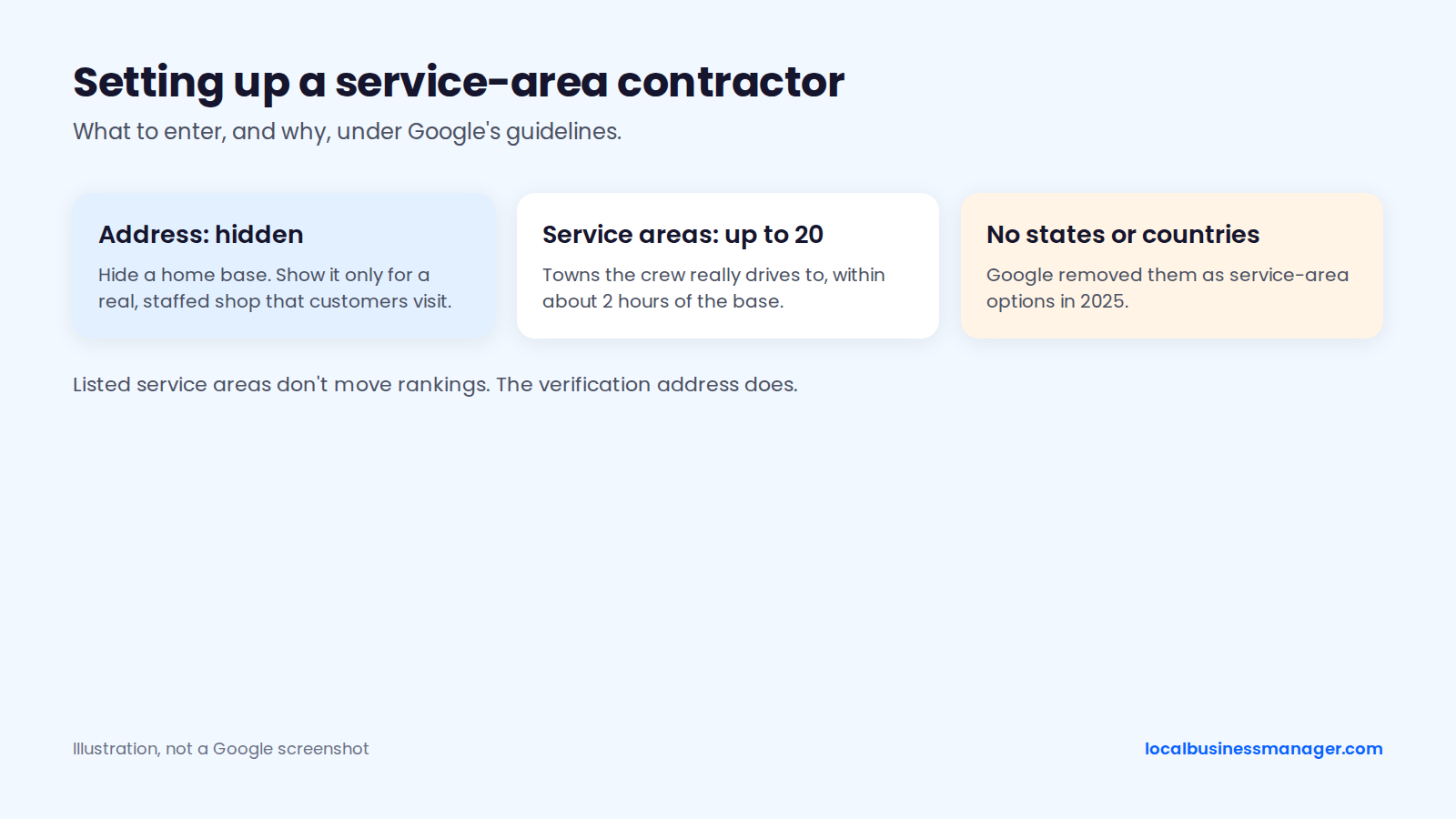
Google allows up to 20 service areas within about 2 hours' driving time of the base. A 2025 change reported by PPC Land removed whole states and countries as options. List the towns the crew really drives to. A far-off city won't add rankings: Sterling Sky's hidden-address profile in Uxbridge lists Toronto and has never ranked there.
A contractor with more than one real, staffed location gets one profile per location, never one per service town. A profile for a town where nobody works is the virtual-office problem Google's guidelines already rule out.
Step 2: Get Through Verification
Verification methods vary by profile, and video is common for service-area businesses. A 2026 Google Business Profile Community guide covers what the video should show. Volunteer Product Experts wrote the guide, and Google hosts it on its own site. It says the video should be one continuous recording showing where the business is based, that it operates and that you manage it.
The same guide describes moving from a street sign or building number to the work vehicle, tools or workspace. It also warns against staging a temporary storefront. A 2025 community guide says video verification is done on a mobile phone, and it lists a live video call with a Google representative as another method.
Step 3: Use a Business Name You Really Use
Google's guidelines require the business's real-world name on the profile. Adding keywords to a name the business doesn't use is a suspension risk, and competitors can report it. The same 2026 survey ranks keyword stuffing in the profile name as the #8 suspension risk factor. Yet a 2026 study of more than 1.4 million listings across 17 industries found keyword names correlate with top-3 local pack visibility.
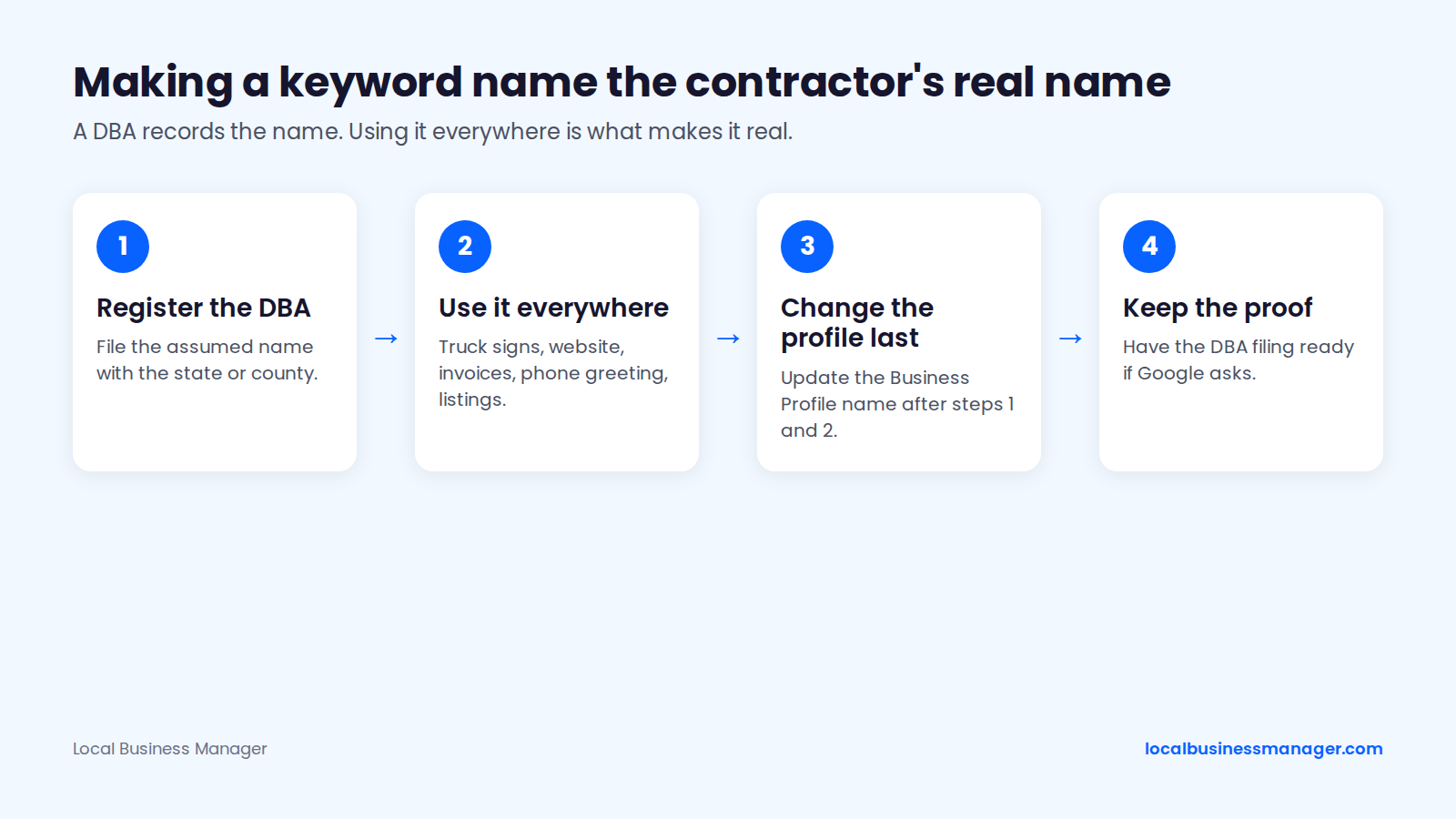
I recommend a keyword name, but only once it is the business's actual name. In the personal-injury markets I worked in, the most common reasons a firm missed the 3-pack were an unoptimized name and too few new reviews. Do it in this order:
- Register the DBA (assumed name).
- Use that exact name on truck signage, the website, invoices, the phone greeting and other listings.
- Change the Business Profile name last.
- Keep the DBA filing ready in case Google asks for proof.
A DBA alone doesn't make a name compliant. Google judges the name the business really uses, and it can still challenge or suspend the profile.
Which Google Business Profile Categories Should Contractors Choose?
Make the core trade the primary category. Add secondary categories only for other work the business really sells. Google's guidelines ask for categories as specific as possible while still representing the main business, and for as few as possible to describe the core business.
Practitioners rate the primary category as the strongest setting on the profile. The same practitioner survey ranks it the #1 local pack factor, according to a GMBapi.com summary. Google gives no rule for choosing by revenue or by search demand. My rule is to use the primary category most ranking competitors use, checked like this:
- Search the client's main service-plus-town terms and note the primary categories on the top profiles.
- Use the category most of the ranking competitors use.
- If Google clearly rewards a different category than the "logical" one, use that one. It must still accurately describe the client's core business, as Google's guidelines require.
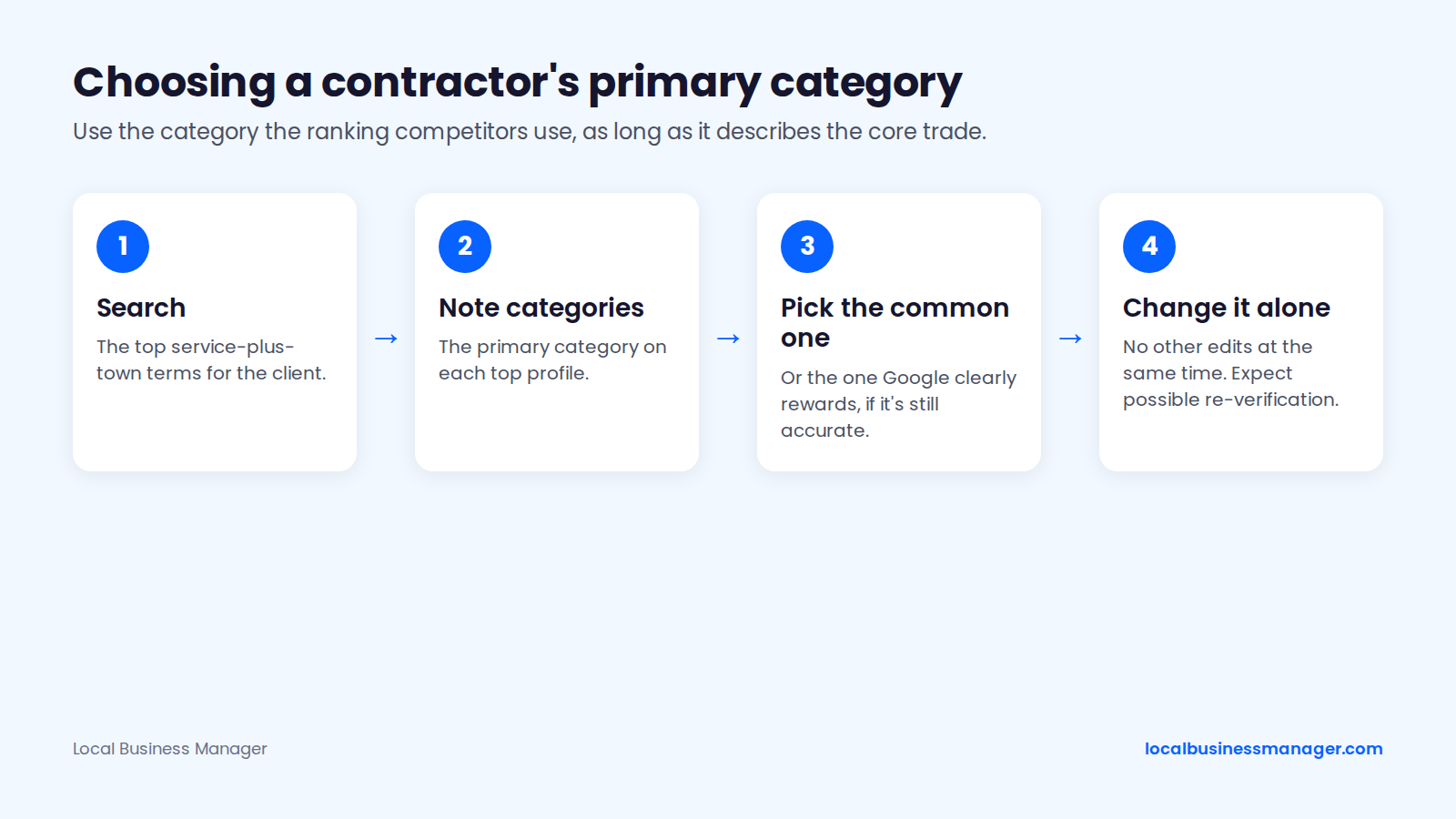
Make the change on its own, not alongside other edits. Sterling Sky says a primary category change can count as a major edit, and DAC Group reported category changes triggering re-verification.
Related secondary categories add reach. In Sterling Sky's 2020 tests, adding related secondary categories didn't hurt rankings and lifted rankings for those categories' keywords. In a January 2019 industry test, unrelated categories caused a sizable drop that reversed once they were removed.
Use these trade pairs as starting points. Each name appears in published US category lists as of November 2026, but Google changes the list, so confirm it in the live picker before you set it, and add the secondary only if the business does that work:
Trade | Primary category | Secondary (only if sold) | When to add the secondary |
|---|---|---|---|
Roofer | Roofing contractor | Gutter cleaning service | Customers hire the business for gutter work on its own, not only as part of a roof job |
Plumber | Plumber | A second trade the business sells | The business takes jobs in that trade by itself |
HVAC company | HVAC contractor | Air conditioning repair service | Repairs are a large share of calls |
HVAC and plumbing | The trade top competitors use as primary | The other trade | Always, if both trades are sold |
Electrician | Electrician | Another electrical service the business sells | Only for separate work, not a task inside every job |
General contractor or local builder | General contractor | Remodeler | The business sells remodels as stand-alone jobs |
Remodeler | Remodeler | Kitchen remodeler | Kitchens are a regular, separately sold job |
The same method works for painting, concrete, flooring and landscape contractors: check the primary category on the top-ranking profiles for the client's main service-plus-town search, and confirm the name in the picker. Don't copy a category label from a blog, including this one, without that check.
In the Services section, list only services the business performs. Give each a plain description, such as "Roof leak repair: inspection and patching for shingle and flat roofs."
How Do Contractors Get More Google Reviews Without Breaking the Rules?
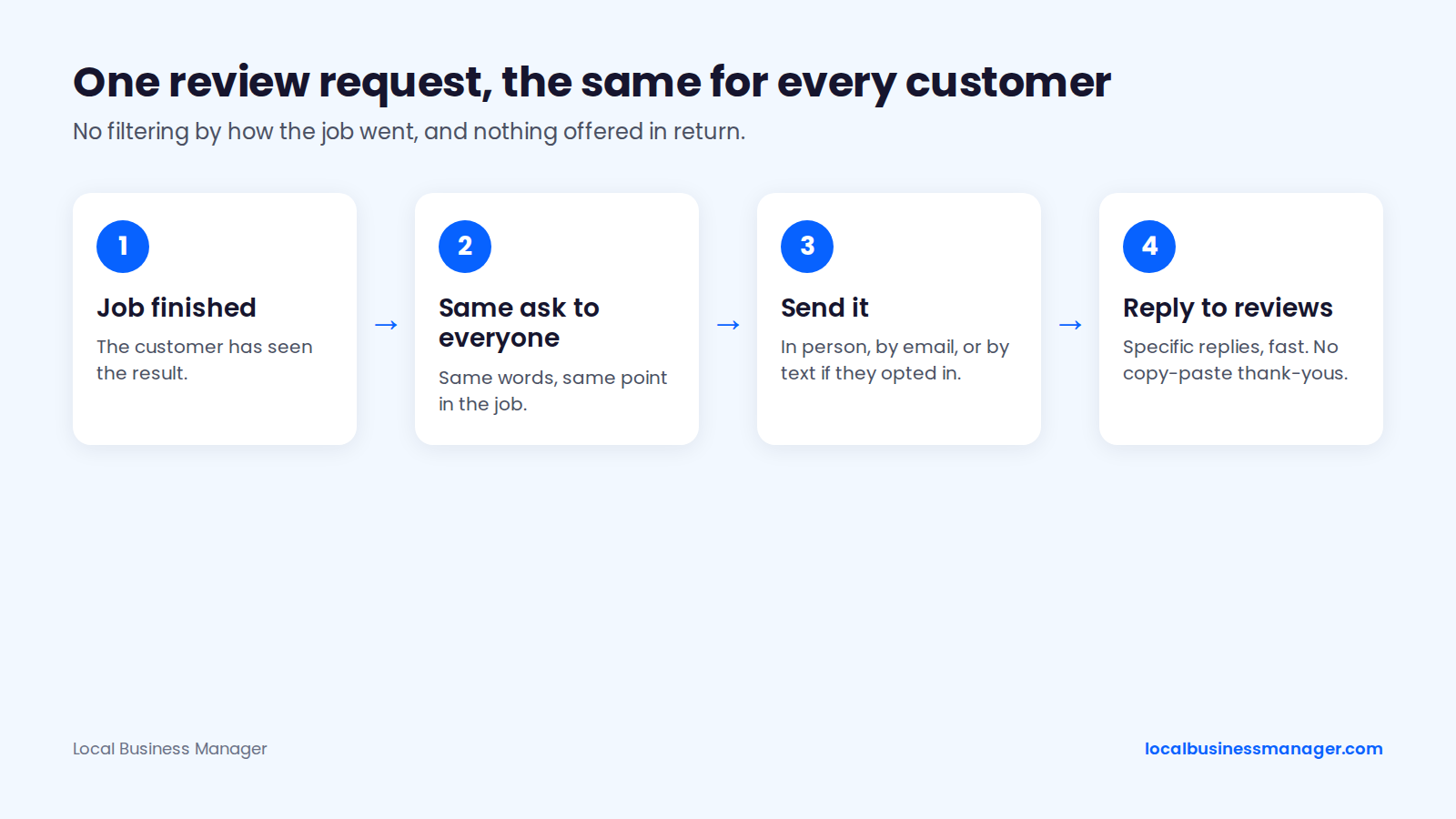
Ask every customer the same way at the same point in the job, and never reward anyone for a review. A steady, unfiltered flow of reviews stays inside Google's policy and the FTC's rule, and Sterling Sky's observations, below, favor a steady pace over bursts.
When and How to Ask
Ask when the job is finished and the customer has seen the result. The easiest way to ask everyone is to trigger the request from the job software when a job is marked complete, then send one reminder a few days later to anyone who hasn't left a review. 5 rules keep the system compliant:
- Ask everyone. Google's policy prohibits selectively soliciting positive reviews, which is known as review gating.
- Offer nothing in return. Google's Prohibited and restricted content policy for Maps bans offering payment, discounts or free goods and services in exchange for reviews. The FTC's final rule on fake reviews took effect October 21, 2024, and bans rewards that depend on a review's sentiment and suppressing reviews through threats.
- No reviews from employees. The same FTC rule covers undisclosed insider reviews.
- Text only customers who opted in to receive texts.
- Ask for Google, not Yelp. Yelp's "Don't ask for reviews" support page tells businesses not to solicit reviews, so let Yelp reviews come on their own.
Sterling Sky's 2025 "18-Day Rule" says rankings can fall off a cliff if a listing goes about 3 weeks without a new review. That rule is one agency's observation, not a controlled study. Bursts carry risk too: Sterling Sky reports that since mid-2025, Google has removed suspicious reviews and appears to hold back new ones for about 30 days.
Review Request Scripts You Can Copy
Use the same wording for every customer, so nobody is selected. Each script also invites a photo of the finished job, which shows the work to the next homeowner:
- In person: "We ask every customer for an honest Google review, good or bad. Can I text or email you the link? A photo of the finished job is welcome too."
- Text (opted-in customers only): "Hi [Name], it's [Your name] at [Business]. We ask every customer for an honest Google review of the [job]: [link]. Photos of the finished job are welcome. Reply STOP to opt out."
- Email: Subject "How did your [job] go?" Body: "Thanks for choosing [Business]. We ask every customer for an honest Google review, whatever the experience: [link]. If you'd like, add a photo of the finished job."
How to Respond to Negative and Fake Reviews
Reply quickly and specifically. A local SEO software company surveyed 1,002 US adults for a consumer review survey published in February 2026. It found 32% of consumers want a reply by the next day, and 81% expect one within a week. Google's help page calls replying a best practice but advises against sending everyone the same thank-you.
Reply to every review that has text, and write each reply for that review: Google advises against sending everyone the same thank-you. Put the most effort into reviews where you can share an update or answer a question. The reviewer is notified of your reply and can still change the review afterward. Start from these 3 templates:
- Positive: "Thanks, [Name]. Glad the [job] in [town] went smoothly. I'll pass this on to [tech]."
- Negative: "[Name], I'm sorry the [job] fell short. Please call me at [number] so I can make it right."
- Suspected fake: "We can't find a job under this name. If we worked for you, please call [number] so we can sort it out."
For reviews that break Google's policies, see our guide to deleting Google reviews.
What Should a Contractor's Service Pages Include?
Each service the business sells needs its own page before any city page exists. A service page that converts names the service and main town in the H1, then covers what's included, how the job runs, the area served, common questions and a call to action with the phone number.
Project Pages Feed Everything Else
A project page documents one real job: the town, the scope, the problem solved, how long it took and photos taken with the owner's permission. Link it to the matching service page and, later, to the city page. Project pages matter most for remodelers and builders, whose jobs differ more from one to the next than repair work does.
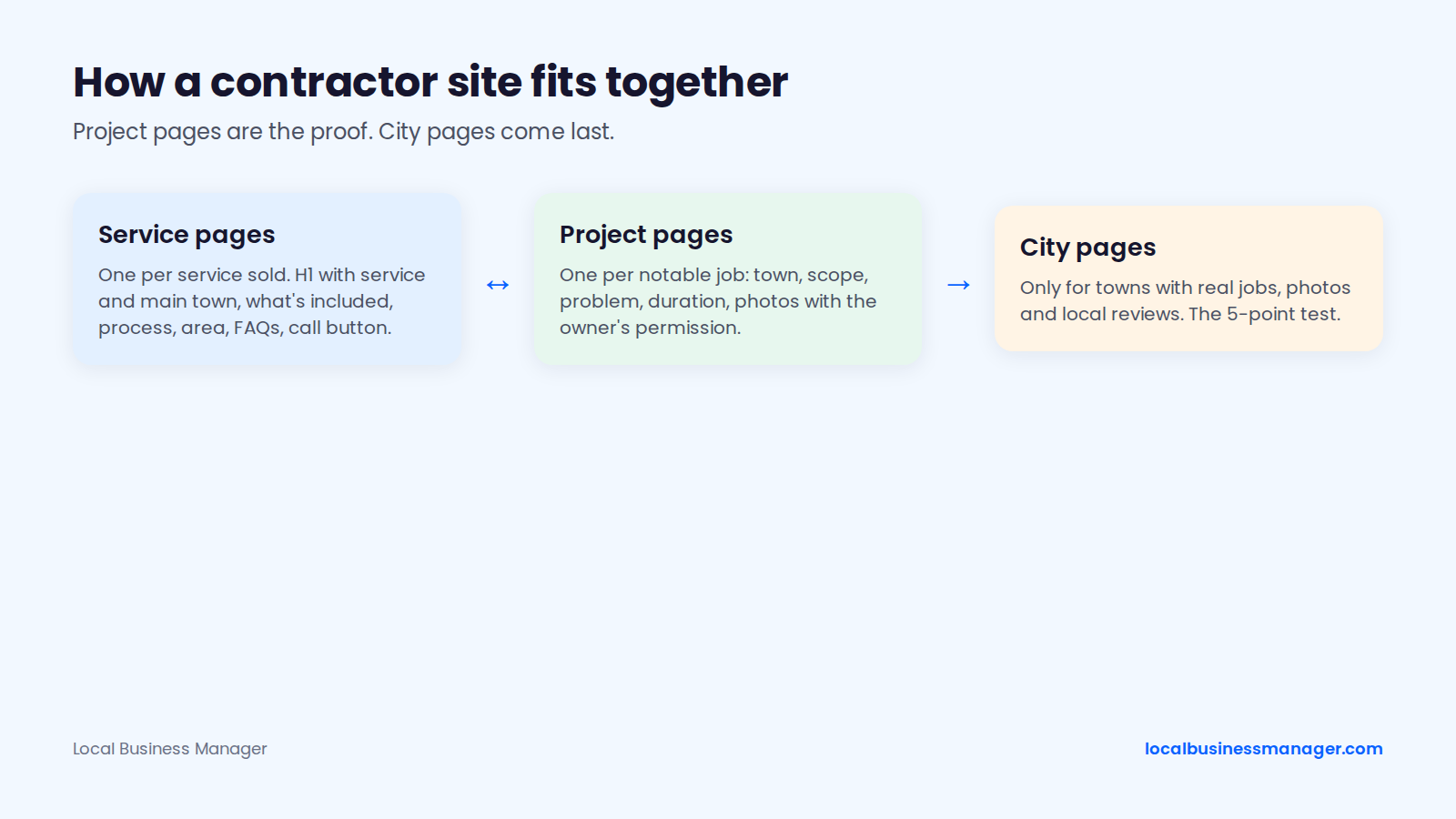
Project pages are also what make a city page possible. The 5-point test in the next section asks for real jobs, photos and reviews from the town, and project pages are where that proof lives.
Mobile Basics and Licence Details
A homeowner who taps through from the map pack lands on the site on a phone, so check it on one:
- Put a tap-to-call number in the mobile header, not only in the footer.
- Read a service page on a phone without zooming, tap the call button and submit the form.
- Compress project photos before upload, so galleries don't slow the page.
Show licence and insurance details on the site. Some states require the licence number in advertising: California's Contractors State License Board, for example, says the requirement covers websites and online listings. Check the rule in each state the client works in; this is marketing guidance, not legal advice.
Should Contractors Build a Page for Every City They Serve?
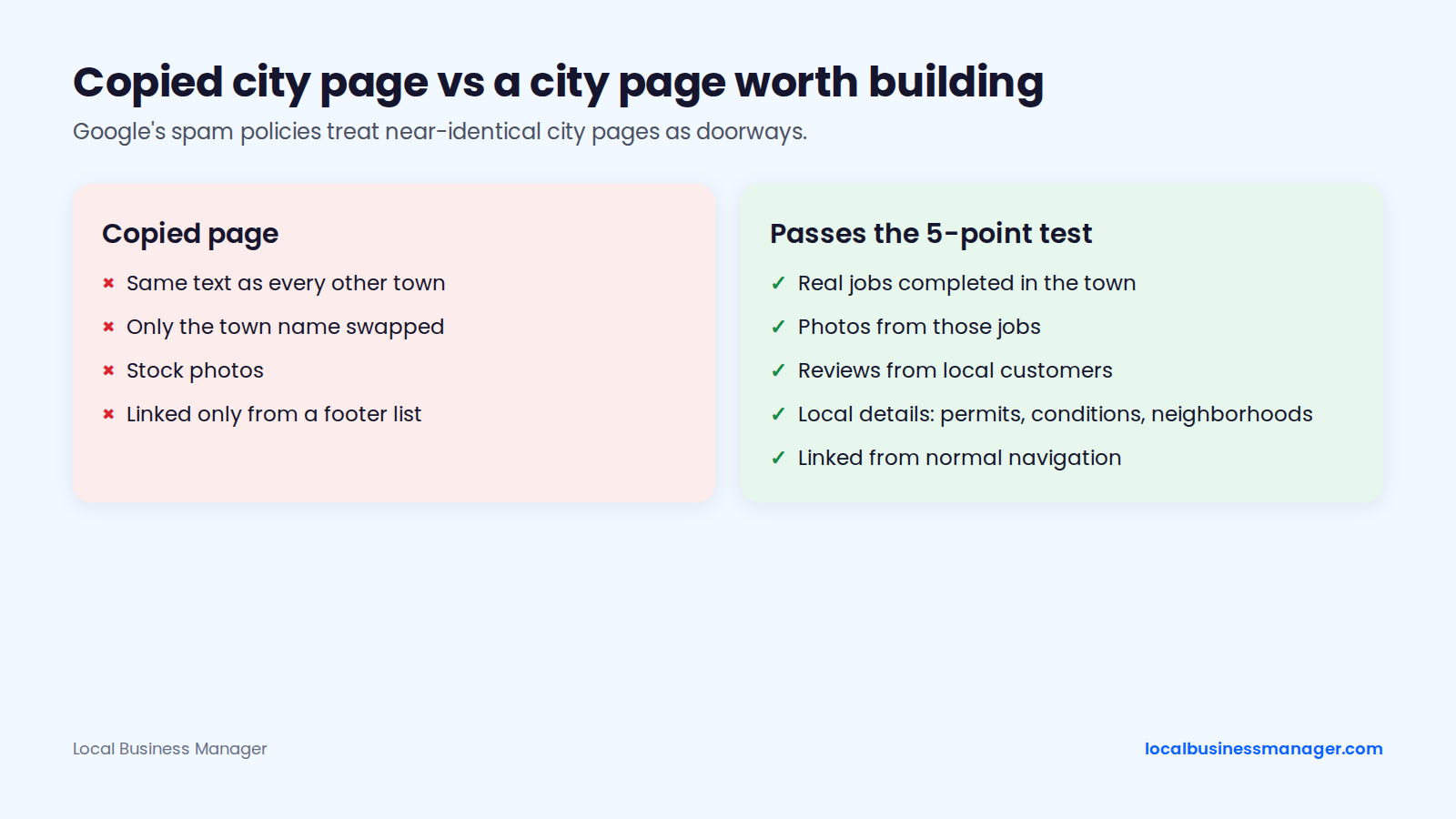
No. Build one strong page per service first. Then add a city page only where the business has done real work and has something local to show. Google's spam policies treat near-identical city pages as doorways, and they do little for the map pack anyway.
Google's spam policies name pages targeted at specific regions or cities that funnel users to one page as doorway abuse. In December 2019, Google's John Mueller said a plan for 1,300 keyword-plus-city pages "sounds like doorway pages, not something I'd recommend."
Since March 5, 2024, Google's scaled content abuse policy has also covered large numbers of pages made mainly to manipulate rankings. Sterling Sky found one service-area business whose 35 city pages averaged 84% matching content and still drove a lot of traffic and conversions. That is one example, and it doesn't show the pattern is safe.
Nobody publishes a safe page count. Build a city page only if all 5 of these are true:
- The business has completed real jobs in that town.
- You have photos from those jobs.
- You have reviews from customers in that town.
- You can add local specifics, such as permit notes, local conditions or neighborhoods served.
- The page is linked from normal navigation, not only from a footer list of every town.
Sterling Sky suggests customizing about 10% to 20% of each page with local reviews, job photos and landmarks, instead of rewording the same text. A page that passes needs:
- A title tag in the pattern Service in City | Business Name, such as "Roof Repair in Plano | [Business]"
- An H1 naming the service and town
- 2 or 3 recent local jobs with photos
- Local reviews and local details
- A tap-to-call number near the top
What Else on the Profile Actually Helps a Contractor?
Six smaller settings matter once the address, name and category are right: job photos, project posts, accurate hours, the description, attributes and a tagged website link. Google doesn't confirm photos or posts as local ranking factors. They help a homeowner choose you and let you track profile traffic, so keep every detail true.
- Photos: real job-site, crew and before-and-after shots. No stock images.
- Posts: finished projects with the town named, and offers only when they're real.
- Hours: emergency or 24/7 hours only if someone really answers the phone at those times.
- Description: what the business does, where and since when. Google's guidelines say no links of any kind and no focus on promotions or prices.
- Attributes: any that are true for the business, such as how customers can pay or book.
- Website link: add UTM parameters, such as
?utm_source=google&utm_medium=organic&utm_campaign=gbp, so GA4 separates profile visits from other traffic. Sterling Sky recommends tagging both the website and appointment links.
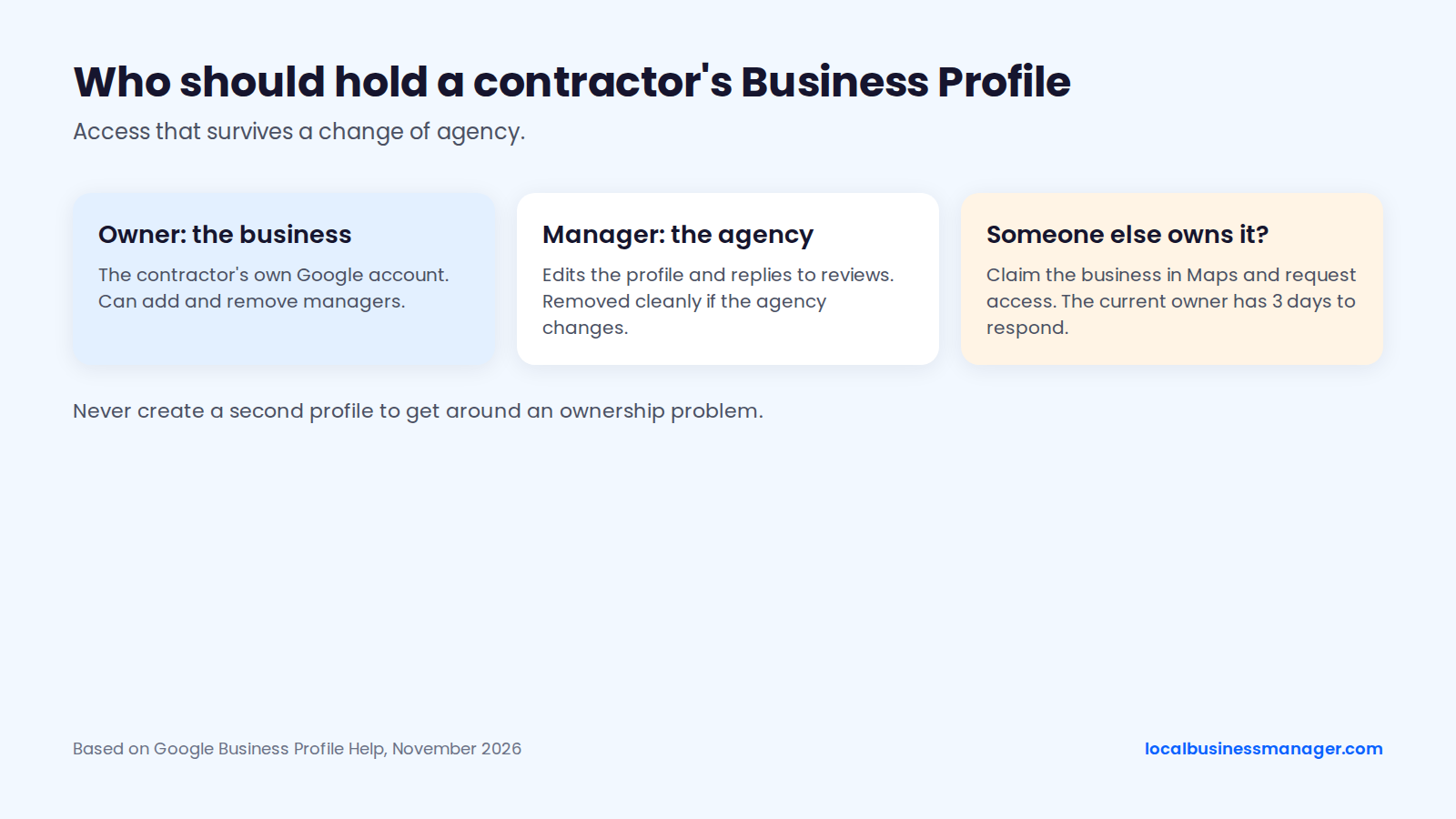
Agencies should also check who owns the profile. The business should be the owner, with the agency added as a manager, so access survives a change of agency. If an ex-employee or an old agency holds ownership, follow Google's "Request ownership of a Business Profile" help page: claim the business in Maps, request access, and the current owner has 3 days to respond. Don't create a second profile to get around it; duplicates split reviews and invite suspension.
Which Citations and Links Matter for Contractors?
Claim a short list of trade-relevant listings with the same name, address and phone as the profile, then earn links from the businesses already around the work. Practitioners agree listing consistency matters; how much citations add to rankings is debated, so treat them as accuracy work.
Google's AI Overview for this topic, checked in November 2026, named Houzz, BBB, Apple Maps and Bing Places among others. A short list for most trades:
Platform | Why it matters | Best for |
|---|---|---|
Apple Business Connect and Bing Places | They power Apple Maps and Bing, the main map apps outside Google | Every trade |
Data aggregators (Data Axle, Foursquare, Neustar Localeze) | They feed business data to many other sites and apps | Every trade, especially after a move or name change |
BBB | Named in Google's AI Overview for this search, and a common check for homeowners vetting a contractor | Every trade |
Angi and Thumbtack | Home-services marketplaces where homeowners hire trades | Repair and installation trades |
Houzz | A project-photo platform | Remodelers, builders and design-build firms |
Nextdoor | Neighborhood recommendations tied to the towns you serve | Trades that rely on word of mouth |
Trade association directory | Shows membership in the trade | Any trade with an association |
Local chamber of commerce | A listing tied to the town itself | Every trade |
Pick one exact format for the name, address and phone, such as "Ave" or "Avenue" and one main number, and use the profile's public details on every listing. Search for duplicate listings at the same time; merge or remove them, because duplicates split reviews and confuse the data sources above. If the profile hides a home address, the website and directories don't need to show it either. The full cleanup steps are in our citation audit guide.
Make sure no other business uses the same phone number, which Search Engine Land (2023) lists as a suspension risk. For call tracking, Sterling Sky puts the tracking number in the profile's primary phone field and moves the main number to an additional phone field; that tracking number is now the main source of call records, because Google ended Business Profile call history on July 31, 2024. The website, schema and every citation keep the main number, so the business's public details stay consistent.
For links, start with manufacturers, suppliers, associations and the local community. Don't buy them: Google's spam policies name buying or selling links for ranking purposes, and excessive link exchanges, as link spam. Good sources include:
- Manufacturer "find a pro" or certified-installer pages, if the business holds the certification
- Supplier pages that feature customers or projects
- Trade association member pages
- Local sponsorships, with the link marked rel="sponsored" or nofollow. Google's spam policies say paid links marked that way aren't a violation, and the sponsorship still puts the name in front of the town
- Local news coverage of notable projects
To find local sponsorship and membership pages, search for the town together with words such as "sponsors", "community partners" or "member directory", for example "Plano" inurl:sponsors. Pages that already list local sponsors show what a sponsorship there would include. Other searches in the same pattern:
"[town]" inurl:chamber-of-commerce inurl:members"[town]" intitle:sponsors"[town]" "community partners""[trade] association" "member directory" [state]
What Schema Should a Contractor Website Use?
Use the most specific schema.org subtype of HomeAndConstructionBusiness for the trade: Plumber, Electrician, RoofingContractor, HVACBusiness or GeneralContractor. HomeAndConstructionBusiness is a subtype of LocalBusiness, and schema.org has no "Contractor" type.
Fill the markup with the same name, phone, URL and service areas (areaServed) as the profile, and include a street address only if it's public. The example below shows a roofing contractor that serves several towns and hides its address.
{
  "@context": "https://schema.org",
  "@type": "RoofingContractor",
  "name": "[Business name]",
  "telephone": "[Phone]",
  "url": "https://www.example.com/",
  "areaServed": [
    { "@type": "City", "name": "Plano" },
    { "@type": "City", "name": "Frisco" },
    { "@type": "City", "name": "Allen" }
  ]
}
Validate the markup with Google's Rich Results Test and the Schema Markup Validator before publishing. Don't add review stars to your own business markup: since September 2019, Google hasn't shown self-serving review stars for LocalBusiness or Organization markup. Skip FAQ markup aimed at rich results too: Google removed FAQ rich results from Search in May 2026.
Do Local Services Ads Replace Local SEO for Contractors?
No. Local Services Ads are a paid placement, separate from the free map pack. Google says there's no way to request or pay for a better local ranking. I found no public test showing LSA spend moving a profile's position in the map pack.
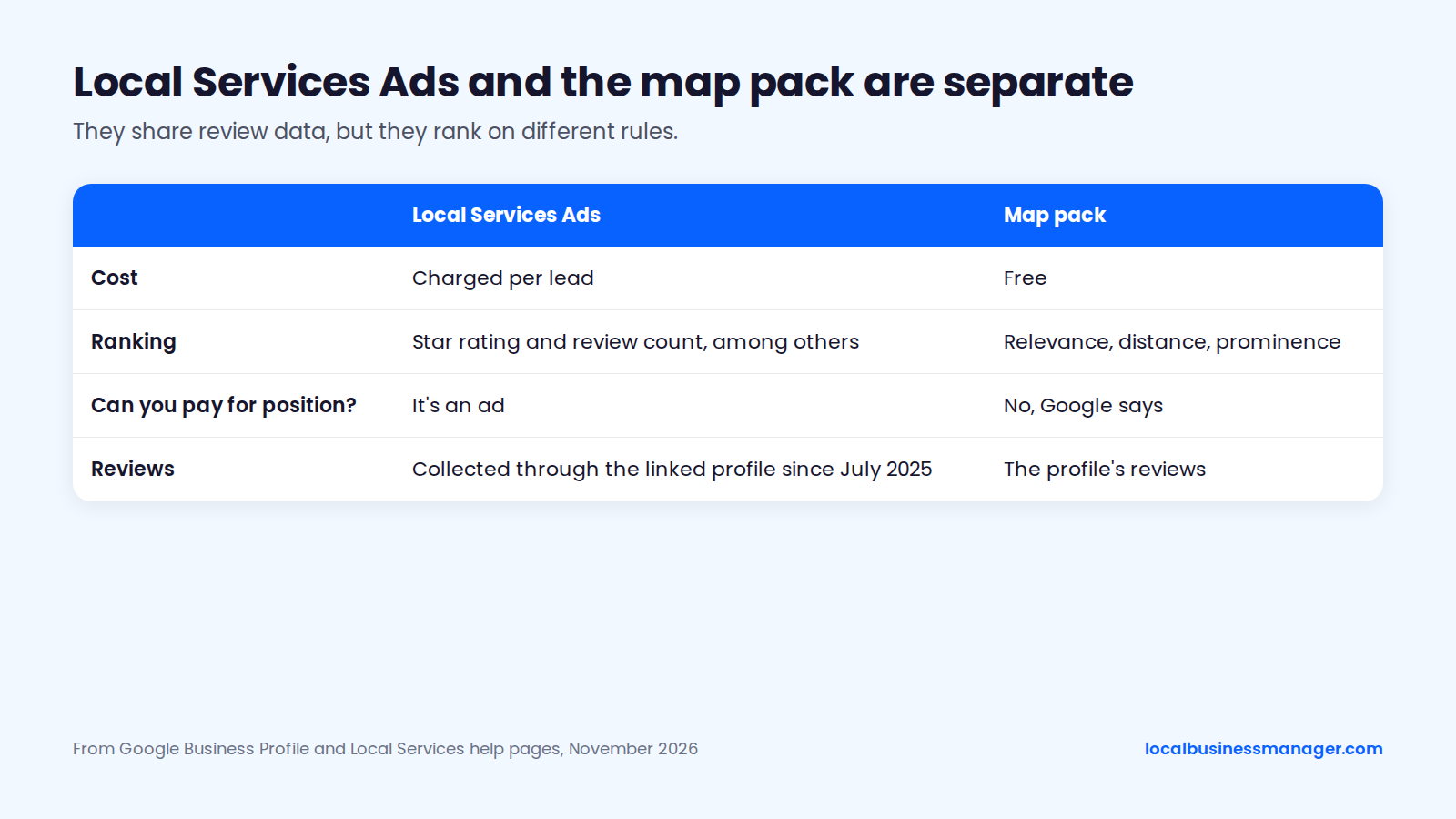
Local Services Ads and the map pack share Business Profile data, but they rank on different rules:
Factor | Local Services Ads | Map pack |
|---|---|---|
Cost | Charged per lead; Google's help page says advertisers pay only for relevant leads | Free |
Ranking | Star rating and review count, per Google's Local Services help | Relevance, distance and prominence |
Reviews | Since July 11, 2025, managed in and collected through the linked Business Profile, which LSAs now require (Search Engine Roundtable) | The profile's own reviews |
Badge | A single "Google Verified" badge replaced Guaranteed and Screened in October 2025 (Boomcycle) | None |
Bad leads | Google's help page still describes disputes; trade sources say they became automatic credits in mid-2024 | Not applicable |
Boomcycle advises running LSAs alongside map-pack SEO. I haven't managed LSAs for clients, so I'll leave it at what the sources say.
How Do You Keep a Contractor's Profile From Getting Suspended?
Prevent suspensions with a pre-edit checklist, and report spam competitors only through Google's own routes. Practitioners repeatedly name a handful of triggers, though nobody has published how often each one leads to a suspension.
The triggers that come up in practitioner reports:
- Core-field edits: changes to the name, address, phone or categories (Search Engine Land, 2023).
- Spam-heavy categories: edits in categories such as locksmiths and garage doors, which Sterling Sky (2026) says can trigger hard suspensions.
- Ineligible addresses: an address with no real physical presence.
- User edits: approved "Spam" or "Doesn't exist" edits from Maps users (Sterling Sky).
- Shared details: 2 businesses sharing one address or phone number.
Sterling Sky reviewed 50 keyword-stuffing cases in an older, undated study, with reader comments from 2018 to 2022. In those cases, Google sent a warning 60% of the time, a soft suspension 20% of the time and a hard suspension 20% of the time.
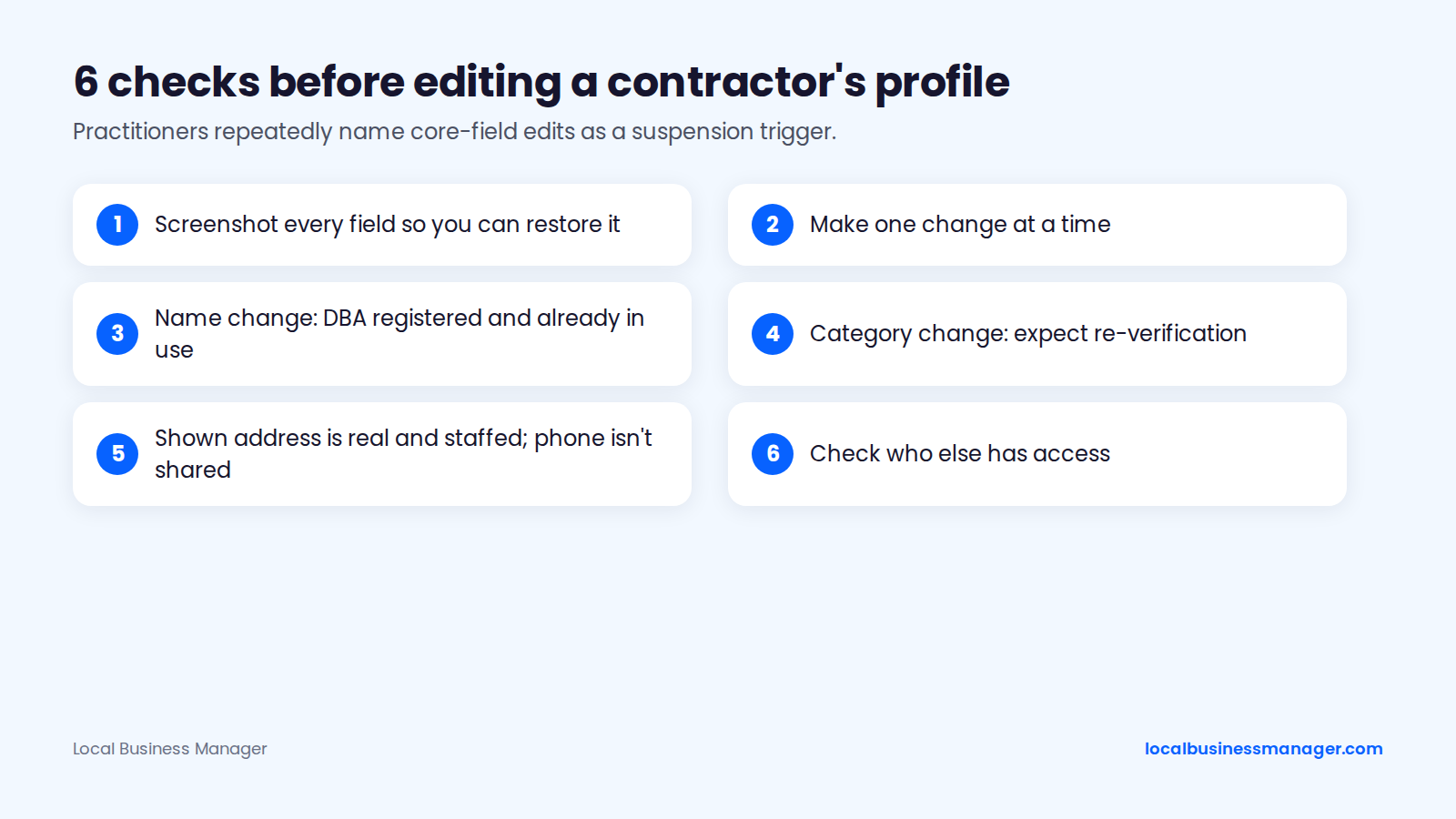
Before touching a contractor profile, run these 6 checks:
- Screenshot every field so you can restore it.
- Make one change at a time. Google says edits usually clear in about 10 minutes but can take up to 30 days.
- For a name change, confirm the DBA is registered and already used on signs, the website and invoices.
- For a primary category change, expect possible re-verification.
- Confirm any shown address is a real, staffed location, and that the phone number isn't shared.
- Check who else has access, so nobody edits the profile at the same time.
Sterling Sky (2024) says changing a service-area business's address is more likely to cause a suspension than creating a new profile, so it recommends a new profile when the business moves. FirstByte (2026) cites Google's edit page and recommends editing the address and re-verifying. Neither has published data showing which route is safer, so plan for re-verification either way.
For spam competitors, Google's help page on reporting misleading listings lists 2 routes. The first is Suggest an edit: choose "Place is closed or not here", then "Offensive, harmful, or misleading". The second is the Business Redressal Complaint Form, which Google recommends for names, phone numbers or URLs that look fraudulent. That form accepts 10 or more profiles at once.
Sterling Sky (2025) puts Redressal turnaround at about 2 weeks. Google says it removed or blocked more than 12 million fake profiles in 2024, and it removed over 10,000 listings run by one group impersonating locksmiths. Before reporting a keyword name, check whether the business really uses it on its signs and website.
If a client's profile is suspended anyway, start from Google's "Fix suspended or disabled profiles" help page. It routes appeals through the Business Profile appeals tool, where you pick the decision, upload evidence such as a business license or utility bill with a matching name and address, and submit. An appeal can be submitted only once, so gather the evidence first, and don't create a new profile for the same business.
How Do AI Overviews Affect Contractor Searches?
AI Overviews put a Google-written summary at the top of some searches, so a searcher can read part of the answer before clicking any result. Google showed one for "local seo for contractors" when this guide was researched in November 2026, and it named directories such as Houzz and BBB. Nobody outside Google can say exactly how AI Overviews pick sources, so put the effort into 4 basics you control:
- An accurate, consistent Business Profile, with a name, categories, service areas and hours that match the website.
- Clear service pages that say what you do, where you do it and who it's for.
- Reviews customers write in their own words about the job. Don't script what they say.
- Consistent listings on the platforms above.
If a client asks whether they show up in ChatGPT, ask it the questions their customers would ask, such as "best roofer in [town]", "who fixes roof leaks near [town]" and "[business name] reviews". Run the same prompts once a month, log whether the client is named and which sources are cited, and show the client the log. Don't promise placement.
What Should You Report to a Contractor Client Every Month?
Calls and rankings lead my monthly report. Website clicks, form fills and booked jobs belong in it too. Google's Performance report supplies most of the profile data, but rankings need more than one search point.
The KPIs That Matter to a Contractor
As of November 2026, the 7 numbers below cover a contractor report, in report order. They come from Google's Performance report help page, Sterling Sky and GA4. The caveat column is the note to write next to each number.
KPI | Where it comes from | Caveat |
|---|---|---|
Calls | GBP Performance report | Counts call-button taps, not connected calls |
Tracked calls | Call-tracking number in the primary phone field | The main source of call records since GBP call history ended |
Rankings across the service area | Rank checks from many points in the area | An average on its own is hard to read right now |
Website clicks | GBP Performance report | Includes Google Ads as well as organic |
Form fills and site calls | GA4 key events from the UTM-tagged profile link | Untagged links mix profile visits with other traffic |
Search terms | GBP Performance report (Searches) | Updates at the start of each month |
Booked jobs | Client's job records | Only the client has this number |
Leave out metrics that no longer exist, such as photo views and the old Direct and Discovery split. Google dropped them when the Performance report replaced Insights in 2023.
Why Rankings From One Spot Mislead
In my experience, a rank check from one address says little about how a contractor ranks across its service area, because local results change with the searcher's location. Most agencies have had the call: the client searched from their kitchen, and "we dropped." My rules:
- Check rankings from many points across the area, at least once a month.
- Run daily checks only after an edit, to see whether it produced a result.
- Don't report an average rank on its own. In my view, Google is mixing and reshuffling results as it fights automated data collection, so the results page is volatile and an average is hard to read with confidence right now.
Sterling Sky takes the opposite view on reporting rankings. It leaves rank tracking out of monthly reports because results are personalized and depend on where the searcher is. It uses grid checks for diagnosis instead: a scattered pattern of strong and weak points can point to filtering.
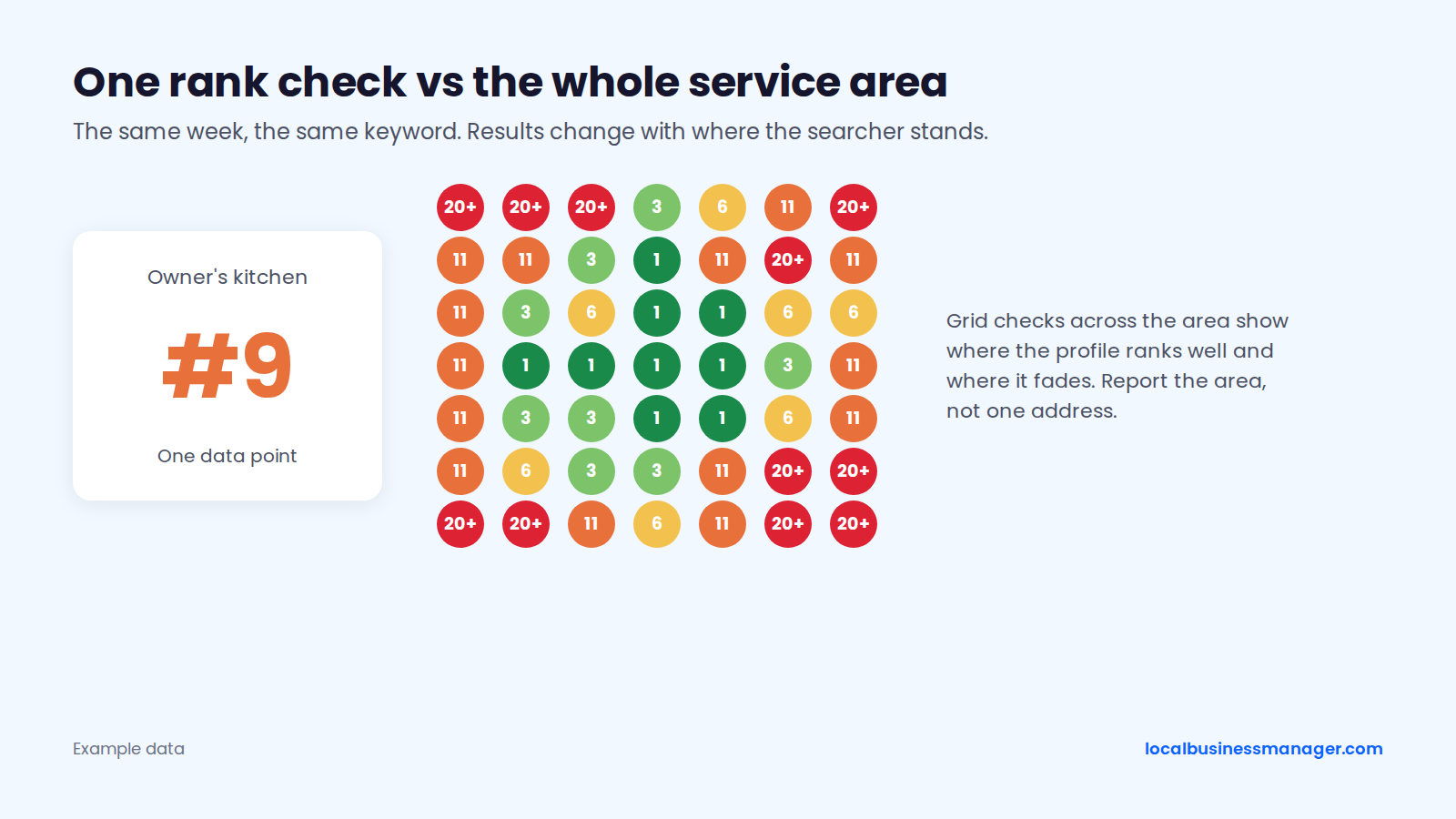
For the kitchen-check call, try: "Google's map results change with where the searcher is, so your search from home is one data point. Here's how the whole service area looks this month."
How Long Does Local SEO Take for a Contractor?
Google publishes no timeline for map pack rankings. In my experience, how fast rankings move depends on how much was already optimized. The fixed waits come from Google's help pages:
- Verification review: up to 5 business days, occasionally longer.
- Postcard codes: usually arrive within 14 days and expire after 30.
- Edits to a verified profile: usually about 10 minutes, up to 30 days.
The closest Google has come to an SEO timeline is a 2017 statement by Maile Ohye. She said that in most cases, an SEO needs 4 months to a year to make improvements and see the potential benefit. Her statement was about organic SEO in general, not the map pack.
In my experience, one high-impact fix on an under-optimized profile can show ranking gains within about a month. Moving to a DBA-backed keyword name is one example. Once the basics are done, further gains come gradually, for example from a strong review push.
What Does This Look Like for One Contractor?
Here is the plan applied to a fictional roofer, to show the order of work.
A 2-truck roofing company works from the owner's house in Plano. The profile hides the home address and lists Plano, Frisco, Allen and McKinney, all well inside a 2-hour drive. The top 3 profiles for "roof repair Plano" use Roofing contractor as their primary category, so the roofer does too. Gutter cleaning service goes on as a secondary because the company sells gutter cleaning as its own job.
Review requests go out from the job software on the day each roof is finished, with the same script for every customer. The website gets a page per service and a project page per notable job. After 6 months, the company has 7 finished jobs, photos and reviews in Frisco, so Frisco gets the first city page; Allen waits. The monthly report leads with calls and a grid view of rankings across all 4 towns.
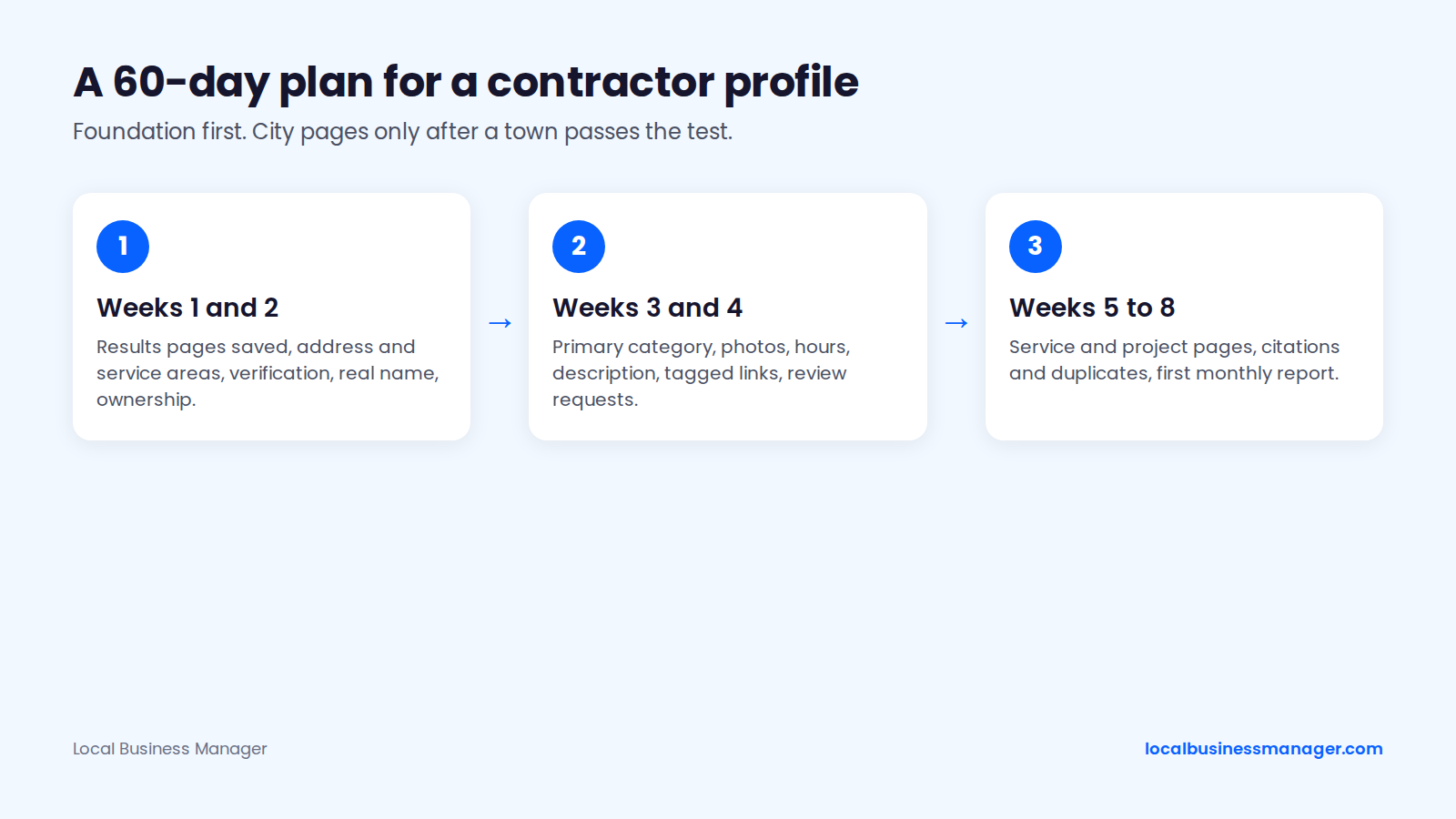
What Is a Realistic 60-Day Plan?
For an existing profile, run a local SEO audit first. Then work in this order:
Weeks | Work |
|---|---|
1 and 2 | Save the results pages for the top 3 service-plus-town searches. Hide the address unless customers visit a real, staffed location. Set up to 20 real service areas. Verify, and confirm the profile name is the name the business really uses. Fix ownership and access. |
3 and 4 | Set the primary category most ranking competitors use, as long as it describes the core trade, plus related secondaries. Add real photos, accurate hours, the description and UTM-tagged links. Start the review request from job software. |
5 to 8 | Build or fix one page per service and the first project pages. Clean up citations and duplicates. Send the first monthly report with calls and a grid view of rankings. City pages come only after a town passes the 5-point test. |
Which Parts Can a Contractor Do Without an Agency?
A contractor can handle the address and service-area settings, the review requests, photos, posts and most listings without outside help. Schema, city pages, grid rank tracking and suspension recovery are where agency or consultant time usually goes, because mistakes there are slower to spot and harder to undo. I won't quote prices: what a contractor pays depends on the market, the number of towns and how much of this list is already done.
Where to Start This Month
Start with the foundation: the address setting, the primary category and a name the business really uses, in that order, before any city page or listing. Then start asking for a review after every job, and keep it running. That order holds for any contractor SEO marketing plan, whatever the trade. If you're doing this across several contractor clients, Local Business Manager is in early access for agencies.