How to Run a Citation Audit: Agency Process and Audit Sheet Template

If you've just inherited a client whose old phone number is still on Yelp and whose suite number changes from site to site, the fix is a citation audit. It gives you one spreadsheet row per listing that shows the client's name, address and phone, with a status and a fix route on each. Citations carry less ranking weight than most guides claim, so sell the audit as accuracy work and tell the client exactly that. Below is the full process, with every sheet you need, a severity scale, fix routes for listings that won't change, and a script for the client call. The whole thing is also available as a free Google Sheets template.
What Is a Citation Audit, and What Counts as a NAP Citation?
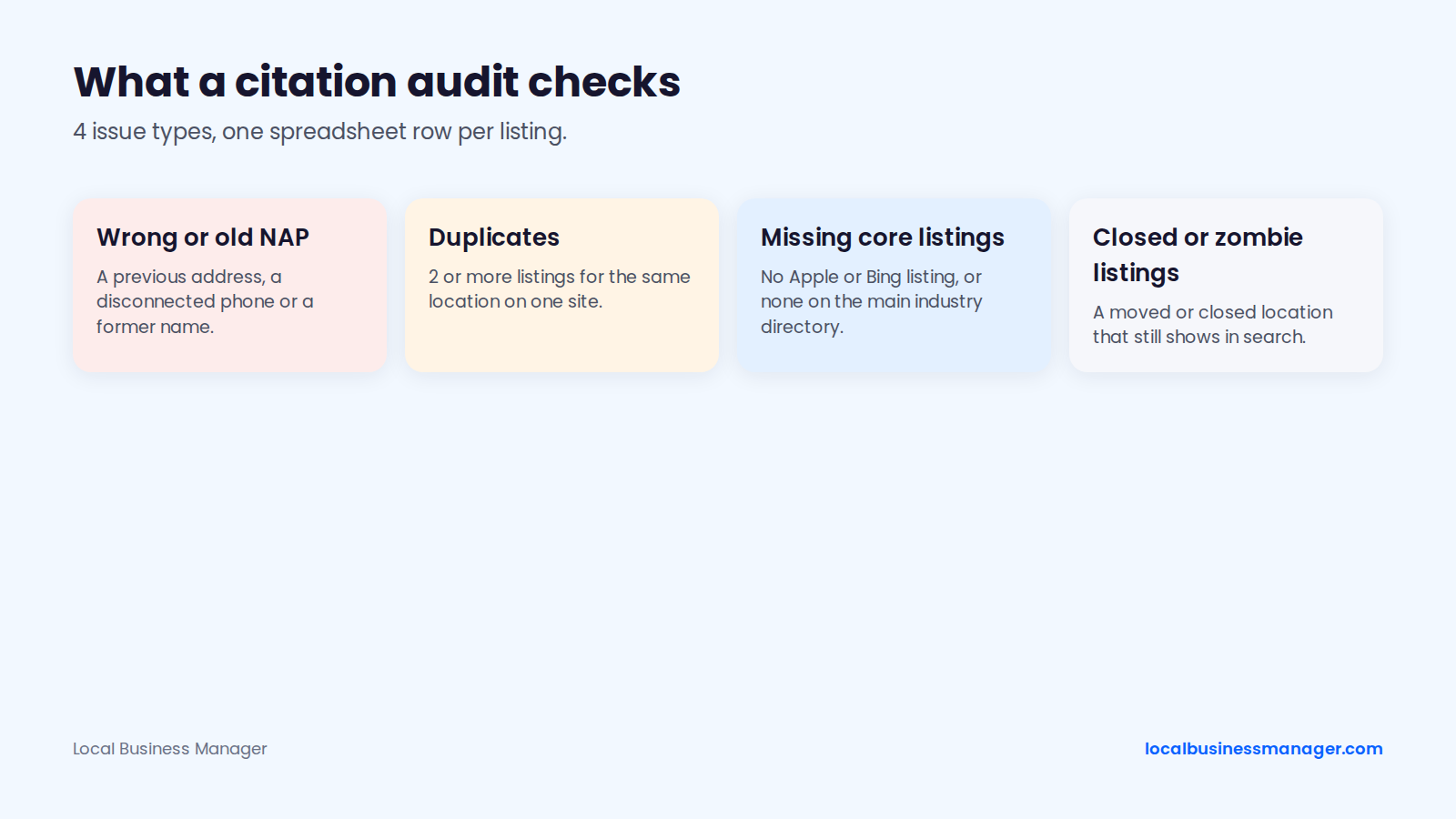
A citation audit is a check of every online listing that shows a business's name, address and phone number (NAP). It ends in a spreadsheet with one row per listing and a fix route for each problem. The audit looks for:
- Wrong or old NAP: a previous address, a disconnected phone number or a former firm name.
- Duplicates: 2 or more listings for the same location on one site.
- Missing core listings: for example, no Apple or Bing listing, or no listing on the main directory for the client's industry.
- Closed or zombie listings: pages for a location that moved or shut down but still show in search.
A NAP citation is any online mention of a business's name, address and phone number, with or without a link to its website. Structured citations sit in directory fields, such as a Google Business Profile, Yelp, Bing Places or Facebook.
Unstructured citations are mentions in free-form content such as news stories, blog posts and event pages. Unstructured citations usually carry some or all of the NAP, and many have no link.
How Much Do Citations Still Matter for Local Rankings?
Citations matter less for local pack rankings than most guides say, but the evidence isn't one-sided. Experts in the main industry ranking-factors survey rate citations a small and shrinking factor. Correlation data from a local SEO software vendor and their possible role in AI search keep them worth cleaning up.
What the Ranking-Factor Surveys and Tests Say
The 2026 Local Search Ranking Factors survey, published November 2025, asked 47 local SEO practitioners to score 187 factors. Its report says citations have been losing ranking importance for a decade. The survey measures expert opinion. Google publishes no ranking weights.
Evidence on citation volume disagrees. Sterling Sky's 2025 test found that few new citations stayed indexed and that they had little impact on pack rankings. A 2026 correlation study by a local SEO software vendor found top-3 rates rising with citation counts up to about 20, and argues the expert survey underrates citation quantity. The survey organizer's 2024 statement in the table is about consistency, a separate question from volume.
Source | Date | Evidence type | Question it addresses | Finding |
|---|---|---|---|---|
Local SEO software vendor study | September 2026 | Correlation across 16,098 profiles | Citation volume | Profiles with 21 to 50 citations reached the top 3 19.9 points more often than those with 1 to 5, leveling off around 20 citations. |
Local Search Ranking Factors survey | November 2025 | Survey of 47 experts | Citation weight overall | Citations have lost ranking importance for a decade. Of the top 5 AI search visibility factors, 3 are citation factors. |
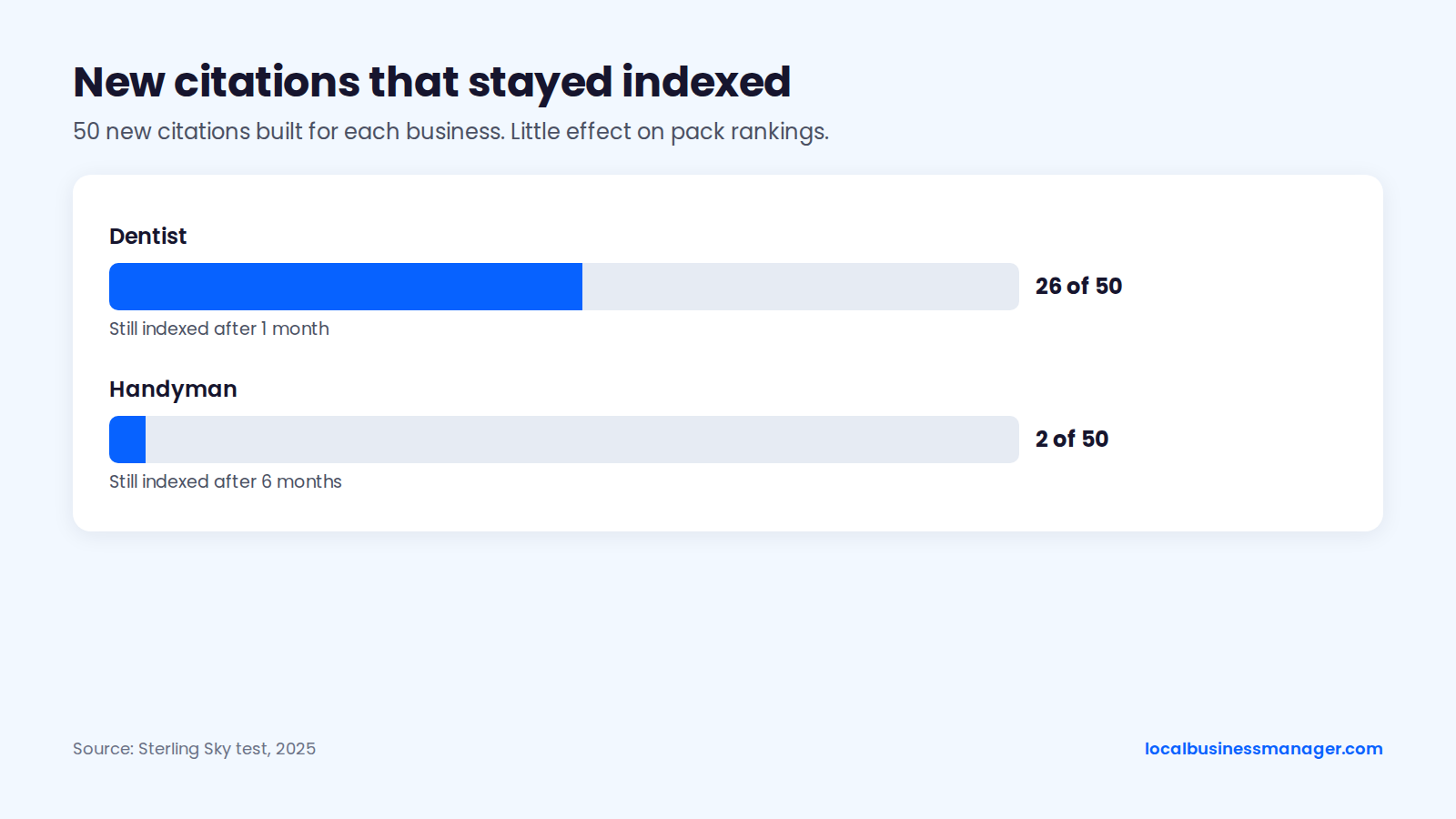
Sterling Sky test | 2025 | Test of 50 new citations per business | New citations | For a dentist, 26 of 50 were still indexed after 1 month; for a handyman, 2 of 50 after 6 months. Little impact on pack rankings. |
Sterling Sky review | 2025 | Paid citation subscription | Paid citation volume | Only 3% of the managed citations were indexed by Google. |
Survey organizer | February 2024 | Practitioner statement | NAP consistency | For rankings, consistency hasn't mattered in over a decade, because Google matches partially correct citations. It still matters for customers and verification (see below). |
Sorted newest first. The September 2026 figure is a correlation measured by a company that sells local SEO software, not a controlled test.
Google's own page on how to improve your local ranking says prominence draws on information from across the web, such as links, articles and directories. The page gives no weight for any of them.
Why Consistency Still Matters Beyond Rankings
Accurate citations are still worth fixing for reasons that have nothing to do with pack weight:
- Customers act on what they find. The clearest sign a cleanup is overdue is customers calling old phone numbers, or maps sending them to an old location.
- Clean citations back up the profile. Practitioners report that Google cross-checks a profile's address against business documents and other listings during verification. Consistent citations are the paper trail behind an address change or a reverification.
- AI answers may draw on them. The 2026 survey finds that 3 of the top 5 AI search visibility factors are citation factors. Its organizer said on a legal-marketing podcast (November 2025) that his extra focus on citations is "an AI thing, it's not a local thing." Use that point with clients as a reason to keep listings accurate, and keep it out of any ranking promise.
What Do You Need Before You Start?
Before searching for a single listing, set up the master NAP style sheet and decide which formatting differences count as errors. Then collect every old name, address and phone, decide where a call tracking number goes, and get access to the core listings. Skip these and the audit sheet fills up with rows nobody can mark right or wrong.
Build the Master NAP Style Sheet
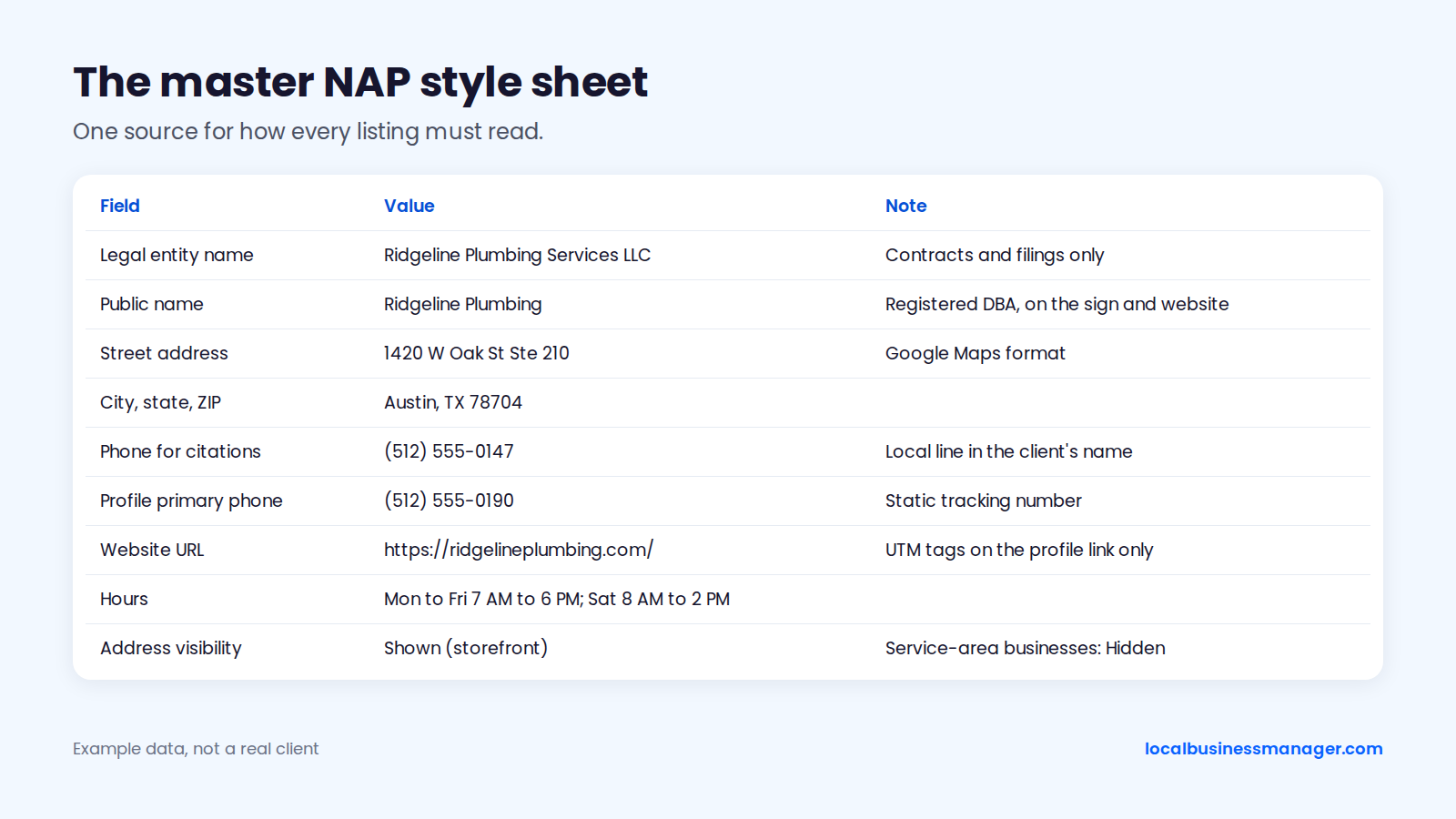
The master NAP style sheet is the single document that says exactly how the client's name, address, phone, website and hours are written everywhere. Use the address format Google Maps shows for the location as the reference.
Here are the style sheet fields filled in for a fictional plumber (Example data), ready to copy into the first tab of a Google Sheet:
- Legal entity name: Ridgeline Plumbing Services LLC (contracts and state filings only)
- Public name on every listing: Ridgeline Plumbing (registered DBA, matches the sign and website)
- Street address: 1420 W Oak St Ste 210 (copied from the Google Maps format; must be a real location the business operates from, never a PO box or virtual office)
- City, state, ZIP: Austin, TX 78704
- Primary phone for citations: (512) 555-0147 (local line in the client's name)
- Business Profile primary phone: (512) 555-0190 (static tracking number, see the call tracking section below)
- Website URL: https://ridgelineplumbing.com/ (no www, with trailing slash; UTM tags only on the Business Profile link)
- Hours: Monday to Friday 7:00 AM to 6:00 PM; Saturday 8:00 AM to 2:00 PM
- Address visibility: Shown (storefront). Service-area businesses record "Hidden" here.
For the name, Google's guidelines for representing your business say the name should reflect the business's real-world name, as used consistently on its storefront, website and stationery, and as known to customers. The style sheet's public name is therefore never a string of service keywords the business doesn't actually use. If the client wants a name that includes its service, follow the rebrand order further down.
Which NAP Formatting Differences Actually Matter?
Formatting differences such as "St" vs "Street" or "Ste" vs "Suite" probably matter much less than a different phone number, address or business name. That reading rests on the survey organizer's 2024 statement that Google matches partially correct citations to the business. You don't need to avoid abbreviations. Pick one form, record it in the style sheet and use it on every listing you control.
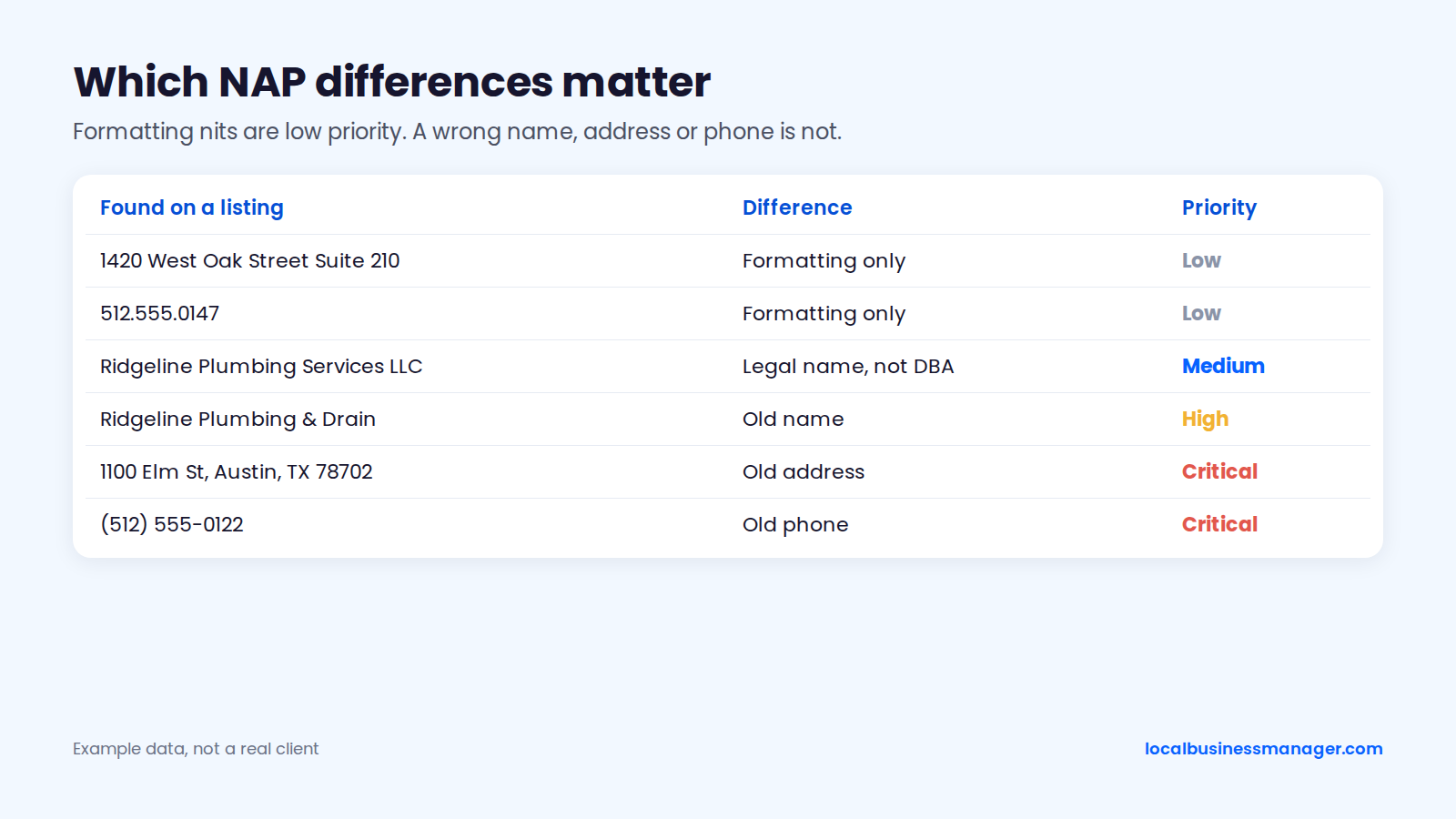
Of the 8 variants below, 4 are formatting-only and the other 4 point customers or Google at the wrong place, number or name.
Variant found | Style sheet version | Type of difference | Fix priority |
|---|---|---|---|
1420 West Oak Street Suite 210 | 1420 W Oak St Ste 210 | Formatting only | Low |
1420 W Oak St #210 | 1420 W Oak St Ste 210 | Formatting only | Low |
512.555.0147 | (512) 555-0147 | Formatting only | Low |
http://www.ridgelineplumbing.com | https://ridgelineplumbing.com/ | Formatting only, if it redirects | Low |
Ridgeline Plumbing Services LLC | Ridgeline Plumbing | Legal name instead of DBA | Medium |
Ridgeline Plumbing & Drain | Ridgeline Plumbing | Old business name | High |
1100 Elm St, Austin, TX 78702 | 1420 W Oak St Ste 210 | Old address | Critical on a core listing |
(512) 555-0122 | (512) 555-0147 | Old phone number | Critical on a core listing |
Example data, sorted from least to most serious.
Collect Old Names, Addresses and Phone Numbers
An audit needs every NAP the business has ever used, because old listings are found by searching old data. Econsultancy (2019) also warns that corrected listings can revert, or be re-copied from old, wrong data.
Ask the client, and check old invoices, marketing materials and any previous agency's reports, for:
- Every former business name, DBA and spelling variant.
- Every previous address, including old suite numbers.
- Every old phone number, including retired tracking numbers and fax lines.
- Former website domains and old location-page URLs.
- Names of departed partners or practitioners (law firms, dental and medical practices).
- Names of businesses the client merged with or acquired.
Put these on a second tab of the style sheet labelled "Old NAP: search for, never publish."
Decide Where a Call Tracking Number Goes
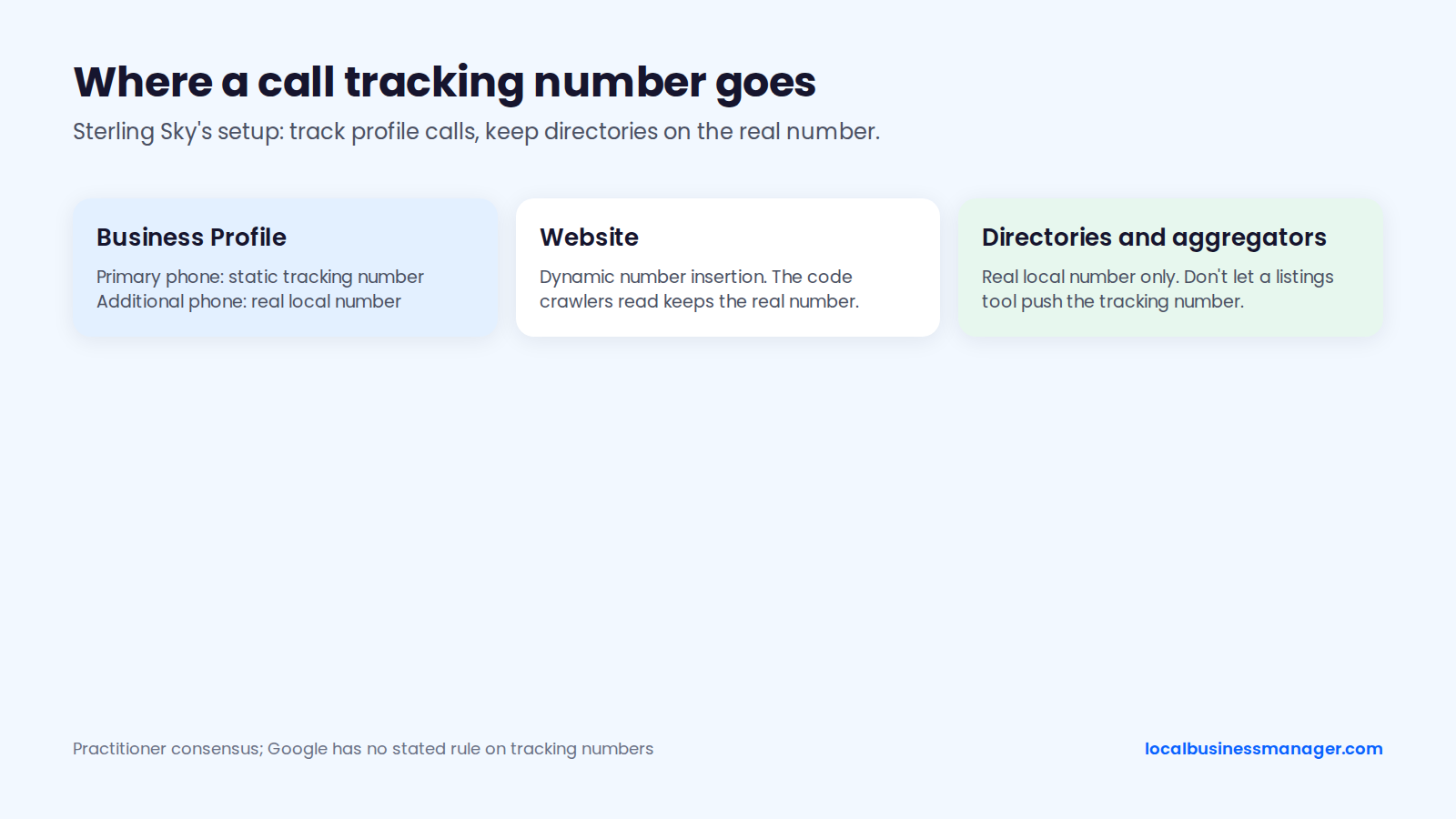
Sterling Sky's recommended setup (from its call tracking myths post, around 2019 to 2020) puts a static tracking number in the Business Profile's Primary phone field, the real local number in an Additional phone field, and only the real local number on directories and aggregators. Google's guidelines for representing your business don't mention call tracking by name. As of November 2026, the guidelines' phone rules are:
- The number must connect to the individual business location.
- It must be "under the direct control of the business."
- A local number is preferred over a central call-center line.
- Numbers that redirect users to anyone other than the actual business are banned.
The guidelines also allow additional numbers. Google has never said yes or no to tracking numbers specifically. Sterling Sky's setup in full:
- Business Profile: the tracking number as Primary phone, the real local number as Additional phone (Google allows 1 primary and 2 additional numbers).
- Website: dynamic number insertion. Sterling Sky says this leaves the real number in the code crawlers read.
- Directories and aggregators: the real local number only. Sterling Sky warns against letting a listings tool push the profile's tracking number to every directory.
Other practitioner sources back the same profile-and-directory split, some calling a tracking number on the profile safe only if the real number sits in the first Additional phone field. A few are looser and allow a tracking number as the main citation number, while warning about consistency problems when listings show different numbers.
Nobody has published a controlled test of this setup's ranking effect, and nothing says whether an agency-owned tracking line counts as "under the direct control of the business." Keep the line in the client's name to stay safe.
Get Access to the Core Listings
Get owner or manager access to the core listings before the audit starts, so fixes can be made from inside each platform instead of by request. Request roles through each platform's user invitations wherever they exist, and avoid sharing passwords.
The access checklist:
- Google Business Profile: owner or manager access.
- Apple Business Connect: access to the business's account.
- Bing Places: access to the listing.
- Yelp: a business account for the location.
- Facebook: a Page role.
- Industry directories: logins for the client's vertical (for law firms, Avvo, Justia, FindLaw, Super Lawyers).
- Website CMS: to fix footer NAP, the contact page and schema.
- A client contact who can take verification calls and postcards.
How to Run a Citation Audit Step by Step
Run the audit in this order:
- Check the core listings.
- Search by current and old NAP.
- Run a tool scan.
- Log every listing in one sheet.
- Score each issue by severity.
Steps 2 and 3 overlap on purpose, because each can catch listings the other misses.
Step 1: Check the Core Listings First
Start with the 5 core platforms: the Business Profile, Apple Business Connect, Bing Places, Yelp and Facebook. Then look up the business at the 3 main US data aggregators: Foursquare, Data Axle and Localeze (formerly Neustar Localeze).
Record for each listing:
- The exact name, address, phone and website URL as shown.
- The hours.
- Whether the business has claimed the listing.
- Whether the same site has a second listing for the location.
- The listing URL.
- Every difference from the style sheet.
Add the 2 or 3 directories that rank for the client's main service in its city. For law firms that means Avvo, Justia, FindLaw and Super Lawyers; for home services, sites such as Angi, Houzz and the BBB; for medical and dental practices, Healthgrades, Zocdoc and Vitals. Searching the client's main service and city in Google shows which ones matter locally.
A wrong phone or address on any of these goes in the Critical or High rows of the severity scale in Step 5. Audit the Business Profile fields beyond NAP separately.
Step 2: Search for Citations by Current and Old NAP
Quoted searches in Google and Bing can turn up listings a tool scan misses, especially under old addresses and old phone formats. Run searches like these (Example data):
"(512) 555-0147""512-555-0147" OR "512.555.0147""5125550147""(512) 555-0122"(old number)"1420 W Oak" Austin"1420 West Oak" Austin"1100 Elm St" Austin(old address)"Ridgeline Plumbing" Austin -site:ridgelineplumbing.com"Ridgeline Plumbing & Drain"(old name)"Ridgeline Plumbing" site:yelp.com(repeat per major site to spot duplicates)
Log every result that shows any part of the NAP, including unstructured mentions on news and blog pages.
Step 3: Run a Citation Tool Scan
Citation tools do 3 different jobs, and an audit needs the first 2.
Tool job | What it answers | When an agency needs it |
|---|---|---|
Discovery | Where does this business appear, and under which NAP? | Every new audit |
Consistency scoring | Which found listings differ from the master data, and in which field? | Every new audit |
Monitoring | Has anything changed or reappeared since the last fix? | Between audits |
Ordered by when an agency needs each job.
Several listings-tool vendors sell scans that cover these jobs. Free plans and trials change, so check what each covers on the day you scope the work.
Treat the scan as a starting list. Vendors themselves note that automated tools often miss duplicates, which is why Step 2's manual searches stay in the process.
Step 4: Log Every Listing in the Audit Sheet
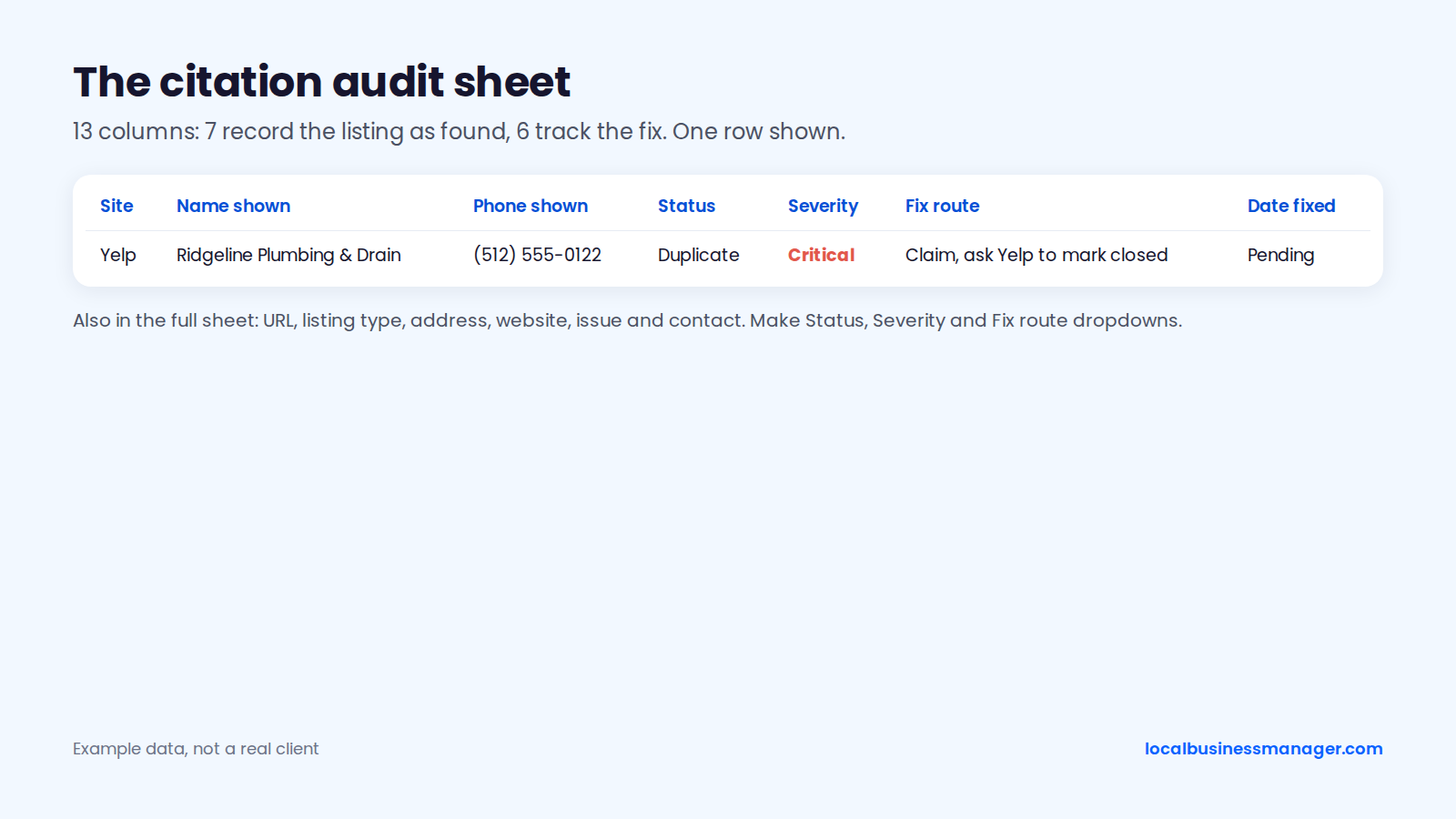
The audit sheet template has 13 columns: 7 that record the listing exactly as you found it, and 6 that track the fix. Copy all 13 into one header row in Google Sheets or Excel. The sample values show a duplicate Yelp page left over from an old address.
Column | What goes in it | Example data |
|---|---|---|
Site | Directory or platform name | Yelp |
URL | Direct link to the listing | yelp.com/biz/ridgeline-plumbing-austin-2 |
Listing type | Structured or Unstructured | Structured |
Name | Name exactly as shown | Ridgeline Plumbing & Drain |
Address | Address exactly as shown | 1100 Elm St, Austin, TX 78702 |
Phone | Phone exactly as shown | (512) 555-0122 |
Website | URL exactly as shown | http://www.ridgelineplumbing.com |
The other 6 columns turn the sheet into a to-do list, one decision per cell:
Column | What goes in it | Example data |
|---|---|---|
Status | Correct, Incorrect, Duplicate, Missing or Closed | Duplicate |
Issue | What's wrong, in one line | Second page with old name, address and phone |
Severity | Critical, High, Medium or Low | Critical |
Fix route | Claim and edit, Suggest edit, Support case, Email, Aggregator, or Leave and log | Claim, then ask Yelp to mark it closed |
Contact | Who you dealt with, and how | Yelp business support, case number |
Date fixed | Date confirmed live, or Pending, or Unfixable (logged) | Pending |
Make Status, Severity and Fix route dropdowns so filters work across clients. Add a Reviews column if duplicates are common, because a duplicate that carries reviews needs a decision before anyone asks for its removal.
Step 5: Score Each Issue by Severity
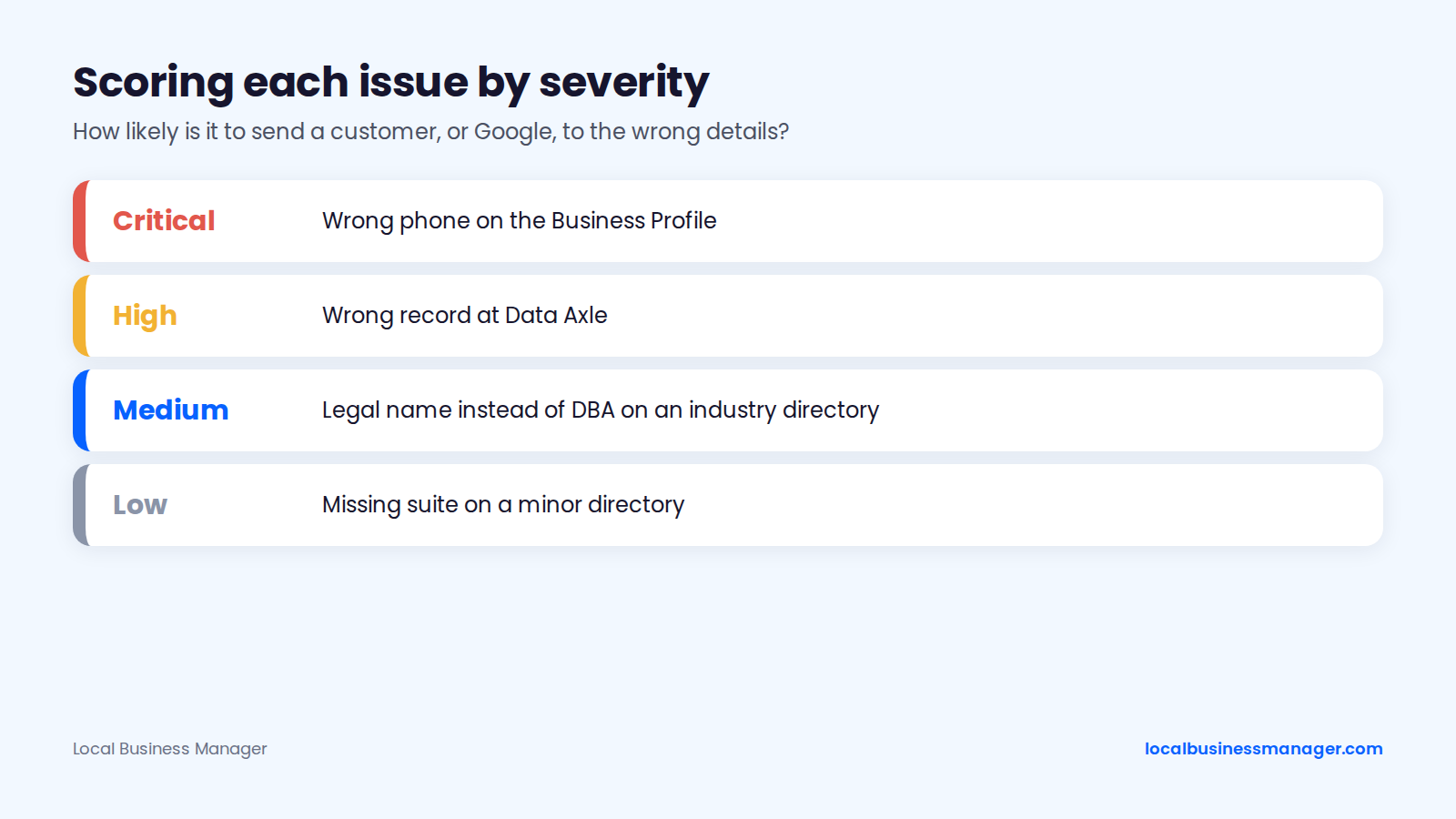
Severity scoring ranks each problem by how likely it is to send a customer, or Google, to the wrong details:
Severity | Issue types | Example (Example data) |
|---|---|---|
Critical | Wrong phone or address on the Business Profile, Apple Business Connect, Bing Places, Yelp or Facebook; a duplicate Business Profile; a core listing showing a moved location as open | Old phone (512) 555-0122 on the Business Profile |
High | Wrong record at Foursquare, Data Axle or Localeze; an old business name on a core listing | Data Axle still lists 1100 Elm St |
Medium | Wrong NAP on an industry directory; the legal entity name where the style sheet says the DBA; a duplicate on a secondary directory | "Ridgeline Plumbing Services LLC" on a home-services directory |
Low | Formatting differences or a missing suite on minor sites; a correct listing that isn't claimed | "Street" instead of "St" on a minor directory |
Sorted from most to least serious.
Sources disagree on fix order:
- Direction.com: fix aggregators before individual directories, because aggregators re-push data and overwrite manual edits.
- Yellowfin Digital (2026): fix the Business Profile, Apple and Bing first.
- Google: publishes no order at all.
My approach is to fix all of them in the same cleanup: the Business Profile, the aggregators, the major platforms and the legal directories. When hours are tight, I fix the most serious issues first, working down the severity scale from Critical to Low.
Either way, the severity column stops a wrong phone number on the profile from getting lost among a long list of formatting nits, and it gives the client report its counts.
How Many Hours Does the Work Take per Location?
No one has published an hours benchmark with a real method behind it. The figures out there are vendor estimates from 3 to more than 50 hours, with no stated method or sample, so use them only to sanity-check your own scoping.
Source | Hours (estimate) | Calendar time | Scope |
|---|---|---|---|
The AdFirm (2026) | 3 | Not published | Example for manual updates, 1 location |
ProGeekTech (2026) | 6 to 12 | A few weeks | Single-location accounting firm |
Redshaw Consulting (2026) | 10 to 25 | Several weeks | Single location with a modest history |
OptiLocal (2023) | More than 50 | Not published | A messy citation profile |
Sorted by hours, lowest first. All figures come from vendor marketing pages.
Calendar time is better documented than labor hours. One managed-listings service quotes 4 to 6 weeks from intake, and Redshaw Consulting says multi-location, older, regulated-sector and rebranded businesses take far longer.
Scope each client by the number of old NAP variants, locations and vertical directories. Log your own hours per location in the audit sheet to build a benchmark of your own.
How Should You Package a Citation Audit Service?
Agencies sell the same audit in 3 ways, and the choice changes the price more than the hours do:
Delivery | What the client gets | Suits | Main limit |
|---|---|---|---|
Manual audit and cleanup | The full process in this guide, done by your team | Single locations, messy histories, law firms with attorney listings | Staff hours; manual searches only find pages a search engine has indexed |
Software scan plus manual fixes | A tool scan for discovery and monitoring, fixes made by hand | Most agencies with 10 or more clients | Scans miss duplicates and old NAP variants; the subscription is per location |
Managed submission service | A vendor pushes corrected data to directories and aggregators | Multi-location brands | Least control over individual listings; some submissions take months |
Ordered from most control to least.
Whichever you sell, price the audit and the cleanup separately. The audit has a fixed scope; the cleanup depends on how many sites respond.
How Do You Fix the Problems You Find?
Fix each problem at the source the site actually reads from:
- The platform's owner dashboard first.
- The aggregator record when bad data keeps coming back.
- A written request when neither works.
Some listings won't change at all, and the audit sheet should say so instead of leaving the row open forever.
Duplicate Google Business Profiles
A duplicate Business Profile is a Critical row, and the fix is to resolve the duplicate, not to start a fresh profile. Google's rule is one profile per business, and its duplicate profiles help page says a business that moves should edit the existing profile's address rather than create a new one. A new profile made to escape a messy history usually just adds another duplicate. The one exception practitioners argue for is a service-area business that moves: Sterling Sky recommends a new profile plus a "mark as moved" request there.
Work through these in order:
- Check whether it's a practitioner profile. Google's page allows separate profiles for individual practitioners at the same address, and Law Firm Central (2026) makes the same point for attorneys.
- Pick the route that fits. Google's page covers each case. Remove a duplicate you created by mistake, after checking it's the right one, because removal deletes its content and managers. Request ownership if someone else holds the profile; they get 3 days to respond. Or suggest a merge on Google Maps: merge requests are reviewed, the reviews combine, and replies to reviews may be lost.
- Log the case number in the Contact column.
Scan for duplicates at least quarterly. Listings vendors warn that duplicates on Google, Bing and Yelp can split ranking power.
Duplicates on Apple, Bing and Facebook
Each platform handles duplicates through its own owner tools or support, and none of them is fast:
Platform | Route | What to know |
|---|---|---|
Google Business Profile | Remove, request ownership, or suggest a merge (section above) | Replies to reviews may be lost in a merge |
Apple Business Connect | Report an Issue on the duplicate's Place Card in Apple Maps; remove it in Business Connect if the client created it | Apple publishes no duplicate-specific process; it says it reviews reports and edits the card |
Bing Places | Bing's help says to report duplicates found while claiming; use the Support option with both listing URLs, the one to keep, and screenshots | Owners on Microsoft's Q&A forum report waits of weeks; if it returns from a Google import, check "Sync with Google" |
Merge the 2 Pages from Page setup, per Facebook's Help Center | Needs full access to both, the same name and address; posts, photos and reviews on the merged-away Page are deleted, and it can't be undone | |
Yelp | Claim, then ask Yelp to mark the duplicate closed (see below) | Yelp doesn't delete business pages on request |
Ordered as in Step 1.
Wrong Data Coming From Aggregators
An aggregator fix stops wrong data from being re-pushed to the sites that license it. The 3 main US aggregators are Foursquare, Data Axle and Localeze.
Many older checklists still list Factual and Infogroup. Factual merged into Foursquare, and Infogroup is now Data Axle.
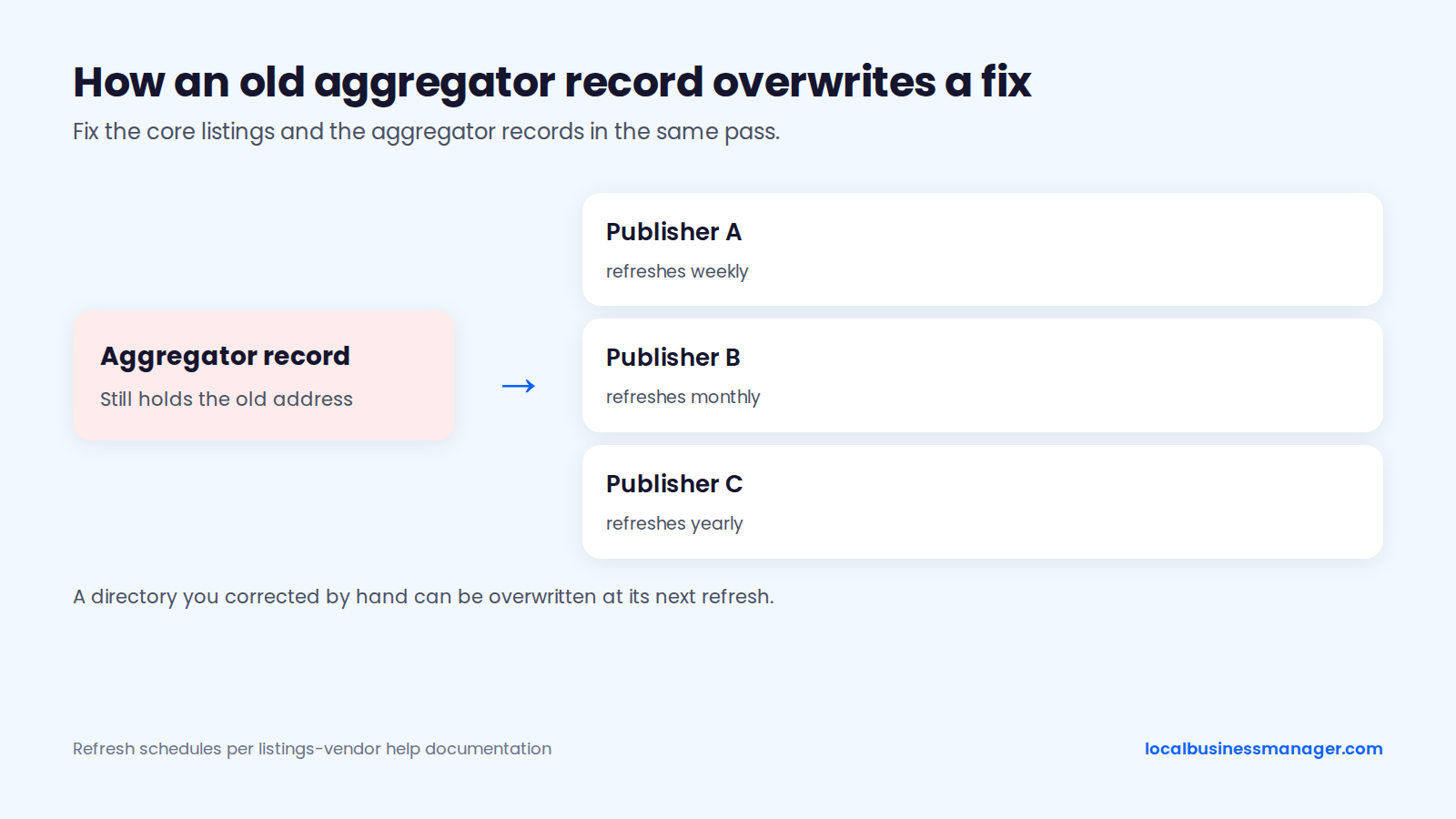
Publishers in each aggregator's network refresh on their own schedules. One listings vendor's help documentation puts that at weekly, monthly or only yearly, so a directory you corrected by hand can be overwritten later. Fix the core listings and the aggregator records in the same pass.
Data Axle may also phone the business to verify new data. Warn the client so the front desk doesn't hang up.
How Long Fixes Take to Go Live
Listings-vendor help documentation says individual citation sites publish anywhere from immediately to a few weeks, some up to 6 weeks, and anything that travels through an aggregator can take 2 to 3 months.
Route | Typical time to go live | Source |
|---|---|---|
Localeze edit | Near-instant | Listings vendor help docs |
Foursquare edit | 1 to 2 days | Listings vendor help docs |
Data Axle edit | 1 day to 1 month | Listings vendor help docs |
Individual directory submission | Immediately to a few weeks, some up to 6 weeks | Listings vendor help docs |
Listings pushed through aggregators | 2 to 3 months | Listings vendor (2026) |
Some managed-service submissions | Months, occasionally more than a year | Managed listings service |
Sorted from fastest to slowest.
Listings then tend to appear in Google results about 4 to 6 weeks after going live. Nobody has a reliable timeline for when rankings or calls change after a cleanup, so don't promise one.
Sites That Won't Update or Remove a Listing
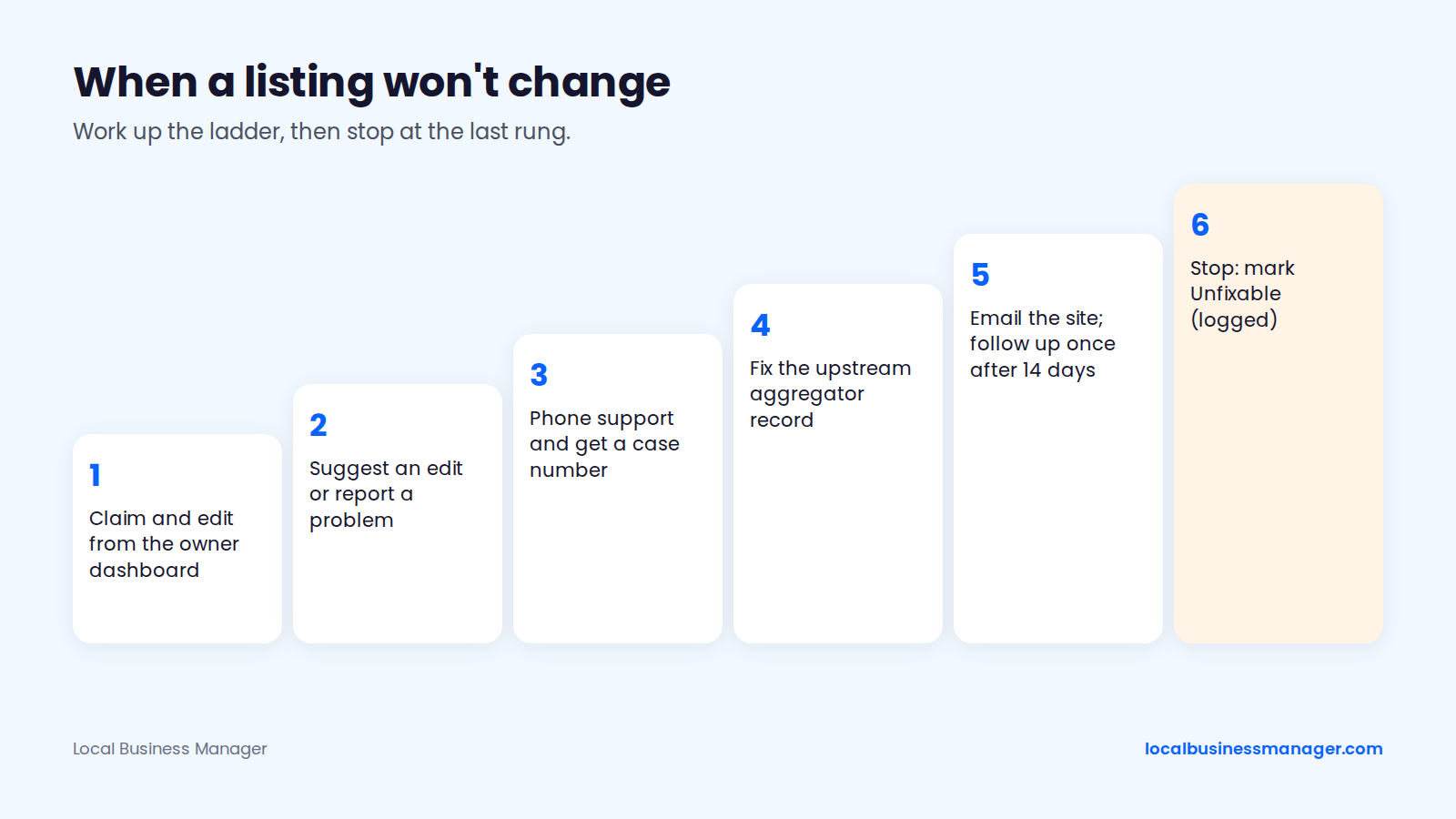
There's no accepted rule for when to give up on a listing, so set a bounded escalation ladder and stop at the last rung:
- Claim the listing and edit it from the owner dashboard.
- Use the site's suggest-an-edit or report-a-problem option.
- Phone the site's support line and ask for a case number. Some support reps can't remove duplicates themselves and have to open a case.
- Fix the upstream aggregator record if the site takes aggregator data.
- Email the site with the script below, then follow up once after 14 days.
- Stop. Mark the row "Unfixable (logged)" with dates and attempts, and recheck it at the next scheduled audit.
Some platforms never delete. Yelp says it doesn't remove business pages on request: the most you get is a page marked closed, which Yelp verifies first, and a closed page can stay visible and link to the new location.
Expect some duplicates to survive: removal depends on site editors, and listings vendors say getting 100% removed is almost impossible. One Local Search Forum practitioner put the success rate of paid cleanup packages at roughly 10% to 15%, a single person's estimate from a 2023 thread. The same practitioner said manual VA outreach worked only on listings nobody had claimed.
Outreach Email Script for a Directory That Won't Update
Send this from an address at the client's domain when you can. It makes ownership easier to confirm.
- Subject: Listing correction request: [Business name], [City] ([listing URL])
- Hi [Site] team,
- I manage the online listings for [Business name] at [current address]. Your listing at [URL] shows outdated details:
- Listed: [old name / old address / old phone]
- Correct: [current name / current address / current phone]
- The business [moved / changed its number / changed its name] on [date]. You can confirm the current details on [website contact page URL] and on the business's Google Business Profile.
- Could you update the listing? If it duplicates [URL of the correct listing], could you remove or merge it?
- I can verify ownership by phone at [client's main number] or from an email at [business domain].
- Thank you,
- [Your name], on behalf of [Business name]
Log the send date and any reply in the Contact column.
Listings You Should Leave Alone
Some rows deserve a "Leave and log" fix route from the start, because chasing them costs more than the listing is worth:
- Defunct directories, spam directories and link farms. Log them as Low and move on.
- Listings Google doesn't index. The Sterling Sky test in the table above shows how many directory pages drop out of the index, and an unindexed page probably contributes little.
- Old news stories that mention a previous address. Ask for a correction only if the story ranks for the business's name.
Sterling Sky also reported in 2021 that a client's rankings rose within days of a Business Profile address update, even though its citations weren't updated for 3 months.
When Should You Re-Audit Citations?
Most published advice puts a full re-audit at quarterly to twice a year, plus a targeted audit right away after any change to the name, address or phone. None of these schedules is backed by a test.
Scheduled Re-Audits
The published recommendations below all fall between quarterly and twice a year, and all are agency or vendor opinions.
Source | Recommended cadence | Scope |
|---|---|---|
StoreRocket (2026) | Quarterly checks, full audit twice a year | Checks plus full audit |
Local SEO Guide (2025) | Quarterly or twice a year | Top-tier citations |
o8 (2026) | Every 6 months | Full audit |
Sorted from most to least frequent.
A reasonable default from that range: a full audit twice a year for a stable single location, and quarterly checks for multi-location clients or any client that changed details recently. None of the sources tested a schedule, so adjust it to what your own audits keep finding.
Some practitioners do far less. Joy Hawkins of Sterling Sky told Search Engine Land that her agency only does citation work after a client moves, and sees little difference even then.
Trigger Events That Need an Immediate Audit
Moves, rebrands and phone changes can break citation consistency overnight, according to both o8 and StoreRocket. Treat these events as triggers for a targeted audit:
- An office move or new suite number.
- A new primary phone number, or a retired tracking number.
- A rebrand or name change, including a newly registered DBA.
- A merger or acquisition.
- A partner or practitioner leaving (law firms, dental and medical practices).
- A new location opening.
- A new service launch that changes the name or website (o8 lists this one).
- A customer saying they called an old number or were sent to an old address.
The Update Order After a Move or Phone Change
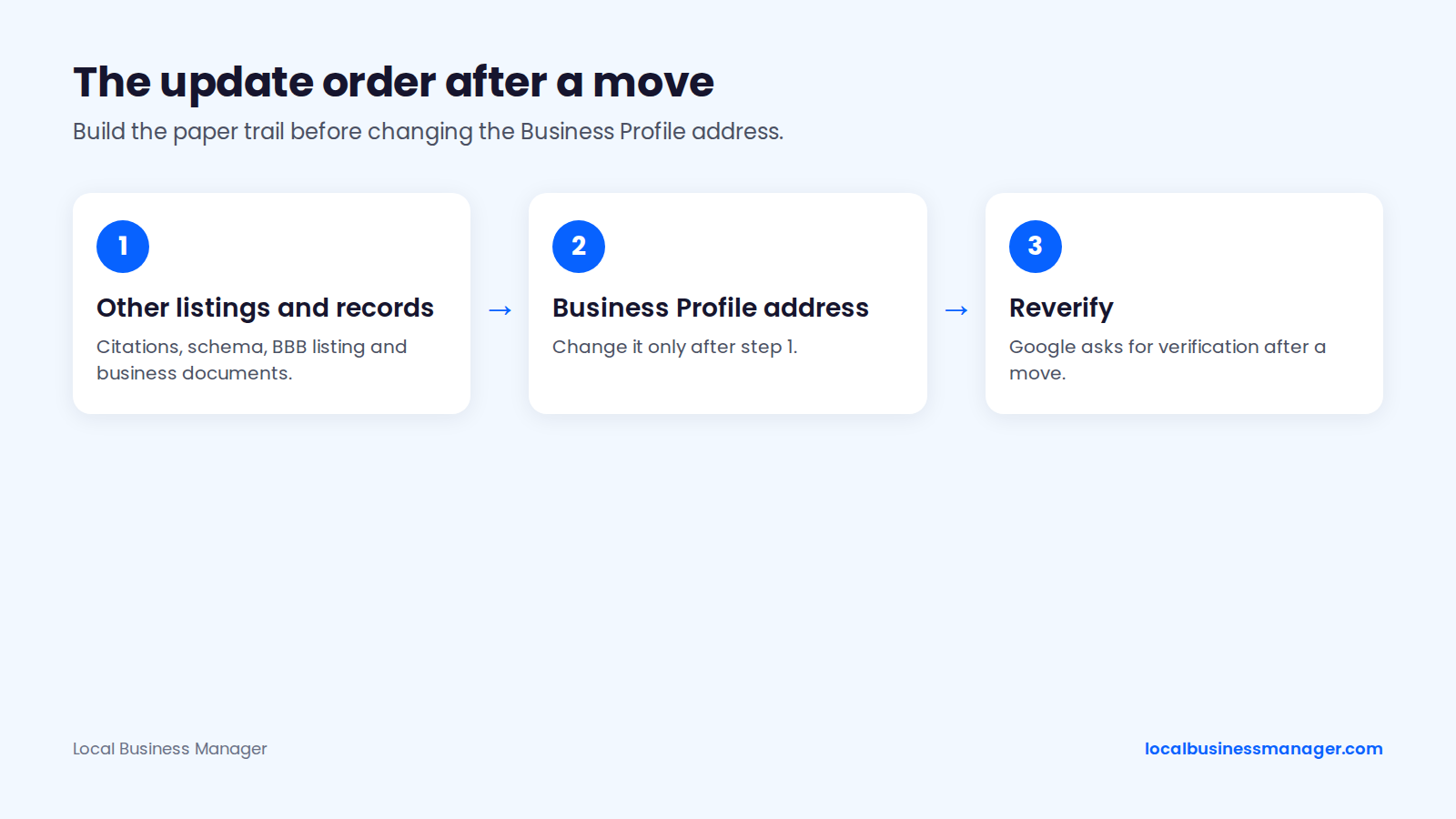
After a move, update the other listings and records before the Business Profile address. Google's "Edit your Business Profile" help page says a business that moves to a new address after verification has to verify the profile again.
A Google Product Expert writing in Search Engine Land (2026) advises updating these before changing the profile:
- Other citations.
- Schema.
- The BBB listing.
- Business documents.
With those updated first, the paper trail described earlier is already in place if the profile is suspended.
For a phone change, a 2024 Local Search Forum thread suggests this order, because changing the primary number may trigger reverification:
- Add the new number as an Additional phone.
- Update the website and citations.
- Switch the primary number.
The Update Order After a Rebrand or New DBA
After a name change, put the new name on the website first and change the Business Profile name last. Sterling Sky's 2025 rebranding checklist lists the website updates: logo, About and Contact pages, footer, CMS site name, and a note saying "Old Name is now New Name." Let Google index that before changing the profile, or Google may revert the name or ask for reverification.
When a client wants a new name that includes the service it sells, I recommend the keyword name only if it becomes the business's real name, in this order:
- Register the DBA.
- Put the name on the signs, website, stationery, phone greeting and every other listing.
- Change the Business Profile name last.
A DBA filing alone doesn't make a name compliant. Google judges the name the business really uses and can still challenge or suspend it; the DBA is your proof if Google asks.
Tell the client about the suspension risk plainly. The 2026 ranking-factors survey lists keyword names among the top suspension risk factors, while also finding that keyword names correlate with higher local pack rankings.
In my experience, when the name is the main thing a profile is missing, fixing it can show ranking gains within about a month; once the basics are done, further gains come gradually. Law firms also need state-bar clearance before any of this, as the next section explains.
How Do Law Firms, Service-Area Businesses and Multi-Location Brands Differ?
The audit steps stay the same for every client type; what changes is the style sheet and which listings get their own rows. Law firms add bar rules on names and separate attorney rows. Service-area businesses need a hidden address handled the same way everywhere, and multi-location brands need one source of truth.
Law Firm Names and Trade Names
A law firm's style sheet name has to clear the state bar's trade-name rules before it goes on any listing. This section covers marketing practice, not legal advice.
ABA Model Rule 7.1, Comment 5 allows a firm name that is either:
- A trade name that isn't false or misleading.
- A name made from some or all current members, or from deceased members the firm succeeded.
The same comment treats a name as misleading if it implies a connection with a lawyer not associated with the firm or a predecessor firm. Whether a departed partner's name can stay in the firm name, and on its citations, depends on how the firm's state bar applies that test, so check before changing the style sheet.
State rules differ:
- New York: Rule 7.5(b) says a lawyer in private practice shall not practice under a trade name, and NYSBA Ethics Opinion 1193 applies that ban even where another state allows the name. LawHQ filed a lawsuit challenging the ban, and we couldn't verify its outcome as of November 2026, so confirm the rule's current status with the New York State Bar.
- Texas: non-misleading trade names have been allowed since the 2021 amendment to Rule 7.01(c). Jaffe PR reports that firms must still submit proposed trade names to the state bar for approval.
- Kentucky, New Jersey and Rhode Island: a 2022 ABA Litigation Journal article named these as still heavily restricting trade names.
Check the firm's state bar before filing a DBA or changing a single listing. Our local SEO guide for law firms covers the rest of a firm's local setup.
Attorney Listings and Legal Directories
Attorney-level listings get their own rows in the audit sheet, separate from the firm listing. Agency summaries of Google's guidelines from Top Local Search Marketing and Law Firm Central (2026) describe this setup:
- Public-facing lawyers can have practitioner profiles alongside the firm's profile.
- A solo attorney at a branded firm uses one profile named "[firm brand]: [attorney name]."
I haven't used attorney profiles in practice yet. The setup I intend to use gives each attorney profile a different primary category from the firm's, so the two don't compete. Treat that as untested.
When a partner leaves, Sterling Sky's practitioner listings guide covers both cases:
- If the firm controls the listing, it can ask Google to delete it.
- If the lawyer controls it, the lawyer can update it to the new firm.
On directories, Avvo builds attorney profiles automatically from state bar records. Claim each profile, and correct any wrong data at the bar record. Justia, FindLaw and Super Lawyers don't publish how they split attorney and firm NAP, so check each one and log what you find.
My own observation is that some paid legal directories bring in cases, and they also help a firm get mentioned in AI Overviews.
Service-Area Businesses With a Hidden Address
A service-area business's audit checks that the hidden address stays hidden and is handled the same way on every listing. Never suggest a PO box, virtual office, coworking desk or fake address as a workaround, even for a client who works from home. Google's guidelines for representing your business set out which addresses a profile can use.
For the address:
- Record the real address and its visibility in the style sheet.
- Use a directory's hide-address option where it has one.
- For a home-based business, skip directories that force a public address instead of publishing the home address the profile hides.
For a plumber or HVAC company, also check that every listing uses the same local phone and the same name as the profile.
Multi-Location Brands
Multi-location audits need one master sheet as the single source of truth, plus one audit tab per location. The scale is the hard part: The AdFirm's 3-hour example from the hours table becomes 300 hours across 100 locations.
Decide these before any work starts:
- Location URLs: each location's citations link to its own location page, not the homepage (Geek Powered Studios).
- Locked fields: the name, primary phone, website URL and address are edited only by the central team.
- Delegated fields: local managers can suggest changes to items such as holiday hours, which the central team reviews against the master sheet.
- Phone numbers per location: a Local Search Forum case shows the risk of leaving this open. A multi-location client used separate tracking numbers for the profile and the location page, and the citation vendor had to ask which number was the real NAP.
How Do You Report the Findings to a Client?
Report a citation audit as a one-page summary of counts, fixes and open items, with the full audit sheet attached. Calls and rankings lead my monthly client reports, so the citation summary works best as a short section after them rather than the headline.
What to Put in the Client Summary
The client summary needs counts the client can check against the audit sheet. The full deliverable is a row-by-row report: directory, listing URL, current NAP, status and the problem field.
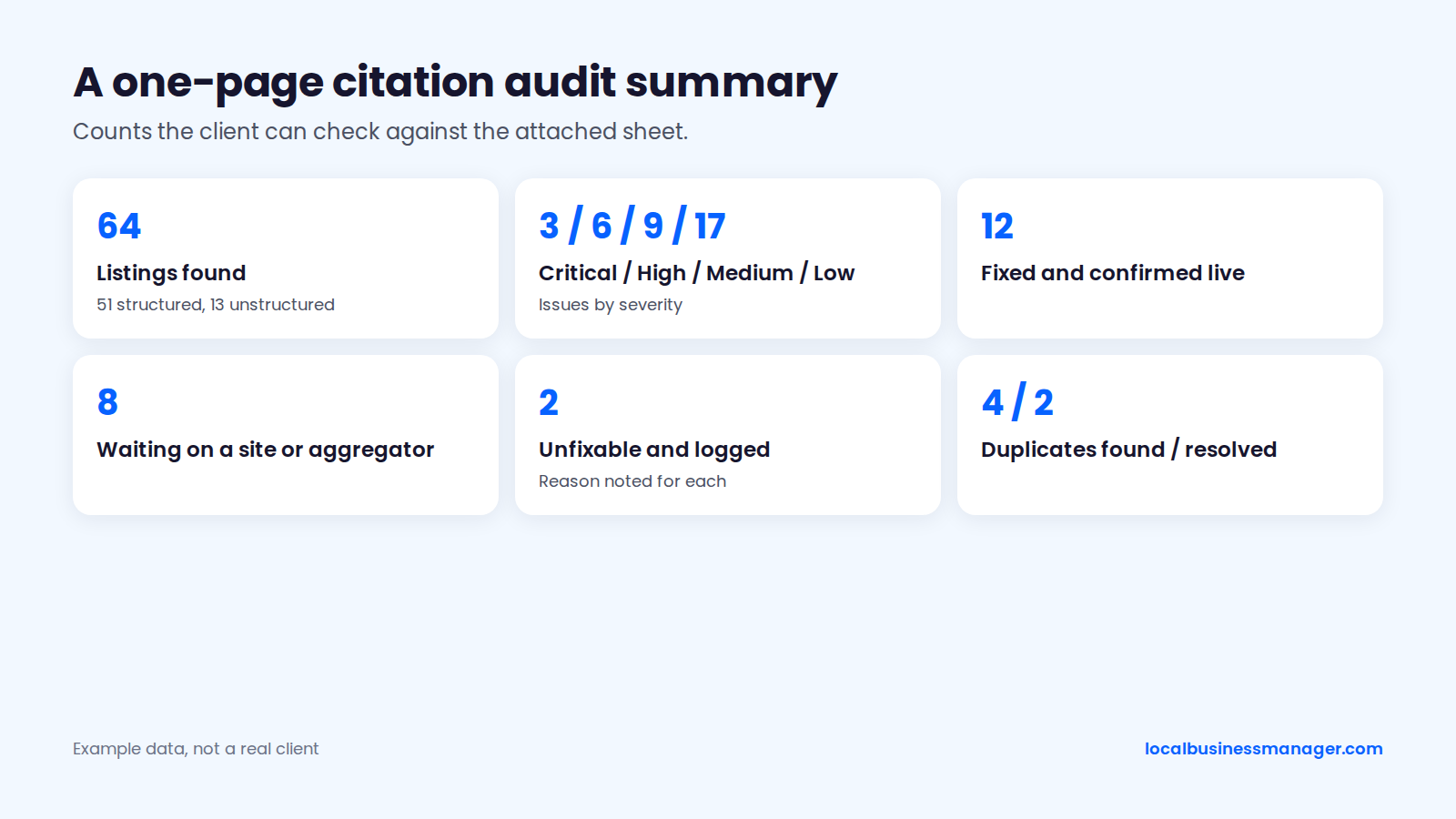
Attach that sheet and put these counts on top (Example data, fictional client):
- Listings found: 64 (51 structured, 13 unstructured).
- Issues by severity: 3 Critical, 6 High, 9 Medium, 17 Low.
- Fixed and confirmed live: 12.
- Submitted and waiting on a site or aggregator: 8, with the expected window from the timing table above.
- Unfixable and logged: 2, with the reason for each.
- Duplicates found and resolved: 4 found, 2 resolved.
- Next scheduled audit: [date].
A Script for Setting Expectations
Use this script on the review call or in the cover email. It reports what was found and avoids promising a ranking jump:
- "We found [64] listings for [business]. [3] had problems serious enough to cost you calls, like the old phone number on Yelp, and those are fixed or submitted."
- "The rest are smaller inconsistencies. We're cleaning them up over the next [2 to 3] months, because changes that go through the data aggregators can take that long to reach every site."
- "Experts in the main 2026 ranking-factors survey rate citations as a small and shrinking part of map rankings, so I don't expect this work alone to move you in the map pack."
- "What it does: customers and Google see the same correct details everywhere, and you have proof on file if Google asks to verify your address."
- "Next, we're focusing on [your Business Profile and your reviews], the work most likely to move your rankings."
That last line comes from what I've seen across close to 100 personal-injury firms: when a firm missed the 3-pack, the most common causes were a Business Profile name that wasn't optimized and too little review flow. By an optimized name I never mean keywords added to the profile alone: I mean a name the firm registers as a DBA, clears with its state bar and really uses everywhere, as in the rebrand order above.
FAQs
These three questions come up on almost every audit call.
Can You Check Citations for Free?
Yes. A manual citation audit needs only Google, Bing, the master NAP style sheet and a spreadsheet. The searches in Step 2 find listings under current and old NAP, and our free template builds those searches for you. The cost is staff time, and the gap is coverage: a free search only finds pages Google or Bing has indexed. Paid scans add monitoring between audits and catch some listings searches miss, but they still miss duplicates and old variants, which is why the manual searches stay in either case. Free plans and trials from citation tool vendors change often, so check what each one covers before you rely on it.
What Is the Difference Between Citation Cleanup and Citation Building?
Citation cleanup corrects listings that already exist; citation building creates new listings on sites where the business is missing. An audit comes first in both cases, so new listings copy the correct NAP from the style sheet. Building also shows diminishing returns in the ranking evidence covered earlier, so focus new listings on core platforms and the client's industry directories where the business is genuinely absent.
Are Reviews Part of the Audit?
No. Reviews and citations are separate signals, so the audit checks NAP data, not ratings. The overlap is duplicates: a duplicate listing can carry reviews, so record the review count before asking a site to close or remove it. Reviews get their own check in Step 4 of our local SEO audit. Practitioners disagree on what happens to a departing practitioner's reviews. One Local Search Forum member said merging them into the firm's profile goes against Google's guidelines, because the reviews belong to the individual.
Where Should You Start?
Start this week by searching the client's old phone number in quotes. Any listing that turns up still shows a number customers might call, and that's the part of citation work no client argues with.
Local Business Manager is in early access for agencies that manage Business Profiles for many clients: request early access.