Local SEO for Lawyers: How to Get Law Firms Into the Map Pack

Law firms get into the map pack the way any local business does, through relevance, distance and prominence, but 4 decisions drive most of the result: the primary category, the business name, attorney profiles and a compliant review flow. If you have a law-firm client, you also know the setup: a crowded metro, competitors whose names read like search queries, and a managing partner who judges you on signed cases.
I was Head of SEO at a legal-marketing agency, and I've ranked and served close to 100 US personal-injury firms in Houston, Denver, Los Angeles and New York. This playbook covers the Google Business Profile decisions specific to law firms, compliant reviews, suspension risks and a monthly report. It's marketing guidance, not legal advice.
What Makes Local SEO for Law Firms Different?
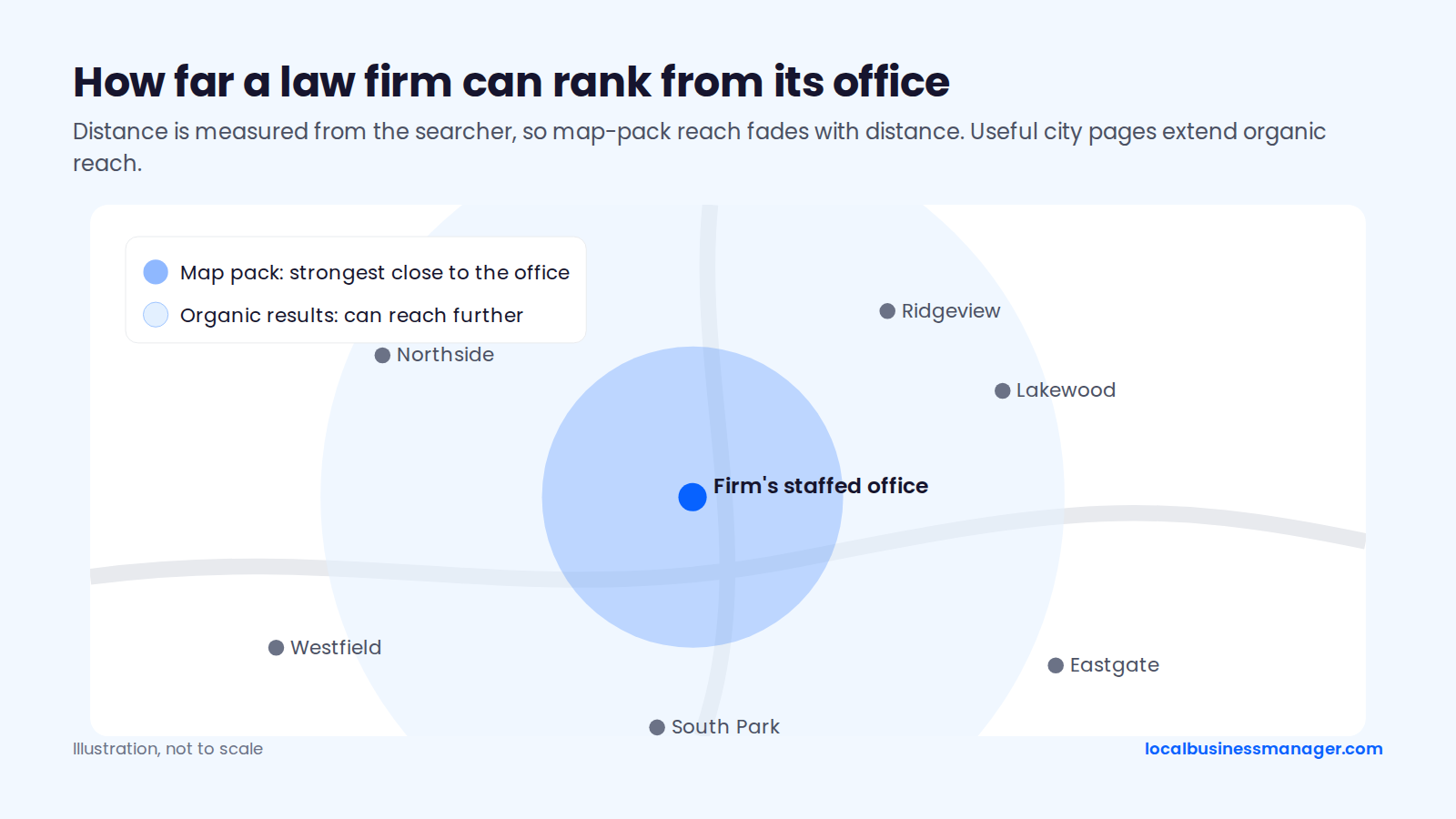
Law firms rank on the same signals as any local business, but 4 things change the work. Google says local results depend mainly on relevance, distance and prominence. Distance is measured from the searcher, not by city limits.
- Heavier spam. In a Sterling Sky study, Google removed 75.7% of the sampled personal-injury lawyer listings for guideline violations, against 23.2% for criminal lawyers. The data is a few years old.
- Attorney profiles. Lawyers can have practitioner listings separate from the firm's.
- Ethics limits. ABA Model Rule 7.1 bars false or misleading communications about a lawyer's services.
- Ads above the pack. Google opened Local Services Ads to legal practices in August 2020.
When a PI firm misses the 3-pack, I most often see 2 causes. The Business Profile name isn't optimized, and too few new reviews are coming in.
How Should a Law Firm Set Up Its Google Business Profile?
Make 4 decisions first: the primary category, the name, attorney profiles and which offices qualify. Then fill in the fields clients read, and run the checklist at the end of this section.
Choose the Primary Category by Practice Area
Use the most specific category that describes what the firm is. Google's guidelines ask for that. The 2026 Local Search Ranking Factors survey ranks the primary category as the #1 local pack factor. In a Sterling Sky case, a PI firm switched its primary category from "Insurance attorney" to "Personal injury attorney." It gained PI visibility and lost insurance visibility.
I use the primary category most of the ranking competitors use. If Google is rewarding a different category than the logical one, I use the one Google rewards. Google says to use as few categories as possible, but Sterling Sky's tests found that relevant extra categories didn't hurt rankings. More in our Google Business Profile categories guide.
Use a Name the Firm Actually Uses
The profile name has to be the name the firm really uses, because Google's guidelines require the real-world name. Adding keywords to a name the firm doesn't use is never acceptable. Industry research finds that keyword names correlate with higher local pack rank, but the same 2026 survey also lists them among the higher suspension risks.
I recommend a keyword name only when the firm makes it its real name, in 4 steps:
- Clear the state bar first. ABA Model Rule 7.1, Comment 5 allows a trade name that isn't misleading, but your state's rule controls. New York bans trade names, and Texas lets firms use a trade name under Rule 7.01 but requires it to be submitted to the state bar.
- Register the name as a DBA (assumed name).
- Use it on the signage, website, letterhead, phone greeting and other listings.
- Change the Business Profile name last.
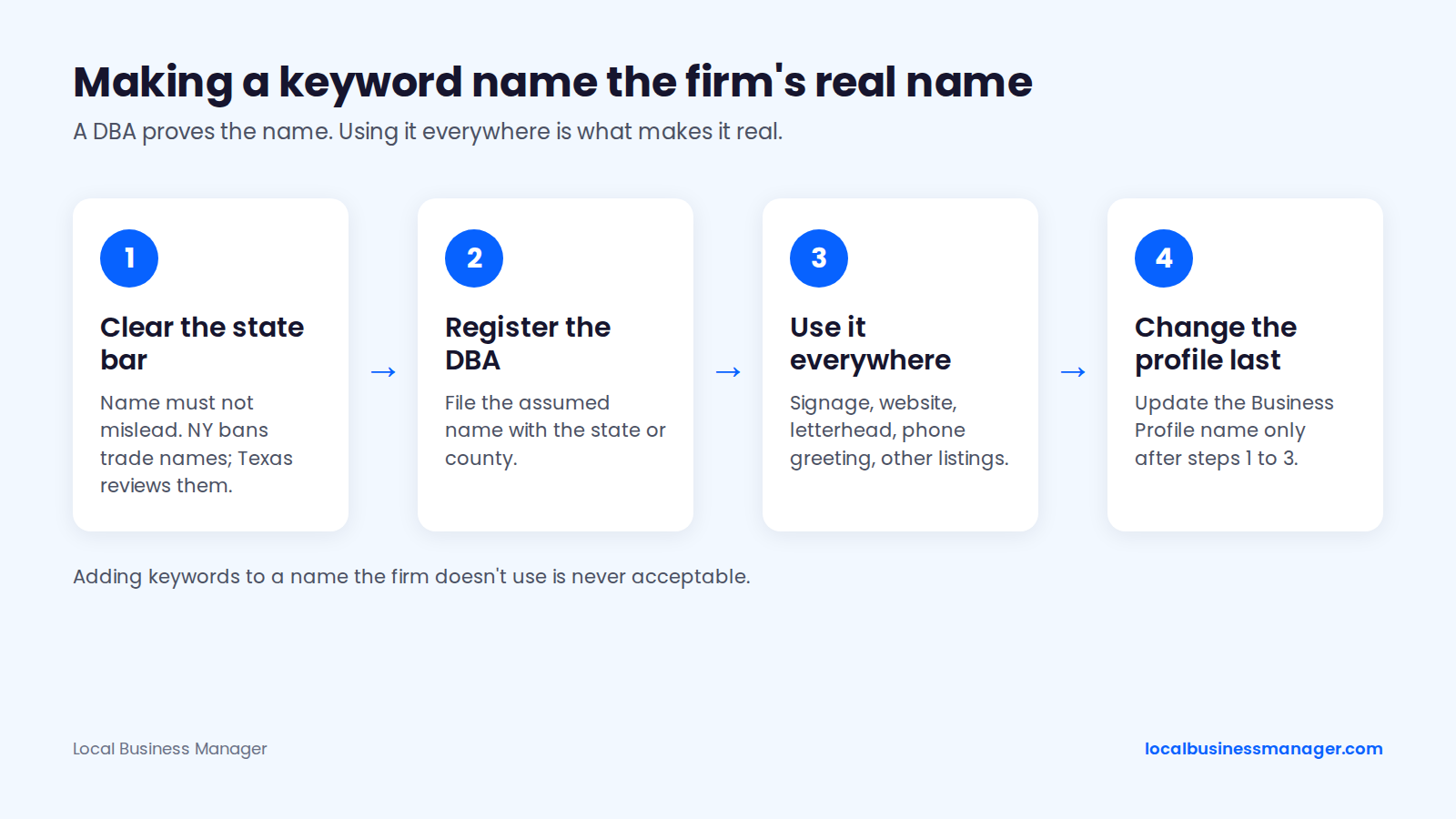
Illustration.
The DBA proves the name if Google asks during re-verification or reinstatement. It doesn't make the name compliant on its own. Google judges the name the firm really uses and can still suspend the profile.
Firm Listing vs Individual Attorney Listings
An attorney can have a separate profile if they're public-facing and reachable at the verified office during stated hours. Support staff can't have one (Google's guidelines). If the firm creates them, keep to these rules:
- Attorney's name only. A solo attorney at a branded firm shares one profile named "[Firm]: [Lawyer name]" (Sterling Sky).
- No firm name. Attorney profiles that included the firm name have been merged into the firm's profile as duplicates. A forum report says this can't be undone without creating a new profile.
- The attorney keeps it. Joy Hawkins notes that the attorney, not the firm, owns the profile if they leave.
I haven't used attorney profiles in practice yet. My intended setup, which is untested, gives each attorney profile a different primary category from the firm's so they don't compete.
Offices and Multi-Office Firms
Only a real, staffed office qualifies, and each staffed office gets its own profile. Google's guidelines treat a rented mailing address where the firm doesn't work as a virtual office, which isn't eligible. PO boxes don't qualify either. Google's own community guide says a coworking office counts only if it has signage, receives clients during business hours and has the firm's own staff present.
Bar rules point the same way. Florida forbids advertising an office that isn't a bona fide office.
For a multi-office firm, give each staffed office its own profile and its own page on the website, with that office's address, phone, hours and attorneys. Link each profile to its own office page, not the homepage, and ask clients for reviews on the profile of the office that handled their case, so every office builds its own review flow.
A 10-Point Setup Checklist
Write the services, hours, photos and description for clients deciding whether to call. The description allows 750 characters with no links; use it to say which cases the office takes and where clients meet the attorneys. Add real photos of the office exterior, entrance and attorneys, and set every attribute that applies, such as wheelchair access and online appointments. Then run these 10 checks:
- The primary category matches what most ranking firms use.
- The profile name matches the signage and website.
- Any keyword name is bar-cleared, a registered DBA and used everywhere.
- The address is a staffed office open to clients.
- No virtual office, unstaffed coworking desk or PO box appears.
- Each staffed office has exactly one firm profile.
- Attorney profiles exist only for public-facing attorneys and carry their names only.
- The website link goes to the office page with UTM tags.
- Services list every practice area the office handles.
- Hours and holiday hours match the front desk.
Can a Law Firm Rank in Cities Where It Has No Office?
In the map pack it's hard. In local organic results, a strong firm can reach further, so compliant expansion into nearby cities runs through useful organic pages.
Illustration, not to scale.
In a Sterling Sky study of Toronto personal-injury searches, only 5 firms filled the top 3 organic spots across 144 searches from 72 postal codes. That's Canadian data, so treat it as a direction. A 2025 follow-up found that proximity still affects organic rankings, but less than in Sterling Sky's 2022 study.
Is a City Page Legitimate or a Doorway Page?
A city page is legitimate when it would help a client in that city even if it never ranked. Google's spam policies treat doorway pages as a violation. Ask 5 questions:
- Does the firm take cases from this city now?
- Does the page name the local courts and procedure?
- Does it name the attorneys who handle these cases?
- Does it say honestly where clients meet the firm?
- Would swapping in another city's name make most of the page false?
If most answers are no, fold the page into one regional page.
How Do You Get Law Firm Reviews Without Breaking the Rules?
Ask every client the same way, and offer nothing in return. Google's policy, the FTC's rule and your state bar's rules all apply, so check these templates against your own bar's rules before using them.
Ask Every Client, the Same Way
Ask every client for an honest review, with no incentive and no suggested wording. 3 rule sets apply:
- Google's review policy bans incentives, steering the rating or wording, and asking only satisfied clients.
- The FTC rule bans rewards tied to a particular sentiment and reviews from officers or managers.
- Your state bar adds its own limits. Texas Opinion 685, for example, lets lawyers ask for reviews if they don't encourage misleading statements.
Ask every client the same way when their matter closes. For PI clients who recovered, I wait until after they've been paid, then send the request by email, or by text if they've opted in to texts. Clients whose matters close without a recovery get the same request at close. Asking only the clients who got paid would mean asking only the ones who won, and Google bans that.
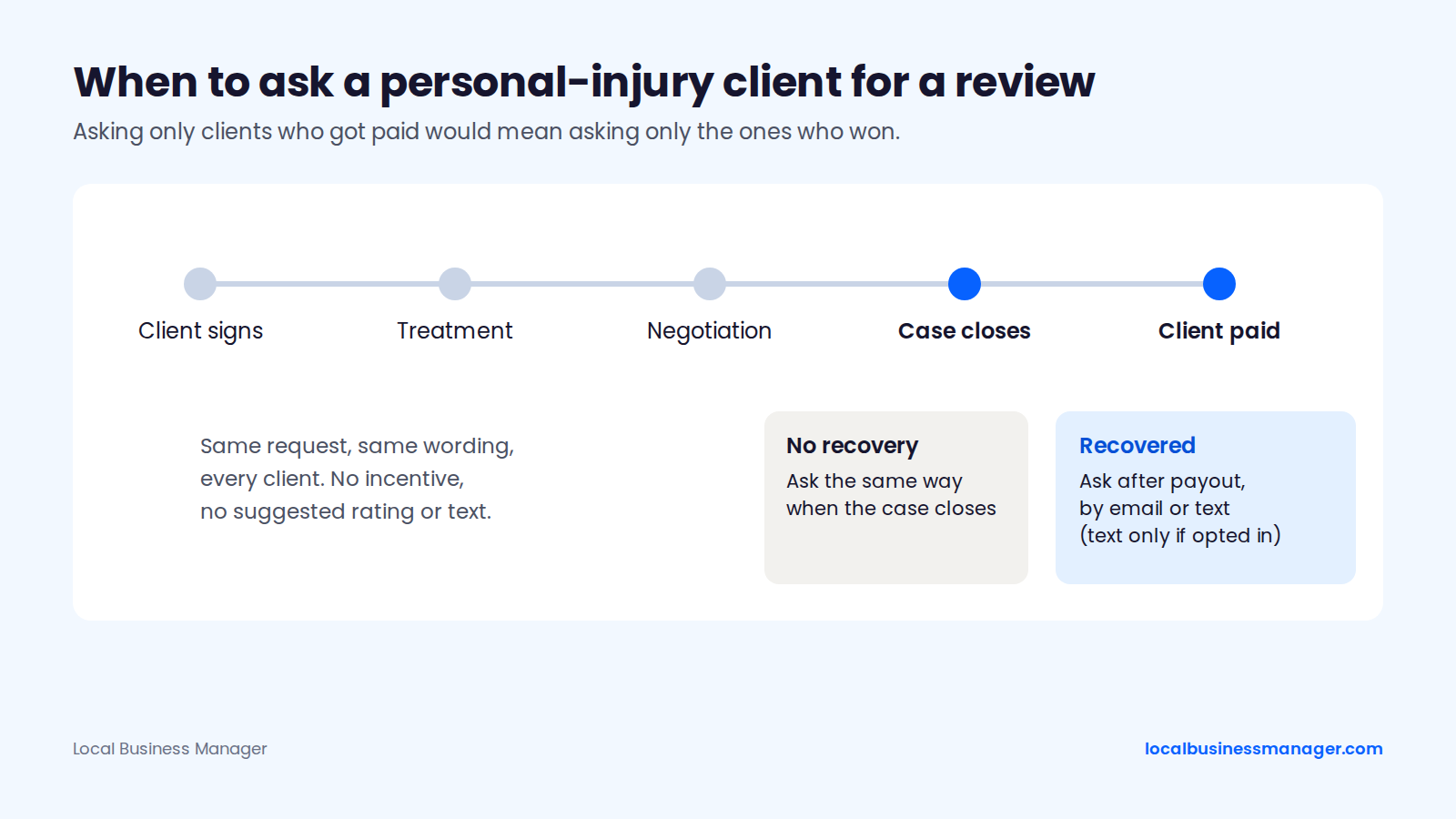
Illustration.
A Review-Request Script You Can Adapt
Send the same request to every client when the matter closes. Adapt whichever version fits the channel:
- Email: "Hi [First name], your matter with [Firm name] is now closed. We ask every client for an honest review, whatever their experience: [review link]. Thank you, [Attorney name]"
- In person: "We ask every client for an honest review when their matter closes. I'll email you the link, and what you write is up to you."
- Text (opted-in clients only): "[Firm name]: Your matter is closed. We ask every client for an honest review: [link]. Reply STOP to opt out."
How to Reply to a Negative Review Without Revealing Client Information
Keep the reply short, and confirm nothing about the reviewer. Under ABA Formal Opinion 496 (January 2021), a negative online review isn't a "controversy" that lets a lawyer reveal confidential information in a reply (LA Legal Ethics summary). Use these 3 sentences, in order:
- "Thank you for taking the time to share this."
- "Our professional obligations don't allow us to discuss any matter, or whether someone is or was a client, in a public forum."
- "If you'd like to talk, please call [Name] at [phone]."
Check your state bar's guidance before posting. If a review breaks Google's policies, our guide to deleting Google reviews covers how to report it.
Which Citations and Legal Directories Matter?
Get a short list of core listings exactly right before adding more. Justia and FindLaw are both free and sit at the top of most attorney directory lists. Claim these 8 listings and make sure the details match; our citation audit guide shows how to check every other listing:
- Google Business Profile
- Bing Places
- Apple Business Connect
- Justia
- FindLaw
- Avvo
- Martindale-Hubbell
- State and local bar directories
Pick one canonical version of the name, address and phone, matching the signage and the bar registration, and copy it exactly everywhere. Decide once whether it's "PLLC" or not, "Suite 400" or "Ste 400", and use the same choice on every listing. Recheck the core listings after any move, merger or phone change.
Call-tracking numbers are a common source of mismatches. Sterling Sky advises putting the tracking number in the primary phone field and the local number in the additional phone field.
Paid Directories
Paid listings are allowed, but a paid link should be nofollow or sponsored. ABA Rule 7.2, Comment 3 permits paying for directory listings, though your state's version of the rule controls. Justia, which sells listings, warns that a followed paid link risks a Google penalty.
In a Juris Digital case study, a Denver PI firm got about 100 website visits from Avvo Pro in a year. In my observation, some paid directories do bring cases and also help a firm get mentioned in AI Overviews. Judge each one on tracked calls and signed cases.
What Should the Law Firm's Website Do for Local Rankings?
Give each practice area and each real office its own page, written for clients. Then add LegalService markup to each office page.
Before writing titles, check which searches actually show a map pack: combine each practice-area term with "near me", "in [city]" and "lawyer"/"attorney" variants, search them, and note which trigger the pack. Use those terms in the GBP services and the office-page titles. Write titles like "Car Accident Lawyer in [City] | [Firm name]". Check your state bar's rules before using "best," "top" or "specialist."
LegalService Schema
Mark up each office page with the LegalService type, using the name, address and phone exactly as they appear on that office's profile. Check it with Google's Rich Results Test before publishing. Include the firm name, address, phone, office-page URL and opening hours. Schema helps Google read the page; it doesn't directly move map-pack rankings.
How Do Law Firms Build Local Prominence and Links?
Law firms build prominence through real involvement in the legal community and their city, which earns links and mentions. 4 sources fit law firms:
- Bar associations: committee work, CLE talks and member profiles.
- Local press: comment on court decisions and new laws.
- Sponsorships: mark the link rel="sponsored" or nofollow.
- Legal publications: bar journals and practice-area newsletters.
Skip paid link packages and link swaps, which Google's spam policies treat as link spam.
Should Law Firms Run Local Services Ads Alongside Local SEO?
Practitioners treat Local Services Ads as a separate channel that runs alongside map-pack work rather than replacing it, and we found no published test showing they lift map-pack rankings. Google treats LSAs as a separate product from the Business Profile, and the 3 places a law firm can appear on a local search work differently:
Placement | How the firm pays | What decides placement | What it needs |
|---|---|---|---|
Local Services Ads | Per lead, not per click | Responsiveness, reviews, proximity, an up-to-date profile and budget (Google) | Google Screened verification and a linked public Business Profile |
Map pack | Not paid; Google says ranking can't be bought | Relevance, distance and prominence (Google) | A verified Business Profile at a staffed office |
Organic results | Not paid | Google's general ranking systems | Useful practice-area and office pages |
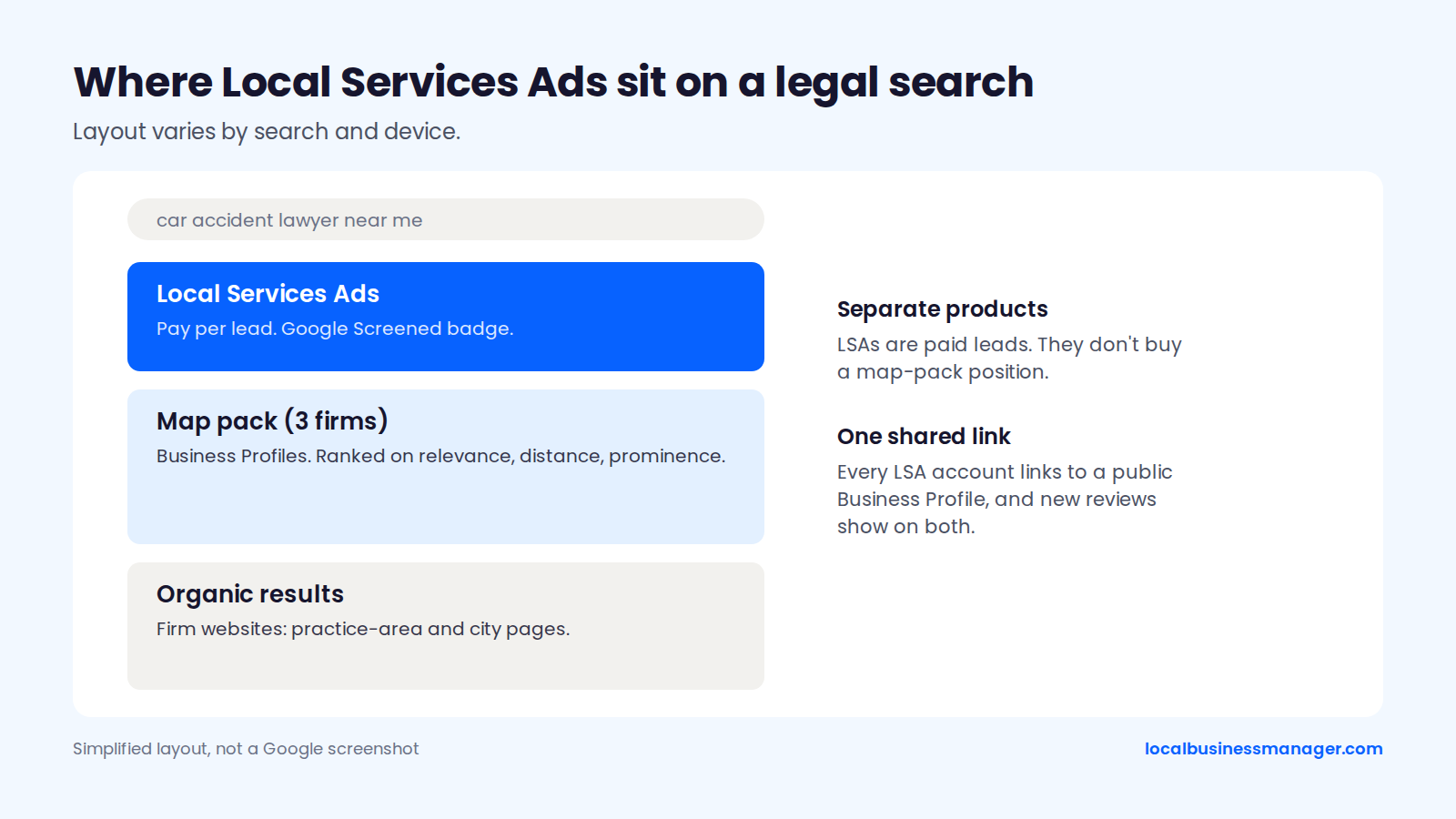
Simplified layout, not a Google screenshot.
New reviews show on both the LSA and the Business Profile, because every LSA account is linked to a public profile. In 2021, the State Bar of Wisconsin noted that lawyer LSAs record calls and messages, which raises confidentiality concerns.
What Gets Law Firm Profiles Suspended, and How Do You Handle Spam Competitors?
Practitioner sources most often name 4 causes: the name, the address, duplicate profiles and recent edits. The 2026 ranking-factors survey ranks keyword-stuffed names high among the risks, and other industry sources cite spammy names and virtual-office addresses. Sterling Sky adds that edits, even ones any Google user suggests, can trigger a suspension.
None of this data is specific to law firms, so run the setup checklist above on every firm. If a profile is suspended, start with Google's help page and the US appeals tool. Keep an appeal kit ready before you need it: dated photos of the exterior signage and the office entrance with the suite number, a lease or utility bill in the firm's name, the bar registration, and the DBA filing if the profile uses a trade name. Our suspension and reinstatement guide covers the rest.
Reporting Fake or Keyword-Stuffed Competitors the Right Way
Report a competitor only for a genuine violation, and only through Google's official paths. Google offers 3 paths, and the right one depends on the problem, as of November 2026:
Problem | Where to report it | Notes |
|---|---|---|
Listing that is misleading or shouldn't exist | Google Maps: Suggest an edit > Place is closed or not here > Offensive, harmful, or misleading | For fake or ineligible listings |
Keyword-stuffed business name | Google Maps: Suggest an edit > Change name or other details | The path Sterling Sky recommends for names |
Fraudulent name, phone or URL | Business Redressal Complaint Form | Google Maps Help points to it; takes bulk reports of 10 or more profiles |
Before reporting a keyword name, check the firm's signage, website and state filings. A registered DBA the firm uses everywhere may be its real name.
How Should You Measure and Report Local SEO for a Law Firm?
Lead the monthly report with calls and rankings. Then connect them to forms and signed cases as far as the data allows, because partners judge you on cases.
What to Put in the Monthly Report
I track rankings across the whole service area, never from one point, because one location says little about how a firm ranks across its area. Scan at least monthly. Daily scans only make sense after an edit you want to measure.
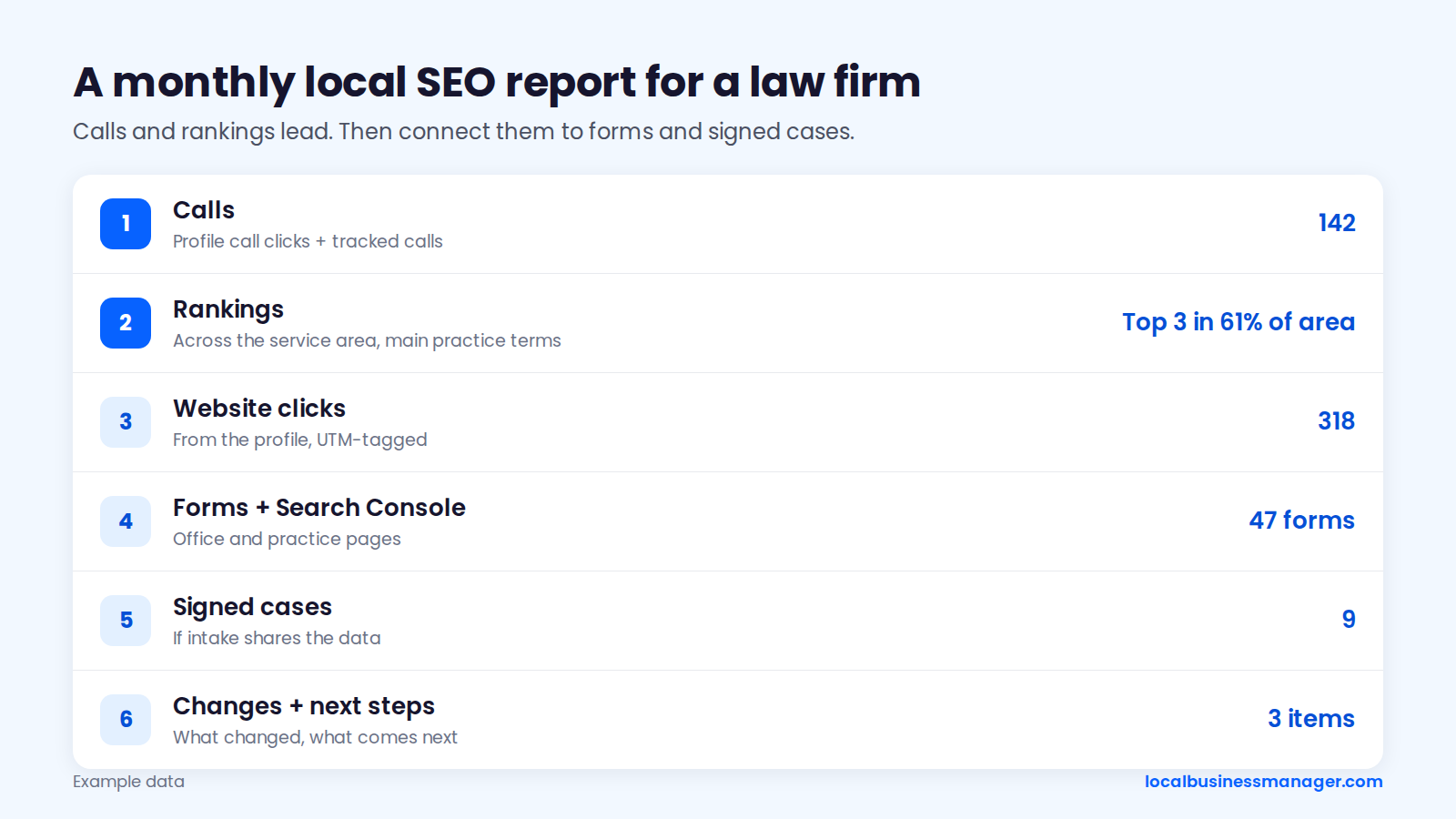
Example data.
Before changing anything, record a baseline: the last 3 months of calls and form fills, and one rank scan across the service area. Then use this 6-part outline, or adapt the one in our local SEO client reporting guide:
- Calls: profile call clicks plus tracked calls. Google counts call-button clicks, not completed calls.
- Rankings: across the area for the main practice-area terms. I wouldn't lean on average rank alone, because results are too volatile right now to read it with confidence.
- Website clicks: from the profile, tagged with UTMs.
- Form fills and Search Console clicks: for office and practice pages.
- Signed cases and cost per case: if intake shares the data.
- Changes and next steps: what changed this month and what comes next.
How Long Results Take
It depends on what's already optimized. In my experience, one high-impact fix can show gains within about a month. One example is a compliant keyword-name change, with the suspension risk described above. Once the basics are done, further gains come gradually, for example from a strong review push.
I know of no published study on law-firm timelines. Google's only figure covers SEO in general: Maile Ohye said it usually takes 4 months to a year to make improvements and see the potential benefit.
Do AI Answers Change Local SEO for Lawyers?
Somewhat, but the map pack still shows up far more often for local-intent searches. A 2025 industry study found AI Overviews on 15% of local-intent queries, against local packs on 93%. That study covers all industries, not legal searches specifically.
AI Overviews do recommend firms on legal questions. A Herringbone study found they named 7.6 firms on average when they recommended any. Herringbone sells AI visibility services, so treat that as a vendor's figure. How these answers pick firms isn't public, so the work above is still the practical response.
Frequently Asked Questions
Can each attorney at a law firm have their own Google Business Profile?
Yes, if the attorney is public-facing and can be reached at the firm's verified office during stated hours. Support staff can't have one. Use the attorney's name only. Profiles that included the firm name have been merged into the firm's profile as duplicates, and a forum report says that can't be undone without a new profile. If the attorney leaves, the profile goes with them, so agree on that before creating one.
Can a law firm use a virtual office for its Google Business Profile?
No. Google treats a rented mailing address where the firm doesn't work as a virtual office, and virtual offices aren't eligible. Industry sources also list virtual-office addresses among common suspension causes. To reach other cities, open a real, staffed office or build useful organic pages for those cities. A coworking desk qualifies only with signage, client hours and the firm's own staff present, per Google's guidelines.
What is the best Google Business Profile category for a personal injury lawyer?
For most PI firms it's "Personal injury attorney," but confirm it against the primary categories the firms already ranking in that market use. Guides such as SubscribePR's recommend it over the generic "Law firm." Add a strong second practice area as an additional category. Google advises using as few categories as possible, though Sterling Sky's tests found relevant extras didn't hurt. Pick from the categories the profile editor actually offers.
Is Google My Business for law firms the same as Google Business Profile?
Yes. Google Business Profile is the current name for what was formerly Google My Business. Older GMB-era guides often carry outdated tactics, so check their advice against Google's current guidelines before using it.
Where Should You Start With a Law-Firm Client?
If you check only 2 things for a law-firm client this month, check the Business Profile name and the review flow. Those are the 2 causes I see most often when a PI firm misses the 3-pack.
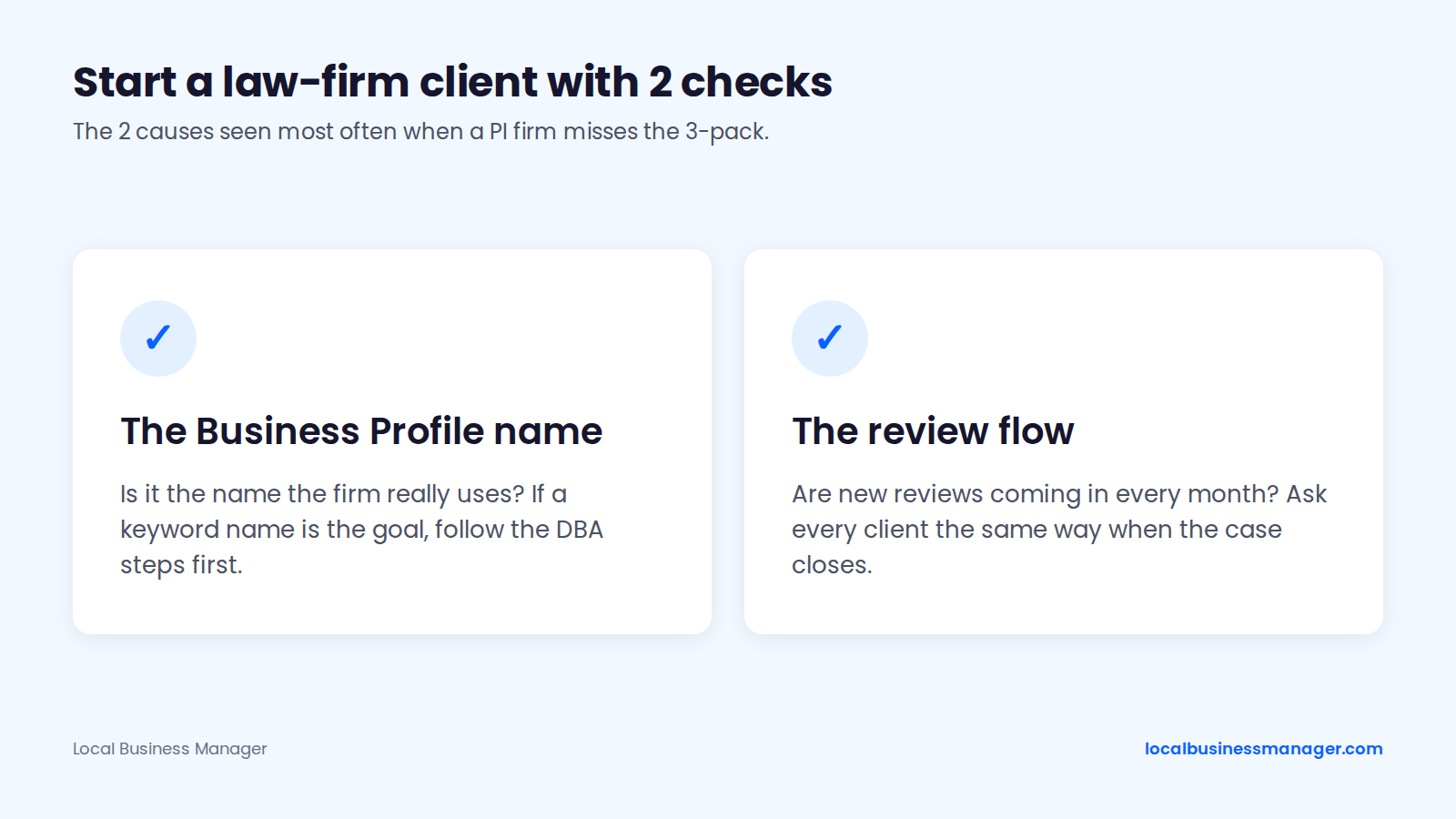
Illustration.
We're building Local Business Manager as one place for an agency's local SEO work, and it's in early access now: join the early access list.