White-Label Local SEO: How Agencies Resell It

White label local SEO means a provider does the Google Business Profile (formerly Google My Business), review, citation and local page work while your agency sells it to the client and reports it under your brand. It only works when the client keeps ownership of their profile and you can check every task. This guide covers the access setup that keeps profiles inside Google's third-party rules, the pricing math, a vetting scorecard, contract clauses, onboarding and offboarding checklists and a report template. I've ranked and served close to 100 US personal-injury firms, and where something is my opinion, I say so.
What Is White Label Local SEO?
White label local SEO is a resale arrangement where a specialist provider does local search work behind the scenes while your agency sells it and reports it under its own brand. Agencies in this role are white label SEO resellers: they buy the work wholesale and sell it at retail. Every setup comes down to 2 decisions: who holds access to the client's profile, and who does which task.
The Three Parties and Who Does What
The 3 parties in white label local SEO are the client who owns the business, the agency that sells and manages the service, and the provider that does the work. As of November 2026, Google's Business Profile third-party policies define a third party as an authorized agency that manages a Business Profile for a business it doesn't own. Your agency is that third party.
- Client (owner): owns the Business Profile, approves changes and review replies, and pays your invoice.
- Agency (manager): sells the package, sets strategy and holds manager access. It writes the brief, checks the work, sends the report and is the client's only contact.
- Provider (does the work): carries out tasks from your brief, logs every change with a date and never contacts the client.
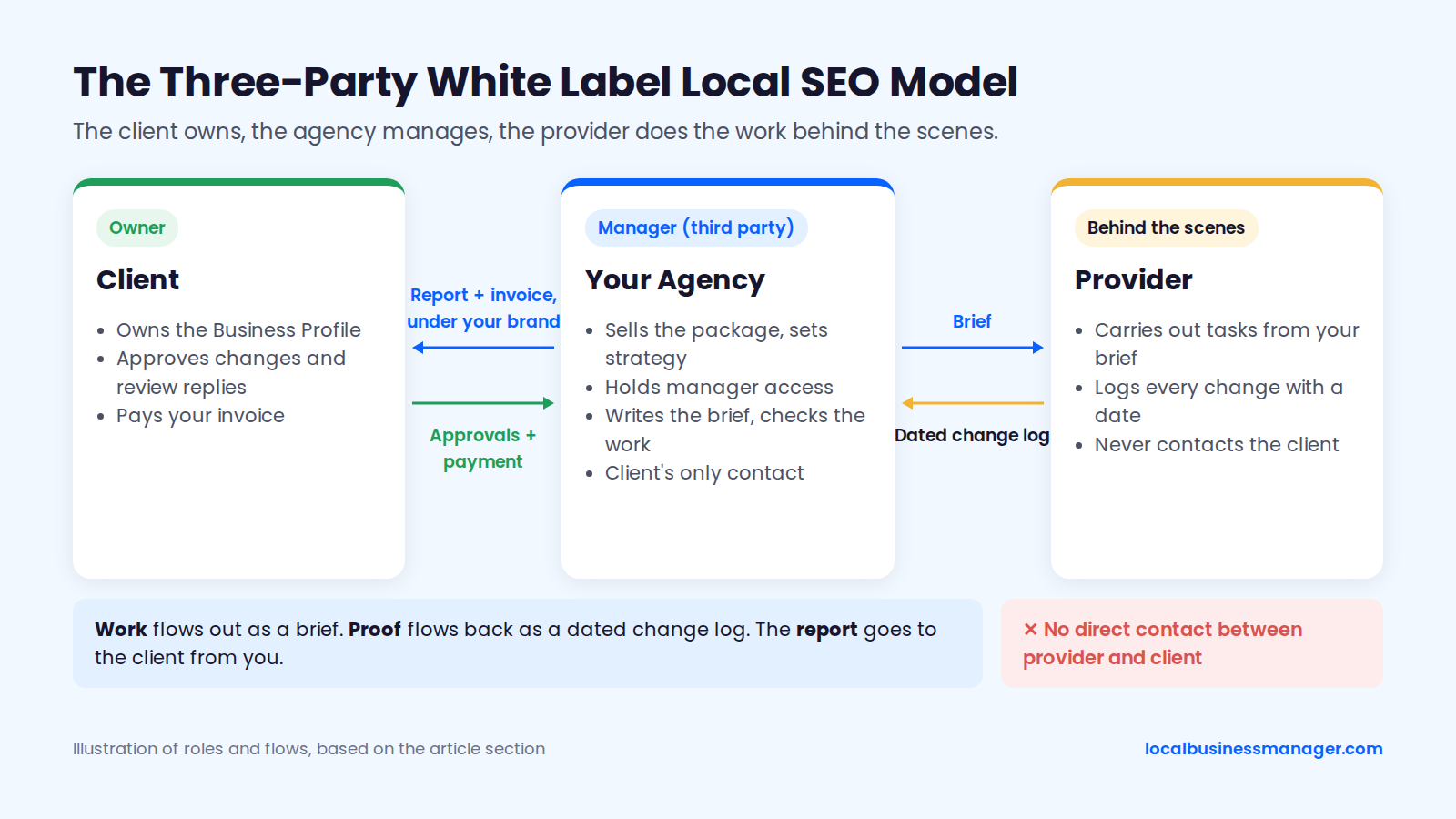
Work flows from you to the provider as a brief. Proof flows back to you as a dated change log, and the report goes to the client from you, under your brand.
White-Label Fulfillment vs White-Label Software
White-label fulfillment means buying someone else's labor. White-label software means renting tools that carry your brand while your own team does the work. CloudBlue's glossary defines a white-label SaaS product as software that one company develops and owns, and another company rebrands and resells under its own brand name. In local SEO, that usually means dashboards and client reports that carry the agency's branding.
- Fulfillment fits when you have more clients than hands and you're willing to manage a vendor.
- Software fits when your team has the skills and the bottleneck is reporting and admin time.
- A mix fits most agencies, in our view: strategy, naming and categories stay in-house, and repeatable tasks like citations or links go to a provider.
The rest of this guide is about fulfillment. That's the model where a client's profile depends on someone else's judgment, so it needs the most safeguards.
What to Check in White-Label Software
When you compare white-label reporting software, check for 6 things before you put your brand on it:
- Your own address: report links on your own domain or a white-labelled URL, not the vendor's.
- Your branding: your logo and colors on every report and dashboard.
- Scheduled delivery: reports that go to the client automatically on a set date.
- Live reports: password-protected shared links the client can open any time.
- Local rank tracking: rankings across the service area, by city or ZIP code, not from a single point.
- Profile data in the same view: Business Profile performance and review monitoring next to the rankings.
Test each item with a real client's data during the trial, not the demo account.
What Local SEO Services Can an Agency Resell?
An agency can resell almost every repeatable local SEO task: Business Profile updates and posts, citation and NAP cleanup, review reply drafting, service and location pages, local links and reporting. The sections below show how to check each one yourself and which package items to refuse or rework.
The Deliverable Verification Table
Each service in a white-label local package leaves evidence you can check yourself without asking the provider. The table is sorted by how directly the work touches the client's Business Profile, with the most direct first. It's current as of November 2026, and the proof and spot checks are our recommendations.
Service | What the provider does | Proof to ask for | How to spot-check it |
|---|---|---|---|
Business Profile updates | Edits categories, services, hours, description and photos | Dated change log with before and after values | Open the live profile on Google Maps and compare field by field |
Business Profile posts | Writes and schedules posts | Post text with publish dates | Check the updates on the live profile |
Review reply drafting | Drafts replies for client approval | Drafts with approval date and approver name | Read posted replies and match each to an approved draft |
Citation and NAP cleanup | Builds and corrects directory listings | Listing URLs, each marked new or corrected | Open 5 random URLs and compare name, address and phone with the master record |
Service and location pages | Writes and publishes pages | Live URLs with publish dates | Read 2 pages side by side and confirm the local content isn't a swapped city name |
Local links | Earns links from local sites | Live linking URLs and how each was earned | Visit each one and ask how any placement that looks paid is marked |
Reporting | Compiles monthly data | Raw exports behind each chart | Compare one number with the Performance page in the profile |
For what a well-built profile looks like before you hand any of it off, see our Google Business Profile optimization guide.
3 Deliverables to Refuse or Rework
3 items show up in white-label packages that you shouldn't resell as written:
- Templated location pages. Before buying location pages with only the city name swapped, read the doorway section of Google Search Central's spam policies, and require genuinely local content on each page.
- Guest-post and paid link packages. Read the link schemes section of Google Search Central's spam policies before buying any guest-post or paid link package, and ask how every paid placement is marked.
- "Review" bundles. Reviews must come from real customers, asked without gating or incentives. The compliant workflow is below.
What I Outsource and What I Keep In-House
Link building is the one local SEO task I've outsourced. I never outsource Business Profile naming or primary category selection.
Both decisions are high-stakes edits:
- Primary category: the 2026 Local Search Ranking Factors survey, published in November 2025, is an expert survey in which local SEO specialists rate each factor (trade summaries report 47 respondents). It ranks the primary category as the #1 local-pack factor, just ahead of proximity.
- Name and category changes: Google says it may reject significant changes to a business name or category.
On categories, my approach is to use the primary category most of the ranking competitors use. If Google is clearly rewarding a different category than the "logical" one, I use the one Google rewards.
How Do You Set Up Client Access Inside Google's Third-Party Rules?
Set up access so the client stays primary owner, your agency is a manager, and the provider works through access you control, never through the client's login. Google's Business Profile third-party policies set the rules on consent, transparency, fees and conduct. The sections below turn those rules into a setup.
The Client Owns the Profile and Your Agency Manages It
The client should be primary owner of their Business Profile, with your agency added as a manager. Google's Business Profile third-party policies require end customers to keep ownership or co-ownership of their profile at all times. Google's help page on managing owners and managers explains the difference between the roles:
- Owners can add or remove users and delete the profile.
- Managers can do almost everything else, but can't add or remove users or remove the profile.
- A profile can have several owners but only one primary owner.
That split keeps the client in control of who has access. 3 more points shape the setup:
- Agency as owner: a Google Product Expert's community guide says an agency can become primary owner but should rarely need to, and should never be the only owner. That guide is volunteer advice, not official policy.
- Organization account: for managing many clients, Google points third parties to a single organization account. An organization account can't directly own an individual profile.
- Provider access: the provider should work through access your agency controls, at the lowest permission level the task needs. Nobody in the chain should ever ask for or hold the client's Google password.
Getting and Keeping Proof of Consent
Keep written or digital proof that the owner consented to your agency managing the profile. Google's Business Profile third-party policies ban gaining access to a profile without the owner's direct written authorization, and if there's a dispute, the third party must provide written or digital proof of consent. Violations can lead to suspension of the profile, the Google account used to manage it, or both.
Our recommendation is a signed authorization that names each profile and the scope of work. Store 5 things in the client's folder, which your agency controls, not the provider's:
- The signed agreement naming each profile and the scope of work
- The owner's email confirming the manager invite
- The date access was granted and the role given
- The name and job title of the person who authorized it
- Any later change to access, with the date
Review Replies Go Out Only After the Client Approves
Have the provider draft review replies, and publish only the text the client has approved. Make client approval your agency's rule for every reply: a reply speaks for the business in public, and some clients, such as law firms, also have professional rules about what a reply can say.
A 5-step approval flow:
- The provider drafts the reply in a shared document and never posts directly.
- Your agency checks tone, facts and anything confidential.
- The client approves by email or comment, and you record the date and the approver's name.
- Your agency or the provider posts the approved text unchanged.
- The change log records the date the reply went live.
Google's reply tips recommend addressing reviewers by name and responding to their specific feedback. That works for most businesses. For law firms it conflicts with American Bar Association guidance, covered in the law firm section below.
A Compliant Review-Request Workflow
A compliant review-request workflow asks every customer the same way, offers nothing in return and goes only through channels the customer agreed to. Hand a provider these 5 rules in writing:
- Same trigger and channel for every customer. Google's Fake Engagement policy bans asking only happy customers for reviews (selective solicitation) and discouraging negative reviews.
- No incentives. Google's review policies remove incentivized reviews, so no discounts, gifts or entries in exchange for a review.
- Text only customers who opted in. Review requests by text go only to customers who agreed to receive them.
- No staff reviews. Our rule: agency and provider staff never review a client.
- The provider drafts replies and the client approves them, as in the flow above.
Google can hide a profile's existing reviews and ratings for a set period and show customers a warning that fake reviews were removed. The FTC's final rule on consumer reviews and testimonials, announced in August 2024 and in effect since October 2024, bans buying reviews the business knew or should have known were fake. The same rule bans offering incentives on the condition that a review expresses a particular sentiment, positive or negative, and lets the FTC seek civil penalties against knowing violators. For agencies with UK clients, the Digital Markets, Competition and Consumers Act 2024 made fake reviews and concealed incentivised reviews banned practices from April 6, 2025, as the law firm CMS summarizes.
Fee Disclosure and the "Working With a Third Party" Notice
If your agency charges a management fee, Google's Business Profile third-party policies require you to disclose it in writing and on invoices. As read in November 2026, the policies set 6 fee and notice duties:
- Tell end customers that Business Profile is provided at no extra cost.
- Tell new customers in writing before you manage their profile.
- Disclose the fee on customer invoices.
- If you mainly serve small and medium-sized businesses, share Google's "Working with a third party" disclosure notice with all customers.
- Link that notice in a clearly discoverable place on your website, such as the homepage footer, the reporting dashboard or the products and services section, and tell customers about it by email or mail when you take on or renew a client.
- Avoid sudden or dramatic fee changes.
2 more points from Google's guidance shape your paperwork:
- Transparency: the same policies require third parties to be transparent with information that affects the business's decisions, to tell the business proactively about its ownership and management options, and never to put undue pressure on a customer to sign up or stay.
- A written agreement: Google advises businesses to get an official copy of the agreement listing the services and their costs before hiring a third party, so list every service and its price in plain terms on your agreement and invoice.
Google's policies don't mention white-label arrangements by name, but its definitions cover them. Google's Business eligibility and ownership guidelines count any individual or company that manages a Business Profile it doesn't own as an authorized representative.
Your agency, which the client hires and pays, carries the duties above. A provider added under its own account would be a third party on that profile too, one more reason it should work only through your agency's access.
What Providers Are Never Allowed to Do
A provider working on your clients' profiles must never do these 7 things. Each one breaks a Google policy, a review rule or both:
- Take ownership or hold a profile hostage. Google's Business Profile third-party policies list keeping a profile hostage in exchange for money as a prohibited practice. The Google community guide says authorized representatives must transfer ownership to the business owner when asked.
- Guarantee top placement. Google's Business Profile third-party policies prohibit guaranteeing top placement on Google and claiming a profile will appear in Search or Maps at all times. A "Page 1 rate" with no keyword set or timeframe is close to a guarantee.
- Discard Google's suggested updates or disable profile features without the owner's consent. The same policies ban both, and require third parties to check with the merchant that the information is still accurate.
- Add keywords to a name the business doesn't use. Google says unnecessary information in the business name isn't allowed and could lead to suspension. The compliant DBA route is below.
- Use virtual offices. Google says a virtual office isn't eligible for a profile. A co-working address qualifies only if it has clear signage, receives customers and is staffed by the business during business hours.
- Buy, gate or incentivize reviews, or let its own staff review the client. The workflow above covers the rules.
- Text customers who haven't opted in.
Keyword Business Names: The Compliant DBA Route
A keyword business name is compliant only when it becomes the business's actual name, registered as a DBA (assumed name) and used everywhere before the profile changes. I recommend this route, and I've taken many clients through the DBA process. It's never something I'd hand to a provider.
The order matters:
- Register the DBA.
- Use that exact name on signage, the website, stationery, the phone greeting and other listings.
- Change the Business Profile name last.
A DBA document alone doesn't make a name compliant. Google judges the name the business really uses and can still challenge or suspend the profile. The DBA is what proves the name if Google asks during re-verification or reinstatement.
Know 3 things before filing:
- Experts rate the risk high: in the 2026 Local Search Ranking Factors survey, keyword names are among the top suspension risk factors, and respondents also rate keyword names as helping local-pack rank.
- Edits trigger it: in my experience, name edits and address edits cause the most suspensions.
- Reinstatement takes proof: in my experience, reinstatement usually needs documents (the DBA, a lease agreement, photos of the office with signage) or a video recording the storefront and office.
How Much Does White-Label Work Cost, and What Should You Charge?
Published white-label rate cards price local SEO per location per month, while a survey of 439 SEO providers put the average agency local SEO retainer at about $1,819 a month, while 30% of agencies in a separate survey of 260 agencies charge under $500. How much you keep depends on your own hours as well as the markup.
What Wholesale and Retail Prices Look Like
Most white-label providers that publish prices use per-location monthly rate cards, but the scope behind each price varies widely. One provider's public pricing page, as listed in November 2026, shows $299 and $499 per location per month for its 2 local tiers. Some packages cover only the Business Profile; others include content and links. Compare providers' task lists side by side before comparing prices, and date any price you quote.
Retail benchmarks come from surveys:
- Average retainer: an SEO software company's survey of 439 SEO providers, updated August 2024, put local SEO at about $1,557 a month on average. Agencies averaged $1,819 and freelancers about $1,150.
- By client tenure: a local SEO software company's 2023 Local Search Industry Survey of 534 local marketers (72% in the US) found US local marketers averaged $799 per client per month in a client's first year. That rose to $1,569 by years 2 to 3.
- Price bands: a December 2024 survey of 260 agencies, run by an SEO software company and a website platform, found 64% charge under $1,000 a month and 30% under $500.
Markup figures are where the evidence runs out. Vendor blogs give conflicting markups (30% to 60%, 50% to 100%, 100% to 200%), some blur markup with margin, and none cites a survey.
Common Pricing Models
A deliverable-based retainer is the most common pricing model in survey data, and per-location pricing fits multi-location clients best. In the 2024 agency edition of a local SEO software company's industry survey (385 respondents, published November 2024), 54% of agencies used a deliverable-based monthly retainer. 21% billed hourly, down from 32% the year before.
Most published white-label rate cards price multi-location work per location. The table compares 4 models, with the retainer first because it's the only one with survey data on adoption.
Model | How it's billed | Fits best | Watch out for |
|---|---|---|---|
Deliverable-based retainer | Fixed monthly fee for a written task list | Ongoing single-location clients | Scope creep without a written task list |
Per location | Flat fee per location per month | Multi-location and franchise clients | Locations with very different competition |
Tiered package | 2 or 3 fixed bundles | Many similar clients in one niche | Clients outgrowing a tier mid-contract |
à la carte | One price per task, such as an audit or a page | One-off projects and add-ons | No ongoing results to report |
Worked Margin Example
In this illustrative example, the 2 single-location clients priced at 2.5 times wholesale return 40% and 43% gross margins, while the 5-location client, priced at 2 times wholesale, drops to 34%. These are made-up numbers, not market data. Swap in your provider's quote, your real hours and your loaded hourly cost.
Line item (USD per month, illustrative) | Client A: 1 location, light market | Client B: 1 location, competitive market | Client C: 5 locations |
|---|---|---|---|
Retail price to client | 750 | 1,500 | 2,500 |
Wholesale cost from provider | 300 | 600 | 1,250 |
Agency hours | 3 | 5 | 8 |
Agency time cost at $50 per hour | 150 | 250 | 400 |
Gross margin (USD) | 300 | 650 | 850 |
Gross margin (% of retail) | 40% | 43% | 34% |
Clients A and B carry a 150% markup and keep 40% and 43% once agency time is counted. Client C carries a 100% markup, so its margin falls to 34% even though its agency hours grew more slowly than its price: 2.7 times Client A's hours against 3.3 times Client A's price.
Costs That Never Show on the Provider's Invoice
Your agency's own time is the cost the provider's invoice leaves out. In the example above it takes 20% of the retail price on Client A, 17% on Client B and 16% on Client C, which is 32% of what's left after wholesale on Client C.
Budget hours for 7 kinds of work:
- Account management and client calls
- Approvals for review replies, posts and pages
- Report review and writing the summary the client actually reads
- Spot checks against the change log
- The onboarding baseline
- Rework when a deliverable fails your review
- Ongoing monitoring
Monitoring adds up. My routine is a weekly check for edits to the name, attributes, services and other fields, whether Google or someone else made them. Once a month I check rankings and the post schedule. On a client with many locations, that time grows with every location.
How Do You Vet a White Label SEO Partner?
Vet a white label SEO partner in 2 stages: written answers to the same 12 questions, then a one-client pilot before you move more accounts. Get every answer in writing, because your contract should point back to it.
The Vetting Scorecard
A provider passes the scorecard when every answer matches the "good" column. One red-flag answer on access, reviews, links, names or addresses is enough to walk away before you sign. The 12 questions are ordered by the risk to the client's profile, highest first.
Question to ask | Good answer | Red-flag answer |
|---|---|---|
What access do you need to client profiles? | Manager access through our agency | Ownership or the client's password |
Will you change business names? | Only after a registered DBA is in real use | Adds keywords so the name ranks |
What addresses do you use for listings? | Only the client's real, staffed address | Virtual offices or mail drops |
How do clients get reviews? | The client asks every customer the same way | Review packages or bundles |
Where do your links come from? | Named sites and how each link was earned | "Our private network" |
How do you build location pages? | Unique local content on each page | One template with the city swapped |
What rankings can you promise? | No guarantees, with rankings reported across the area | Guaranteed top 3 or a Page 1 rate |
Do you ever contact our clients? | Never, everything goes through us | "Sometimes, to save time" |
How do you log changes? | Dated log with before and after values | "It's in the report" |
How do you report? | Raw exports plus an unbranded report | Branded PDF with no data behind it |
What are your turnaround times? | Written per task type | "It depends" |
What happens when we leave? | Access removed and asset list handed over | Listings and pages stay in their accounts |
Add one stop rule the table can't catch: a provider that hires from black-hat marketplaces brings link-scheme and fake-review risk with it, whatever its answers say. Google's "Do you need an SEO?" guidance tells business owners to learn enough to spot an SEO who wants to use risky techniques, and agencies buying wholesale should hold providers to the same standard.
Problems I've inherited from previous agencies include:
- Duplicate listings
- Bad naming
- No review campaign
- No services or products set up on the profile
Ask a candidate provider how it would find and fix each one.
Run a One-Client Pilot First
Our recommendation is to trial the provider on one client for at least 2 full monthly reporting cycles before rolling it out to other accounts. No outside standard sets this period; it's simply long enough to see 2 reports and a full month of change logs. Pick a client with a clean profile, an uncomplicated market and no legal or regulatory constraints.
The pilot passes when all 6 criteria are met:
- Every task in the change log matches what's live on the profile and the web.
- Spot checks on citations, pages and links pass.
- Turnaround times match what was promised in writing.
- Both reports arrive on time, with raw data behind them.
- The provider has no direct contact with the client.
- No policy issue appears: no name edits without approval, no review shortcuts, no paid links.
What Should a White-Label Contract and SLA Include?
A white-label contract should cover confidentiality, client protection, turnaround, proof of work, asset ownership, compliance and exit. Neither Google nor any regulator publishes a standard template. Have a lawyer review your contract; this is marketing guidance, not legal advice.
7 clauses appear across checklists published by white-label providers and agencies such as KrishaWeb, Lead Advisors and Gatilab:
- NDA: covers client names, client data and your pricing.
- Non-solicitation: the provider can't approach your clients or staff during the contract and for a set period after. KrishaWeb, a white-label provider, suggests 12 to 24 months. Ask your lawyer whether the term is enforceable where you operate.
- Turnaround per task type: Lead Advisors, a white-label vendor, suggests content within 5 business days of brief approval, the monthly report within 3 business days of month end, and a technical audit within 10 business days of getting access. Treat these as starting points, not industry standards.
- Remedy and escalation: what happens when a deliverable fails your review, plus a named escalation contact with a response window.
- Asset ownership: content, links and reports belong to your agency or the client, never the provider.
- Access: the lowest permission that does the job, never ownership, and a written list of every access granted.
- Termination and handover: notice period, access removed within a set time, and all assets handed over.
6 more clauses are our own recommendations:
- No direct client contact: all communication goes through your agency.
- Unbranded communications: no provider logos, links or email signatures in anything client-facing.
- Dated change log: every edit recorded with the date, field, old value and new value.
- Compliance commitment: no fake or incentivized reviews, no gating, no undisclosed paid links, no keyword names without a used DBA and no virtual offices, with immediate termination if broken. Ask your lawyer how to word it.
- Phone numbers: who is the account holder for any call-tracking or phone number shown on the client's profile, and how that number transfers if the relationship ends.
- Data handling: what client data the provider holds, where it's stored and when it's deleted, plus who holds the listing logins.
How to Onboard a New White-Label Client, Step by Step
Onboarding a white-label client takes 7 steps, from written scope to an approved first-month plan. The order matters because Google's 7-day waiting period applies to every new owner and manager. The sections below give the checklist and the recovery path for when a former agency still owns the profile.
Onboarding Checklist
- Agree the scope in writing: services, price and what's excluded.
- Collect intake: legal name, any DBA, real address, phone, hours, services, current primary category, and every current owner and manager.
- Get manager access. The owner goes to Business Profile settings, then People and access, then Add. They enter your agency's email, choose Manager and send the invite. Google Groups can't be added. New owners and managers wait 7 days before they can transfer primary ownership, delete the profile or remove other users.
- Record consent: save the agreement and the invite date in your client folder.
- Capture a baseline: rankings across the area, the name against competitors, the primary category and the website (details below).
- Set up call tracking. My practice is to make the call-tracking number the profile's primary number, with no additional number.
- Get the first-month plan approved before the provider starts work.
For step 5, I run 4 checks in this order:
- Local rankings across the area with a grid scan, typically 13 Ã 13 points 0.5 miles apart. Widen the spacing if the grid comes back mostly ranking well, and tighten it if mostly not.
- The business name compared with the names of the ranking competitors.
- The primary category.
- The website.
When a Former Agency Owns the Profile
Ask the former agency to transfer ownership first. The Google community guide says authorized representatives must hand ownership to the business owner when asked. If they don't respond, use Google's ownership request process:
- The business requests access at business.google.com/add.
- Google emails the current owner, who has 3 days to respond. Some older guides say 7 days, but Google's current page says 3.
- If the owner doesn't respond, the requester opens the confirmation email, chooses View request and verifies.
- Service-area businesses contact Google support instead and choose "Transfer ownership of listing".
- A denied request may come with an appeal option.
How long recovery takes depends on the person holding the profile. In my experience it's sometimes immediate and sometimes a week or two. Plan around the 7-day restriction on new owners, and never leave a transfer until the last day of a contract.
What Should a White Label Local SEO Report Show?
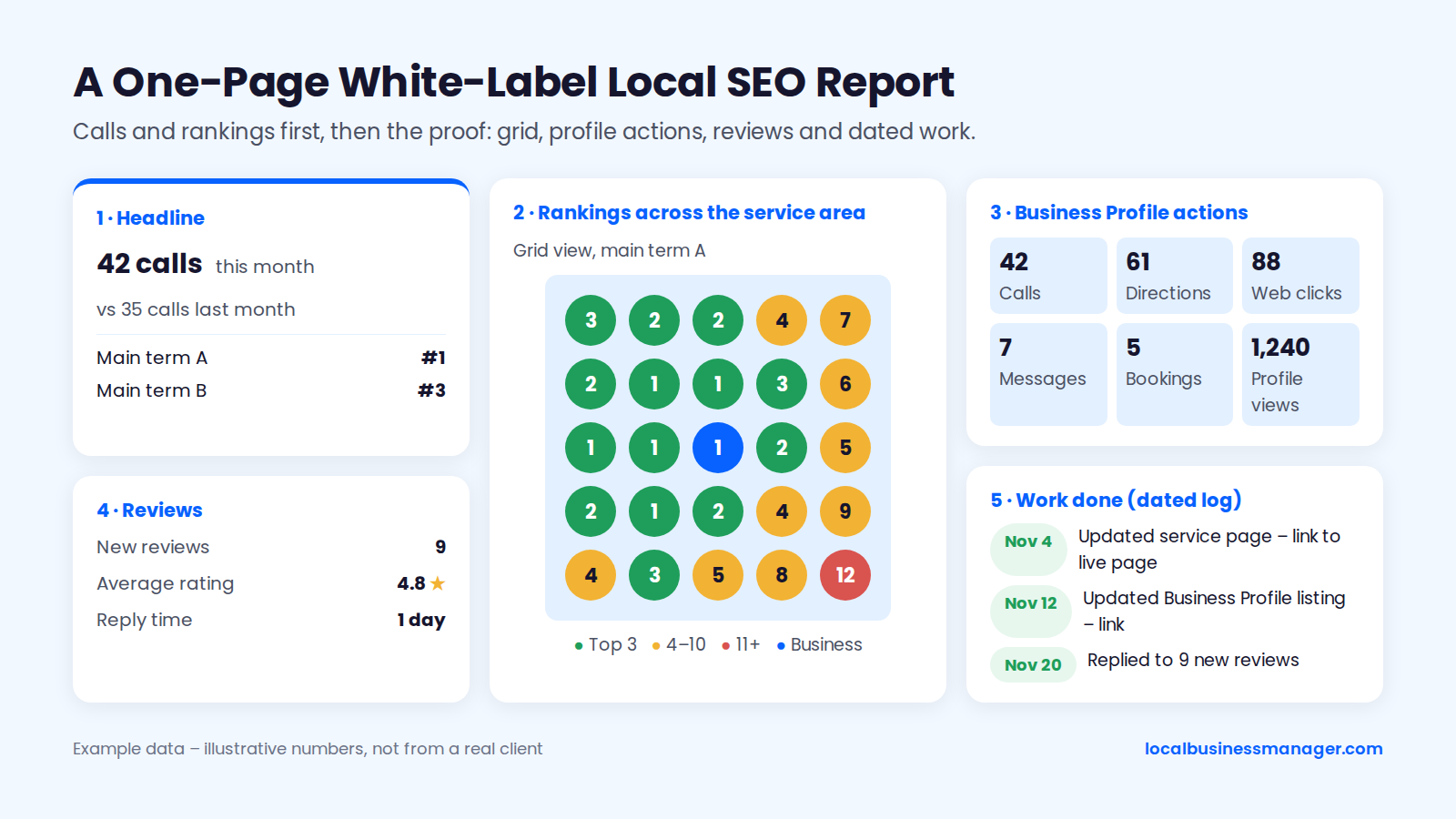
A white label local SEO report should lead with calls and rankings, then show service-area rankings, Business Profile performance, reviews, the dated work log and next month's plan. Calls and rankings lead every monthly report I send. Our local SEO reporting guide goes deeper into the data behind each section.
The Report Template
Put results and proof in the first screen of the report: calls and rankings first, then the evidence of work. In my view, rankings for the main terms are what a proper engagement has to deliver. On its own, I find average rank misleading right now, because Google is mixing results and the results page is very volatile.
The table lists the 7 sections in the order they appear in the report. The performance metrics are the ones Google's Performance help page lists as of November 2026.
Section | Metrics to show | Why it matters | Skip |
|---|---|---|---|
Headline | Calls this month against last month, and rankings for the main terms | The 2 numbers the client checks first | Percentage ranking increases |
Rankings across the service area | A grid view for each main term | One search from one spot shows one point only | Single-point checks |
Business Profile performance | Calls, direction requests, website clicks, messages, bookings and profile views on Search and Maps | Shows the actions the profile drove | Metrics Google no longer reports |
Reviews | New review count, average rating and reply time | Shows review flow and reply speed | Lifetime totals with no time period |
Work done | Dated change log with links to live pages and listings | Proves each task was done | Task lists with no dates |
Next month's plan | 3 to 5 tasks for the client to approve | Gets approval before work starts | Open-ended "ongoing optimization" |
AI visibility (optional) | Whether AI Overviews and AI assistants name the business for main terms, as tracking only | Answers "are we showing up in ChatGPT?" | Any promise of placement |
Google's Performance help page says calls count clicks on the call button, bookings appear only when they're managed through a booking provider, and performance data is available only for verified profiles. Google also says this data covers views, searches and actions from both organic results and Google Ads. Positions don't rise by a percentage, so leave percentage ranking claims out entirely. For law firms that track intake, add signed cases, cost per case and qualified leads, the measures law-firm marketers such as Rankings.io put first.
How to Explain a Drop
Answer a "we dropped" call by moving the conversation from one search to the whole service area. In my view, a single location says little about how a business ranks across its area, so show the grid for the client's main terms rather than debating one search from their kitchen.
Reported numbers also shift for reasons that have nothing to do with the work:
- On February 6, 2023, Google removed several Business Profile metrics, including total views and total searches, as reported by Momentic Marketing.
- In a 2026 study of 1,560 keywords, Sterling Sky found that 66% of top-10 keyword lists differ between Search Console and Business Profile Performance. Business Profile counts unique users, while Search Console counts impressions.
A script for the call:
"Thanks for flagging it. A search from one spot only shows one point on the map, and it says little about how you rank across your whole area. Here's the grid for your main terms from [date]: you're in the top 3 across [area] and you slipped around [area]. Calls this month were [number], against [number] last month. Here's what we changed, and here's what we're doing about [area] next month."
Should You Tell Clients the Work Is White-Labelled?
I don't tell clients the work is outsourced, and it's a common white-label practice. That stays honest only when 3 conditions hold, and if a client asks directly, you answer truthfully:
- Your agency stays accountable for every task.
- The client stays primary owner of the profile.
- The provider works through your agency's own access, so no unknown manager appears on the profile.
What the Client Can See on Their Profile
A client can see every owner and manager on their Business Profile. Google says users in the account can find the names and email addresses of all owners and managers. If a provider is added under its own account, the client will see a name they don't recognize. That's why the provider should work through your agency's access.
Google's Business Profile third-party policies require agencies to be transparent with information that affects the business's decisions. Cutting Edge PR, writing about agency trust, leans the same way: not volunteering details can be acceptable, but never deny using outside help when asked, and don't let the client discover it on their own. Whatever you decide, never mislead a client about who owns their profile.
Script: "Who Is This Manager on My Profile?"
With the setup above, the only manager a client should see is your agency. If they ask about it, answer in 3 parts:
- Who it is: "That's our agency's account. Everyone who works on your profile, including any specialist we bring in, works through our access, and we're responsible for all of it."
- Who's in control: "You're the primary owner, so you decide who has access and can remove anyone at any time."
- An offer: "Want me to walk you through the People and access screen so you can see every user?"
If the client points to a manager that isn't your agency's account, ask them to remove it right away, then check the profile against your change log for edits you didn't make.
White Label vs In-House vs Freelancer: Which Fits Your Agency?
White-label fulfillment scales fastest, and in-house staff give the most control. Freelancers carry the highest continuity risk, and white-label software only helps if your team already has the skills. The table compares the 4 models structurally, not with measured data, sorted by speed to scale.
Model | Cost predictability | Control | Quality consistency | Speed to scale | Continuity risk |
|---|---|---|---|---|---|
White-label fulfillment | High, with fixed per-task or per-location fees | Medium | Depends on the provider | Fast | Medium |
Freelancer | Medium | Medium | Depends on one person | Medium | High |
White-label software | High | High | Depends on your team | Medium | Low |
In-house hire | Low until the role is full | High | High once trained | Slow | Medium |
Each model wins in a different situation:
- White-label fulfillment: demand is ahead of hiring and the tasks are repeatable.
- Freelancer: a specialist task is needed for a few clients.
- White-label software: you have the skills and want branded reporting without more staff.
- In-house hire: you have steady volume in one niche and want control of quality.
White-label fulfillment brings capacity without hiring, a margin on every task and speed when demand jumps. It costs you direct control, consistent quality, independence from one vendor and some control over client data. Each risk has a safeguard in this guide: the verification table for quality, the scorecard and pilot for control, the contract for data and dependency, and the offboarding steps for an exit.
How Should You Handle Multi-Location and Law Firm Clients?
Multi-location and law firm clients need the same playbook with tighter rules. Multi-location work multiplies every mistake by the number of locations. Law firm work adds bar rules on reviews, supervision and trade names. Keep the high-risk decisions in-house for both.
Multi-Location and Franchise Clients
Multi-location clients need consistent data across every location and genuinely local content for each one:
- Pages: each office's profile links to its own city page, which carries local details for that office. That's how I set them up.
- Doorway risk: check each location page against the doorway section of Google's spam policies before it goes live.
- Consistency: hours, holiday hours and categories must match the real business at every location. Check each location weekly for edits.
- Approval: a provider must never edit names or addresses without your approval.
- Eligibility: only create profiles for locations that serve customers there.
Price these clients per location, and budget your own monitoring hours per location as well. Our guide to local SEO for multiple locations covers the setup in more detail.
Law Firm Clients
Law firms add 3 professional-conduct issues to white-label work. What follows is marketing guidance, not legal advice:
- Review replies. ABA Formal Opinion 496 (January 2021) says lawyers should consider not responding to negative online reviews at all. Any response must not disclose information about the representation, though the lawyer may invite the reviewer to make contact privately. Keep reply approval with the firm.
- Vendor supervision. Law firm clients have an ethics reason to ask how your provider is supervised. Under ABA Model Rule 5.3, lawyers must make reasonable efforts to ensure that the conduct of nonlawyers they outsource to is compatible with the lawyers' professional obligations, as the American Bar Association's Litigation Section explains in "Ethical Implications When Outsourcing Legal Work". North Carolina's version is Rule 5.3.
- Trade names. A keyword DBA must clear bar rules. ABA Model Rule 7.1, Comment 5, requires that trade names not be false or misleading. New York bans trade names under Rule 7.5(b), Texas requires state-bar approval of a trade name, and Kentucky, New Jersey and Rhode Island restrict them. Check the firm's state bar before filing anything.
In my experience, PI firms most often miss the 3-pack because the business name isn't optimized and review flow is too low. By an optimized name I mean a keyword name made real through a registered DBA and cleared with the state bar, as in the DBA route above.
For reviews, ask every client the same way when their matter closes. For clients who recovered, that moment is after payout. Asking only clients who were paid would be selective solicitation. Our local SEO for lawyers guide covers the rest of the law firm playbook.
How Do You Leave a White-Label Provider Without Losing Anything?
Leave a provider by removing its access, collecting every log and asset, and confirming the profile is unchanged, in that order. Only owners can remove users, and managers can only remove themselves, so the client usually has to act.
- Give notice as the contract requires and set an exit date.
- Remove the provider's access from your agency's tools and organization account. If a provider account was ever added as a manager on the profile, ask the owner to remove it.
- Export everything: the change log, reports and the raw data behind them.
- Collect the asset list: listings created, logins, pages and links. Confirm whose name and email each is in, and transfer any that sit in the provider's name. A citation audit catches listings nobody wrote down.
- Move tool access, including any call-tracking numbers the provider set up. Check who the contract names as account holder for each number shown on the profile, and transfer it before the exit date.
- Check the profile after removal: name, categories, hours and services should match your last approved values.
- Tell the client if they knew about the provider or will notice a manager disappear.
- Confirm data deletion in writing, as the contract requires.
Frequently Asked Questions
Who is responsible if a client's profile gets suspended?
In practice your agency answers to the client, because you hold the relationship and the invoice. Your contracts decide who owes what, including what the provider owes you. Google's Business Profile third-party policies say violations can lead to suspension of the profile, the Google account used to manage it, or both, so a provider's mistake can reach your agency's own access. Keep the consent proof and the client's name and address documents on file before anything goes wrong.
Can a white-label provider get my clients into AI Overviews or ChatGPT?
No provider can promise a client a place in AI Overviews or ChatGPT answers, so treat any placement promise as a red flag. Google Search Central's "AI features and your website" page says there are no additional requirements or special optimizations needed to appear in AI Overviews or AI Mode; a page only needs to be indexed and eligible to appear in Google Search with a snippet. In our view, ask what the provider tracks (presence in AI Overviews for main terms, and whether ChatGPT, Gemini or Perplexity name the business) and how it attributes referral traffic from AI tools. For law firms, I've observed that some paid legal directories bring cases and also help firms get mentioned in AI Overviews.
How do I check reviews of a white-label provider before choosing one?
Call 2 or 3 agencies the provider works with, read independent agency discussions such as r/localseo, and trust a paid pilot over any testimonial. Be wary of "top white label SEO companies" lists: several that rank for this topic are published by a provider that places itself first. Ask references what went wrong and how the provider handled it, and run the scorecard questions above against each answer.
How long before a white-label client sees results, and what can I promise?
Promise the work, the reporting and the turnaround, never a ranking position or date. Timing depends on what's already optimized. In my experience, one high-impact fix can show ranking gains within about a month, while gains after the basics, for example from a strong review push, come gradually. Set expectations around rankings for the client's main terms, measured across their area every month.
Before You Sign With a Provider
Before you sign anything, check who owns every client's profile. Move each one to client as primary owner and your agency as manager, with the consent proof saved. Everything else in this guide is easier to fix than a profile you can't control. We're building Local Business Manager as one platform for agency local SEO work, and you can join the early access list if you'd like to try it.